




A Final Judgment in A Six-Year Extradition Fight Between Malawi and South Africa
No one should be condemned unheard. The old legal maxim, audi alteram partem, “hear the other side”, has now decided one of Southern Africa’s most closely watched legal battles. Malawi’s High Court has delivered its full, final judgment on why the preacher Shepherd Bushiri and his wife, Mary, will not be sent to South Africa to face trial. Its central finding is that the magistrate who ordered their extradition never properly heard their side.
The judgment, from Justice Mzonde Mvula of the High Court’s Lilongwe Criminal Division in Criminal Review No. 5 of 2025, sets aside the committal order made by the Chief Resident Magistrate on 12 March 2025. Accounts of the date and length differ slightly: two Malawian reports date the final judgment to 12 October, while another account says the ruling was issued on Wednesday, 14 October; its length is given as 172 pages in one report and 175 in others. The court had already announced its decision in a summary order in October 2025; this judgment sets out the reasons.
A Case Built on Paper and Hearsay
The judgment goes through South Africa’s case point by point. The magistrate, it finds, delivered a final committal ruling after hearing only the requesting state’s case, without giving the Bushiris a structured chance to answer once the prosecution had closed. “The failure by the Magistrate to afford them this opportunity, particularly after electing a hearing-based approach, amounts to a material irregularity,” the judgment states. It also finds that the ruling addressed only one of eight issues raised and dismissed the rest in a single paragraph, contrary to the requirement that every judgment set out the points for decision and the reasons. “The ruling on committal by the Magistrate is fatally defective,” Justice Mvula wrote.
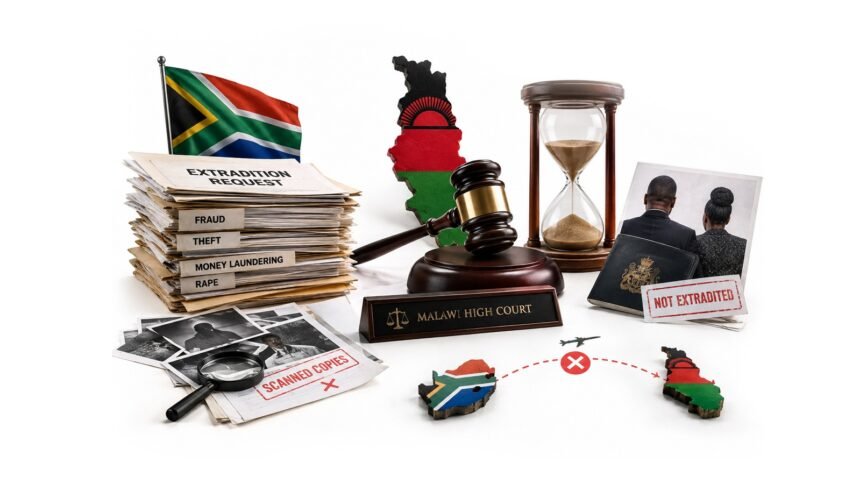
The evidence fared no better. The extradition documents were not properly authenticated under Malawi’s Extradition Act: the certificate from South African judge Elmarie van der Schyff authenticated a signature rather than the documents themselves, and she had only scanned copies, not originals. The sole state witness, South African Director of Public Prosecutions Sibongile Mzinyathi, was found not competent to testify on the requirements of Malawian law; he admitted under cross-examination that he did not know what a “relevant offense” means under that law. His evidence was ruled inadmissible hearsay, third-hand accounts from investigators who had heard from complainants. Relying on a Namibian precedent, the court held that hearsay cannot establish a prima facie case for committal.
Charges That Did Not Hold
On Mary Bushiri, the court found that she had been committed for a non-existent offense, described as “forgery about immigration laws”, which did not appear in South Africa’s request. The only forgery allegation concerned a loan agreement and aircraft purchase receipts, which the magistrate had already rejected for lack of evidence. On Shepherd Bushiri, the court set aside committal on three rape charges, finding that the magistrate had not identified which of the anonymized complainants, labeled A to H, were involved, nor shown how the evidence met the elements of the offense under Malawi’s Penal Code.
The court went further. It ruled that surrender would be unjust or oppressive because of the passage of time, nearly a decade since the alleged offenses, some of which date back to 2015, while South Africa only sought extradition in 2020. It noted that Shepherd Bushiri had lived openly in South Africa without being arrested. And it found that the accusations were not made in good faith in the interest of justice, citing a docket at South Africa’s Independent Police Investigative Directorate recording extortion allegations against police, as well as the magistrate’s own finding that withdrawal statements and promised payments had “greatly prejudiced the integrity of the State’s case”. The judgment also faulted the magistrate for committing the couple despite finding that South Africa’s guarantees on “specialty”, the rule that a person may be tried only for the offenses they were surrendered for, were inadequate.
What the Ruling Does Not Decide
It is important to be clear about what this judgment is. It is not an acquittal. The couple left South Africa in 2020 while on bail, facing charges of fraud, theft and money laundering worth more than R102 million, and they have long denied wrongdoing. The court ruled on whether Malawi may lawfully surrender them on this request, leaving open the possibility that South Africa could submit a fresh or supplemented request that fixes the defects. Their lawyer, Wapona Kita, said: “The only way forward now is through an appeal by the State.” South Africa’s Department of Justice and Constitutional Development said it would comment later.
Bushiri marked the outcome with a social media post claiming vindication. He said the court had agreed with concerns about missing evidence, anonymous witnesses and hearsay, and he accused South African police officers of opening “fake cases” to extort money from the couple, alleging that some generals involved in his arrest had since been arrested or dismissed in other corruption matters. He also said they had faced xenophobic attacks. None of these allegations has been independently verified, and the post named no officers. It ended: “There is a God in heaven!”
Due Process Cuts Both Ways
For South Africa, the judgment is an embarrassment as much as a defeat: a high-profile request undone by scanned documents, a witness unfamiliar with the other country’s law and evidence the court called hearsay. For Malawi, it shows a judiciary prepared to hold a powerful neighbor to the letter of its own statute. For the complainants, including those behind the rape allegations, it means another delay with no trial in sight. Regional legal co-operation depends on both sides doing the basic work properly. If African states want their courts to be trusted with each other’s most sensitive cases, the lesson of this judgment is simple: prepare the file as carefully as you would want the other side to.