



A War Now Fought Far Beyond Its Front Lines
More than 2,230 civilians have been killed between January and the end of October 2026, and over 1,630 of them by drones. That is the count the UN Human Rights Office says it has been able to confirm in Sudan, where the army and the Rapid Support Forces (RSF) have been at war since April 2023. Drones, in other words, account for nearly three in every four verified civilian deaths this year. The office stresses that these are only the deaths it could verify one by one, and that the real toll is likely to be higher.
The figures were published on Tuesday, 17 November, alongside a new report covering the first half of 2026. The report describes persistent disregard for the protection of civilians, which it says continues to exact “an unbearable toll” on the Sudanese people. It finds that drones have become a “defining feature” of the war, allowing the warring parties to extend their reach far beyond the areas they control and far beyond the front lines.
How the Toll Was Built
Between January and June, at least 1,390 civilians were killed in the conflict between the Sudanese Armed Forces, the RSF and allied armed movements, and drone strikes caused more than 80 percent of those deaths. In the four months that followed, another 840 civilians were killed, close to 520 of them in drone attacks. October stood out, with a surge in drone strikes against civilian objects and a high number of casualties.
The geography of the killing is uneven. Civilians in the Kordofan region accounted for more than two-thirds of the documented casualties, and most of the rest were recorded in Darfur. Eastern and central Sudan were not spared: in White Nile state, at least 41 civilians were killed by drones during the period covered by the report.
“The facts speak for themselves,” said UN High Commissioner for Human Rights Volker Türk. “The findings in our report provide more evidence, if any were needed, of the ceaselessly unbearable civilian suffering of the war in Sudan and the warring parties’ continued and brazen disregard for the laws of war.” He added that the violations documented by the report may amount to war crimes.
What the Drones Are Hitting
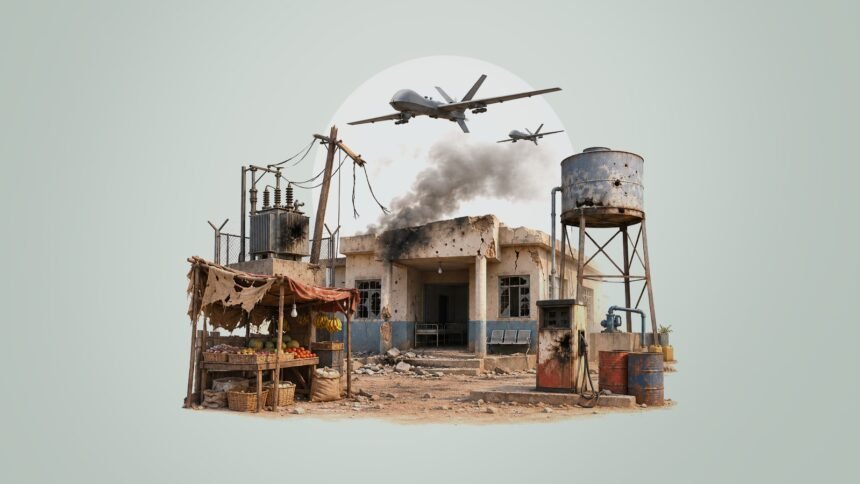
The report lists the targets in plain terms: markets, hospitals, schools, fuel supplies, water sources, displacement sites and civilian vehicles, some of them struck repeatedly. In the first half of the year alone, the office documented at least 39 drone strikes on markets, 20 on civilian vehicles, 17 on fuel tankers and depots, and 16 on health facilities.
These are not random points on a map. A market is where families who have lost their income buy and sell what little they have. A fuel depot keeps water pumps, generators and ambulances running. A clinic in Kordofan or Darfur may be the only place for many kilometers where a wounded child can be treated. The report says such strikes raise serious concerns about compliance with the rules of war that protect civilians and the objects they need to survive, and about the protection of health workers in areas already in dire need of medical help.
The report also documents patterns that have run through the war from its start: indiscriminate attacks, reprisals against civilians accused of “collaboration” with the other side, the continued use of sexual violence as a weapon of war, unlawful killings, arbitrary detention and the erosion of civic space.
Blackouts Far From the Fighting
The most recent trend the office flags is an intensification of strikes on electricity and fuel. In just over two weeks, between 20 October and 4 November, 29 drone strikes attributed to the RSF hit power facilities and fuel stations across 11 states. The result was widespread blackouts and deeper fuel shortages for millions of people living far from any front line.
The consequences reach into hospital wards. Power cuts have disrupted health services including kidney dialysis and surgery, and have cut access to clean water and food production. Li Fung, the UN Human Rights Office’s representative in Sudan, speaking from Khartoum, described “a progressive erosion of the infrastructure and essential services on which civilian survival depends”, adding: “The civilian harm extends well beyond the casualties.”
Hunger as a Second Front
Drone attacks on markets, combined with looting and restrictions on movement, have severely undermined access to food, the report finds. That warning builds on an alarm raised in October by the Integrated Food Security Phase Classification (IPC), which said conflict, displacement and drought were driving an increased risk of famine in parts of Darfur and Kordofan, amid rising acute food insecurity and malnutrition.
The overlap matters. The two regions where drones kill the most civilians are also the two regions where famine risk is rising. When a market is bombed, the loss is counted first in lives and then, over the following weeks, in the meals that cannot be bought. Fung said drone strikes have become “the major cause of civilian deaths in 2026, and a driver of displacement and civilian harm”, worsening the effects of three and a half years of conflict.
Who Stops the Flow of Weapons
The UN office’s message to outside powers is direct. Fung called for action on “the continued influx of arms, in particular, drones” that is fuelling the expansion of the conflict, and for an end to arms transfers used in manifest disregard of the duty to protect civilians. She also urged the parties to negotiate a ceasefire in good faith and to take human rights-based confidence-building steps as a starting point for dialogue.
For Sudan, and for the wider continent, the drone war raises a hard question about who really decides the course of an African conflict. The aircraft that strike markets in Kordofan are not built in Kordofan. Each new supply line extends the war’s reach and weakens the ability of Sudanese people, and of African institutions, to shape its end. The report’s insistence that accountability must apply “regardless of the affiliation of the perpetrators” is a reminder that impunity is also a choice made by those who keep the weapons coming.
“The parties to the conflict must protect civilians and uphold their international law obligations; the world is watching,” Türk said. Whether the world, and Sudan’s neighbors, act on what they are watching will decide whether next year’s report counts fewer dead or more.