



Facing slumping export revenues and climate shocks, the Sahelian nation is racing to lift cotton output by more than 50 percent in a single season. Millions of rural livelihoods are on the line.
On a dusty plain outside Sikasso in southern Mali, tractors trace long, careful lines in fields that lay half-abandoned just a few seasons ago. At the edge of one plot, a group of farmers listens as an agronomist from the state cotton company outlines what the government is promising this time: more seeds, more fertilizer, earlier delivery, and a bold plan to increase cotton production sharply.
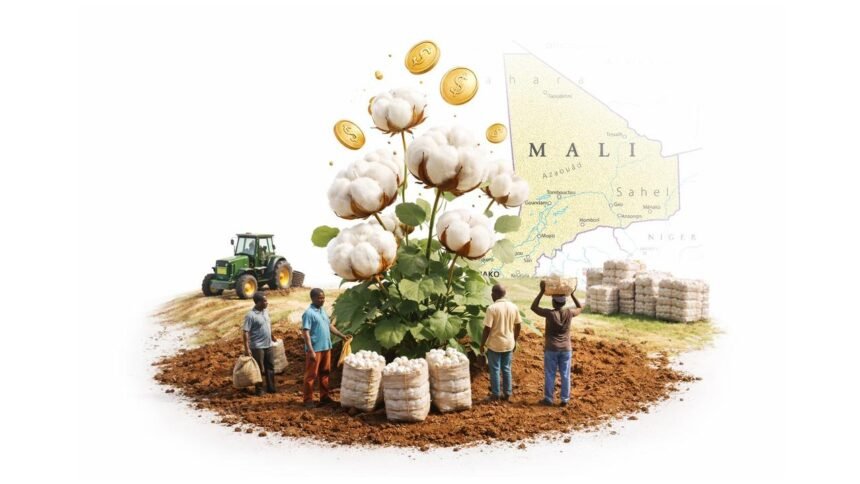
Mali’s authorities say they aim to raise seed cotton output to more than 650,000 tons in the 2026–27 season, more than 50 percent above the 433,700 tons expected this year, according to figures reported by Ecofin Agency and a Malian interprofessional body. It is an ambitious target in a country where “white gold” still anchors the rural economy, and where sustainable booms have often followed previous booms.
Background and Stakes
Cotton has long been one of Mali’s main export pillars, alongside gold. A landmark study on “Mali’s White Revolution” by the International Food Policy Research Institute found that about 30 percent of Malian households grow cotton, and that the sector has historically been a “principal motor of economic development” in rural areas.
Seed cotton, grown mostly by smallholders under rain-fed conditions, has at times accounted for a significant share of national gross domestic product and export earnings.
Recent years have underlined just how fragile that engine can be. After a record harvest of around 777,000 tons in the 2021–22 season, Mali’s output failed to stay above 700,000 tons amid pest attacks, erratic rainfall, and, in one season, a farmer boycott over prices and fertilizer subsidies. In 2024, cotton export revenues fell to about 69.7 million dollars, down from 256 million dollars in 2020, Ecofin Agency reports, as global prices softened.
These swings reverberate far beyond the ginneries. A report on the cotton economy by the ELD Initiative notes that the sector supports millions of Malians directly and indirectly, and that cotton profits have helped smallholders invest in plows, draft animals, and fertilizer, boosting their cereal yields and food security. When cotton stumbles, those knock-on gains are at risk.
Against that backdrop, the new expansion drive is designed to restore a sense of direction. The Malian Textile Development Company, known as CMDT, plans to increase planted area by 96,000 hectares to 630,000 hectares and raise average yields by 17 percent, to 950 kilograms per hectare, according to the company’s board documents cited by Ecofin and local media.
Human Stories on the Ground
The plan lands in villages still processing the shock of recent seasons. During the 2020–21 growing season, a reduction in the farmgate cotton price and changes in fertilizer subsidies prompted many farmers to boycott the crop, slashing national cotton area from around 700,000 hectares to 165,000 hectares, according to research published in Frontiers in Sustainable Food Systems.
“We lost not only the cotton income, but also the credit that lets us buy fertilizer for millet and maize,” one farmer in southern Mali told researchers in that study, describing how abandoning cotton cascaded into lower cereal production. That dynamic helps explain why many households, despite their frustrations, still see cotton as their best bet for financing food and school fees.
Studies of Mali’s cotton zones show that cotton households tend to earn higher incomes and produce up to 70 percent more cereals per capita than non-cotton farmers, largely because of the input and credit systems tied to CMDT. But those benefits depend on functioning institutions: timely delivery of seeds and fertilizer, predictable prices, and the ability to move safely between scattered fields and markets.
In several producing areas, those conditions are fraying. CMDT itself has acknowledged that insecurity has constrained farming activities, while climate variability, floods in some pockets, and localized droughts in others have weighed on yields. Producers have faced jassid infestations and delays in input supply, problems the company says it wants to tackle through an “interim recovery plan” and an operational action plan to anticipate risks better.
Policy Debate and What’s Next
To government officials, lifting cotton output is about more than chasing a statistical target. It is a bid to stabilize rural livelihoods and shore up foreign exchange at a time when Mali faces sanctions, political isolation, and mounting security costs. Cotton remains one of the few sectors where the state can still mobilize large-scale production quickly, using CMDT’s vertically integrated model of inputs, extension support, and guaranteed purchase.
But experts caution that volume alone will not insulate Mali from deeper vulnerabilities. A recent U.S. Department of Agriculture “Cotton and Products” update notes that cotton area and production in Mali, Senegal, and Burkina Faso are expected to decline in some upcoming marketing years due to late rains, delayed input deliveries, and delayed payments to farmers.
Climate projections suggest more intense rainfall variability in the Sahel, raising the odds of both floods and dry spells during critical stages of the growing season.
Price volatility is another fault line. While Mali can, in theory, reclaim or defend its status as one of sub-Saharan Africa’s leading cotton producers, a position it has traded in recent years with Benin, its export earnings still depend heavily on global cotton prices and on subsidies and trade policies in major importing and competing countries. IFPRI’s analysis has long argued that, without reforms in OECD countries and investment along the entire supply chain, Malian cotton will remain vulnerable to external shocks.
Then there is the issue of value addition. Only a small fraction of Malian cotton is processed domestically, meaning most of the value is captured abroad. Development agencies have urged West African producers to expand ginning, spinning, and textile manufacturing, but this requires reliable power, infrastructure, and capital, conditions that remain uneven in Mali.
For now, the government’s bet is focused on the farm: more hectares under cotton, higher yields per hectare, and a hope that the weather and prices will cooperate. If the country reaches 650,000 tons in 2026–27, it will mark a sharp rebound from recent lows and send a signal that a traditional export sector can still be marshaled even amid political and security turmoil.
Whether that rebound translates into durable gains for families in the cotton belt is less certain. That will depend on how far the current push goes beyond raw volume toward fairer, more predictable pricing, stronger farmer organizations, investment in soil health, and a clearer pathway from bales of “white gold” to locally made cloth.
For the farmers listening on the edge of those fields in Sikasso and beyond, the question is more immediate. They must decide, again, whether to stake another season’s labor and credit on cotton, trusting that this time, the promises will hold.