





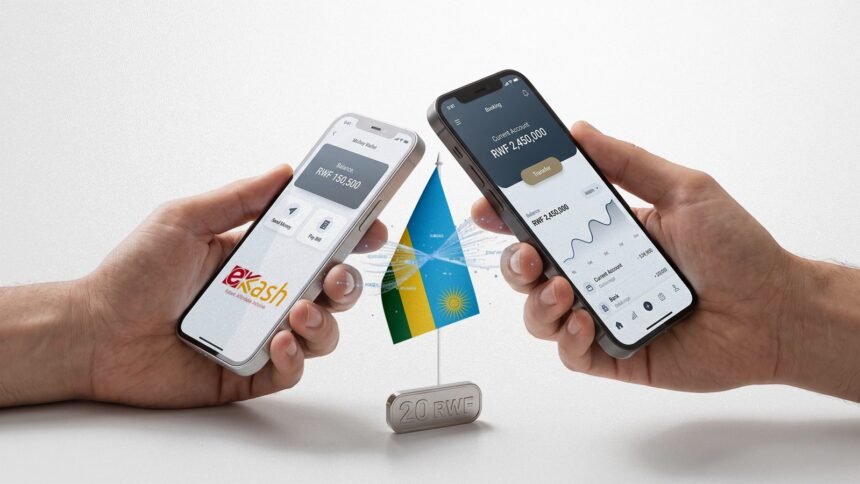
Rwanda has completed the migration of all domestic interoperable retail payments to eKash, its national instant payment system, allowing customers to transfer money seamlessly between banks, mobile money providers, savings and credit cooperatives (SACCOs), and microfinance institutions via a single payment infrastructure.
The transition, which took effect on July 14, is expected to simplify digital payments, lower transaction costs, and strengthen financial inclusion by replacing the fragmented payment arrangements that previously required financial institutions to maintain multiple bilateral connections.
Under the new system, customers can transfer funds between bank accounts and mobile wallets, as well as between different banks and mobile money providers, while paying a maximum interoperability fee of RWF20 (about US$0.01) per person-to-person transaction.
Unlike the previous model, financial institutions now connect once to the national payment switch rather than establishing separate technical integrations with every other institution.
According to Rwanda’s central bank, the move creates a more efficient digital payments ecosystem that supports faster, more reliable, and more accessible financial services.
Before eKash, interoperability depended on individual agreements between banks and electronic money issuers, making payment infrastructure more complex and costly to maintain.
The new platform, operated by RSwitch, serves as a single national payment switch linking commercial banks, mobile money operators, SACCOs, and microfinance institutions.
The change means customers continue using the same mobile banking applications, internet banking platforms, mobile money services, and USSD channels they already know. They do not need to open a new account or download a separate eKash application.
“With eKash, institutions connect once to the national payment system, reducing technical complexity and improving the efficiency of digital transactions,” said Chirenje Clinton, Senior Marketing and Communications Officer at RSwitch.
He added that the platform is designed to make digital payments easier, faster, and more affordable while improving accessibility across Rwanda’s financial sector.
One of the immediate changes is the introduction of a maximum interoperability fee of RWF20 for person-to-person transfers across participating financial institutions.
The sender pays the fee, although individual banks and electronic money providers may charge less or waive it entirely, depending on their pricing policies.
The new pricing significantly lowers the cost of certain transfers. Previously, transferring between some banks and mobile money platforms could incur charges of thousands of Rwandan francs, particularly for high-value transactions.
Merchant payments processed through eKash will not attract interoperability charges for either customers or merchants.
The system also supports interoperable transfers of up to RWF 10 million per transaction, although participating institutions may apply lower limits in line with their internal risk management policies.
Launched in 2022, eKash initially enabled interoperability between Rwanda’s mobile money providers before expanding to commercial banks, SACCOs, and microfinance institutions.
The platform now connects 22 financial institutions, creating a unified payment ecosystem that allows money to move seamlessly across different providers.
The rollout aligns with Rwanda’s broader ambition to build a cash-lite digital economy by expanding access to affordable financial services and reducing barriers between payment providers.
Beyond domestic interoperability, RSwitch says the next phase of development will focus on integrating more government payment services into the platform while laying the groundwork for cross-border instant payments.
Rwanda’s transition reflects a broader trend across Africa, where governments and central banks are investing in interoperable payment infrastructure to reduce fragmentation in digital finance.
As countries pursue the goals of the African Continental Free Trade Area (AfCFTA), instant payment systems that connect banks, mobile money providers, and fintech companies are increasingly seen as critical infrastructure for facilitating trade, financial inclusion, and regional commerce.
If expanded to support cross-border transactions, platforms such as eKash could help reduce the cost and complexity of moving money across African markets, strengthening both intra-African trade and the continent’s rapidly growing digital economy.