




The Pan-African Paradigm of Sovereignty Under Siege and the Architecture of Endless War
Across the African landscape, few conflicts expose the fragility of post-colonial state architecture as starkly as Sudan’s, a war that the United Nations now considers the world’s worst humanitarian crisis and one that has drawn foreign powers into a contest over territory, legitimacy, and resources since fighting erupted in April 2023. The renewed assault by the Rapid Support Forces on the strategically vital city of al-Obeid, and the return of drone strikes to Khartoum and Atbara for the first time since May, mark not an isolated escalation but the latest iteration of a structural pattern: a paramilitary force and a national army, once partners in overthrowing autocrat Omar al-Bashir, now locked in an asymmetric struggle for sovereignty itself. This is the paradigm through which Sudan’s war must be read, not as chaos without direction, but as a contest over who controls the institutional architecture of the state, its capital, its resource-rich regions, and its claim to represent Sudanese self-determination on the international stage. Reclaiming sovereignty here means more than winning territory; it means rebuilding a state capable of governing rather than merely occupying.
Al-Obeid Under Fire: A City as Strategic Chessboard
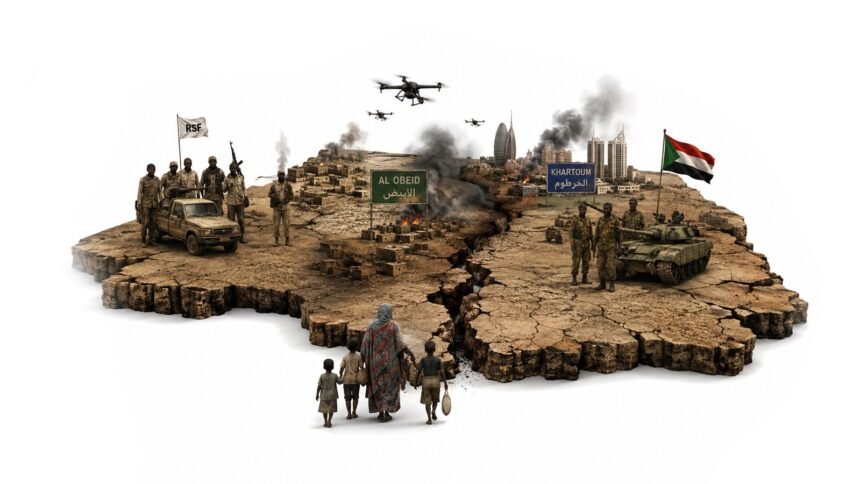
Witnesses reported that eight drones struck al-Obeid on Wednesday, triggering army air defenses and killing at least two people, according to medical sources, as the RSF renewed a long campaign for control of the Kordofan regional capital. The city, home to an estimated half a million people including roughly 100,000 already displaced by the wider conflict, has endured siege tactics that have decimated its power, fuel, food and water infrastructure, a deliberate strategy of structural strangulation rather than direct conquest. Al-Obeid’s significance lies precisely in this architecture of denial: controlling it would grant the RSF a decisive foothold in Kordofan. In this region, both the army and the paramilitaries have recently amassed reinforcements after a brief, internationally pressured pause in hostilities. That the assault resumed despite this pressure signals the limits of external diplomatic leverage over a conflict whose internal military logic, control of strategic urban nodes and the supply corridors that sustain them, continues to override negotiated restraint, leaving civilians trapped in what has become a textbook case of urban siege warfare.
The Drone Matrix Returns to Khartoum
The reappearance of drone strikes in the capital, absent since May, carries a symbolic as well as military weight. In Bahri, part of greater Khartoum, a drone crashed through a mosque’s courtyard in the early morning, an image of collapsed walls captured in Reuters footage that speaks to how thoroughly the war’s technological matrix, unmanned aerial systems whose origin neither side has claimed nor could Reuters independently verify, has penetrated even the recaptured seat of government. The army retook Khartoum early last year, a milestone meant to signal the reassertion of institutional control over the capital’s symbolic and administrative core. That drones can once again reach the city, alongside strikes reported in Atbara to the north, undercuts that narrative of consolidation and reveals the asymmetric reach modern conflict technology grants even a force on the defensive elsewhere. Neither the RSF nor the Sudanese army has claimed responsibility, a silence that itself reflects the opacity increasingly characteristic of a war fought as much through deniable, long-range strikes as through the ground offensives that once defined its trajectory.
Hemedti’s Doctrine of Escalation
RSF commander Mohamed Hamdan Dagalo, known as Hemedti, has pledged that his forces would double down on attacks after setbacks in Kordofan, vowing to eventually reach Khartoum, a declaration that frames the current escalation as a deliberate strategy rather than an opportunistic reaction. On Tuesday, the RSF claimed capture of the town of Geissan in Blue Nile state; local government officials accused the RSF of attacking farmers in their fields, while the army did not comment. This pattern, claims of territorial gain matched by allegations of attacks on civilian livelihoods, illustrates the institutional vacuum in which the conflict now operates, one where neither combatant faces meaningful accountability mechanisms for verifying battlefield claims or protecting non-combatants. The RSF’s parallel governance project in Darfur, where it has begun establishing administrative structures independent of Khartoum, represents perhaps the most consequential structural threat to Sudanese unity: a de facto partition enforced through military control rather than negotiated settlement, one that would fracture the very sovereignty both sides claim to be fighting to preserve.
A Parallel State and the Fracturing of National Architecture
The army, meanwhile, holds most of the eastern half of the country and has pursued a national dialogue intended to cement the legitimacy of the government it leads, recording recent advances in Kordofan, southeastern Blue Nile state, and West Darfur. Yet legitimacy asserted through military gains and unilateral political processes, absent RSF participation or broad civilian buy-in, risks reproducing rather than resolving the crisis of representation that helped trigger the 2023 collapse of the post-uprising power-sharing arrangement. The war’s institutional architecture is thus bifurcating in real time: an army-aligned government seeking international recognition through territorial control and diplomatic outreach, and an RSF-aligned parallel structure consolidating administrative authority in the west. Both trajectories converge on the same underlying claim, that military dominance can substitute for the harder, slower work of constitutional settlement. For a country whose 2019 popular uprising once promised a genuinely negotiated transition, this militarised path toward two rival architectures of governance represents a profound retreat from the self-determination that uprising was meant to secure.
The World’s Forgotten Humanitarian Emergency
The United Nations’ characterization of Sudan as the world’s worst humanitarian crisis is not rhetorical excess; it reflects a war that has displaced millions, decimated basic services in besieged cities like al-Obeid, and unfolded with comparatively little sustained international attention relative to its scale. The structural asymmetry here is stark: a crisis of this magnitude generates a fraction of the diplomatic urgency and resourcing directed at conflicts elsewhere, a disparity that itself reflects the persistent marginalization of African crises within the global attention matrix. Civilians in al-Obeid, Khartoum, Atbara, and Blue Nile state bear the direct cost of this neglect, caught between an army seeking to legitimize its rule through force and an RSF seeking to expand its control through the same means. Renewed international pressure had briefly paused RSF operations, evidence that external leverage can shift battlefield calculus. Still, its unraveling within weeks demonstrates how contingent and fragile such gains remain in the absence of a sustained, structurally embedded peace architecture capable of outlasting any single diplomatic intervention.
Toward a Sovereign Peace, Not an Imposed One
Sudan’s renewed violence in Kordofan and the return of drones to its capital underscore a hard truth: ceasefires brokered under external pressure without addressing the underlying contest for state architecture will always be provisional. Genuine resolution requires a settlement that reflects Sudanese self-determination, negotiated by Sudanese political actors, civil society, and both armed factions, rather than one imposed through temporary international leverage or won by exhausting one side’s ammunition. The stakes extend beyond Sudan’s borders. A fractured Sudan, split between an army-led government and an RSF-administered parallel state, would reverberate across the Horn of Africa and the Sahel, already contending with fragile transitions elsewhere, reinforcing a continental pattern in which the promise of popular uprisings gives way to protracted militarised stalemate. Reclaiming Sudan’s sovereignty, in the fullest sense, will mean building an institutional architecture resilient enough to survive contested elections, resource disputes, and rival claims to legitimacy without collapsing into war. Until that architecture exists, cities like al-Obeid will remain what they are now: strategic chessboards in a war whose ultimate cost is measured in the erosion of Sudan’s own capacity to govern itself.