


The Pan-African Paradigm of Climate Self-Reliance and Ecological Reclamation
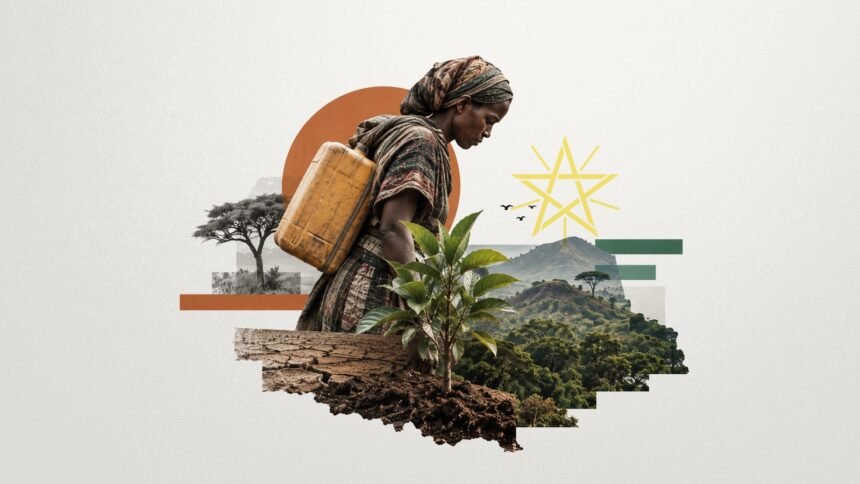
Halima Kedir walks an hour each way for water she does not drink herself; it goes to the trees she has planted across her garden in Ethiopia’s Oromia region, trees she describes, in the language of her community’s adoption tradition, as her own children. Her individual persistence sits inside a far larger national undertaking: Ethiopia’s Green Legacy Initiative. This government-led reforestation drive claims to have planted 48 billion trees since 2019 and aims to reach 50 billion by 2030. The scale of the ambition is itself a statement about African climate agency. Rather than positioning reforestation primarily as a service performed for international carbon markets or foreign donor targets, Ethiopia has framed it as domestic infrastructure, a defense against food insecurity, soil degradation and water scarcity built and staffed by its own citizens. That framing matters for a continent frequently cast in international climate diplomacy as a passive recipient of adaptation funding rather than an active author of ecological strategy. Ethiopia’s initiative, imperfect and unevenly verified as it remains, offers a model of climate self-reliance built from millions of individual acts of labor rather than a single foreign-financed program, and its success or failure will shape how the rest of the continent weighs citizen-led restoration against externally funded alternatives.
A Nation That Lost Its Forests, Then Organized to Regrow Them
Between the turn of the century and 2025, Ethiopia lost roughly 560,000 hectares of tree cover to agricultural expansion, commercial logging and charcoal production, a loss with cascading effects on biodiversity, soil quality and water availability. The Green Legacy Initiative, launched in 2019, has coincided with a genuine reversal in that trajectory: the annual deforestation rate fell from 92,000 hectares in 2013 to 27,703 hectares by 2023, while national forest cover rose from 15.5% to 23.6% over the same period. Kedir’s own transformation from a subject of neighborhood mockery to a locally recognized model, and her neighbor Fate Abdulahi has since joined her in planting, mirrors the broader shift in public sentiment that officials describe as the program’s most significant, if least quantifiable, achievement: a change in how Ethiopians relate to the land they cultivate.
The Numbers Behind the Green Legacy Initiative
The government reports a record 353 million seedlings planted in a single day at the height of the campaign, contributing to the cumulative 48 billion trees claimed over seven years. WaterAid Ethiopia, working alongside households in Kedir’s district of Berbere, has distributed roughly 55,000 indigenous seedlings to local families and institutions, reporting an 85% growth success rate in that specific program. These figures, if they hold at scale, would represent one of the most ambitious state-organized ecological restoration efforts undertaken anywhere in the world in the past decade, a scale of civic mobilization that few African governments, or indeed few governments globally, have attempted to replicate.
Survival Rates: The Question Nobody Wants to Rush
The initiative’s credibility rests less on planting totals than on survival rates, a metric that has proven considerably harder to verify. A government-backed technical committee reported average seedling survival of 83.4% in 2019 and 79% the following year, figures that independent researchers examining fifteen Ethiopian tree-planting schemes with defined targets have met with skepticism; ten of those schemes, by their assessment, achieved less than 50% success. Comparative research from reforestation efforts in Asia found nearly half of all planted trees failed to survive beyond five years, a caution against treating any single country’s self-reported figures as definitive. Yitebitu Moges of the UN Environment Program’s Ethiopia office says a systematic survival-rate assessment is now underway, acknowledging that the greatest documented success so far has concentrated in the country’s highland regions rather than nationwide.
Financing Restoration From the National Budget
Ethiopia’s parliament established a dedicated Green Legacy and Landscape Restoration Special Fund two years ago, allocating between 0.5% and 1% of the country’s 2.339 trillion birr annual federal budget, roughly £50 million to £110 million, specifically to landscape restoration. That domestic financing commitment distinguishes the program from reforestation efforts elsewhere on the continent that depend primarily on international climate finance, positioning Ethiopia’s initiative as a case of a state directing its own fiscal resources toward long-term ecological infrastructure rather than waiting on external funding cycles that can prove unreliable or conditional.
A Continent Watching Addis Ababa
Ethiopia’s selection to host the 32nd UN Climate Change Conference in Addis Ababa in November 2027 will place the Green Legacy Initiative under sustained international scrutiny, forcing a reckoning between the scale of its claimed achievements and the rigor of independent verification. For a country that has positioned itself as one of Africa’s leading green-energy nations, hosting COP32 is both an opportunity to demonstrate a genuinely citizen-driven model of climate self-reliance and a risk, should survival-rate data ultimately undercut the headline planting figures. Kedir’s message to the environmentalists who will descend on her country is characteristically grounded: attention to trees means little without attention to the water needed to keep them alive. Her hour-long walk to a well is, in miniature, the same infrastructural gap the country’s climate diplomacy will eventually have to answer for at scale.