



A Country That Eats 9,000 Tonnes of Chicken a Month, Mostly From Abroad
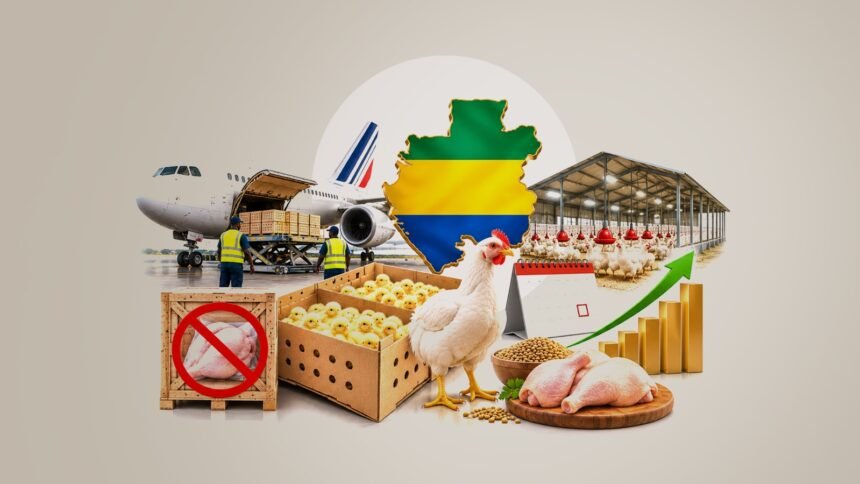
Gabonese households eat an average of 9,000 tonnes of chicken a month, and the country imports around 100,000 tonnes of poultry a year. From 1 January 2027, the government says it will no longer import broiler chickens at all. Between those two facts lies a race against the calendar that became visible on Thursday 19 November, when the first consignment of tens of thousands of day-old chicks, flown in from France, was unloaded at Léon-Mba International Airport in Libreville and driven to farms under police motorcycle escort.
The operation is part of the Emergency Operational Plan for the Poultry Sector, known by its French initials POUFA, launched in February 2026. It places Gabon among African states trying to cut food import bills by backing local producers, a goal that sits at the heart of debates on jobs, prices and self-reliance from the Sahel to the Gulf of Guinea. What sets Gabon’s case apart is the speed of the switch, with an outright ban due in barely six weeks and local production still at the earliest stage.
A VIP Welcome at the Airport
Agriculture and Livestock Minister Pacôme Kossy supervised the arrival in person, alongside Interior Minister Edgard Moukoumbi. Official accounts put the first batch at 37,600 day-old chicks of the Ross strain, while another account rounds it to 37,000, delivered on an Air France flight from Paris. “It is important for Gabonese people to see this. We are moving from a planning stage to a very concrete stage,” Kossy said, in remarks made in French.
Moukoumbi described the security arrangements, including escorts and coordination with provincial governors, to move the birds quickly. “We must minimize losses. We must do everything so that the product arrives at its destination intact,” he said. The chicks were taken to the first farms selected for the program in and around Libreville and Ntoum.
How Many Chicks, and How Fast
The scale of the program is described differently depending on who is speaking. Kossy said more than 162,400 chicks would be received between 19 November and 17 December. Another account of the government’s announcements puts the deliveries over the same period at 262,400, and Théophile Boutamba, Director-General of the Gabon Central Purchasing Agency (CEAG), which buys the inputs from foreign suppliers, said his agency had acquired 268,400 chicks for this operation. A further report says the total order stands at three million chicks, distributed free to local farmers. Boutamba said distribution of feed for the birds was about 80 percent complete.
Of 150 farms selected under the program, 79 are involved in this first phase. One of them is the Bidzi farm on the Donguila road, where Abourou Ndong Ghislain is taking 5,000 birds, the current capacity of his buildings. He said his farm was inspected beforehand and that training sessions were held on health rules. “It was an opportunity to make all the farmers aware of the need to respect the biosecurity protocol,” he said.
Five Hundred Tonnes Against a Monthly Appetite
The government’s projections show both the ambition and the gap. Officials expect the deliveries to yield more than 500 tonnes of broiler chicken for the end-of-year holidays, and Boutamba has promised that Gabonese chicken will be on plates by Christmas. Adding production outside the program, authorities estimate national supply could reach about 796.7 tonnes by 1 January 2027.
Set against consumption of around 9,000 tonnes a month, that would cover less than a tenth of a single month’s demand. The long-term national target is 120,000 tonnes of broiler meat a year, and additional investment of 7.163 billion CFA francs has been announced to support the build-up. The state also plans to supply feed, veterinary products and health kits, and to build slaughterhouses and cutting and packing lines so that local chicken can be sold in the same form as imported cuts.
The Risks of a Hard Deadline
The central question is what happens on 2 January if imports stop and local output is still far below demand. Domestic commentators have warned that the transition requires tight coordination between government, farmers, input suppliers and distributors to avoid shortages or a jump in prices for consumers. Producing chicken locally is one thing; selling it at a price households can afford, in sufficient quantity, is another.
There is also an irony in the supply chain itself. The chicks arrived from France, and the purchasing agency buys the program’s inputs from international suppliers. Cutting imports of finished chicken shifts dependence upstream rather than ending it, at least until Gabon can produce its own hatching eggs and much of its own feed. The government’s own justification for the ban cites security reasons as well as the goal of reducing reliance on foreign food.
Feeding a Country From Its Own Farms
Gabon’s leaders present the ban as a step towards control over what the country eats, and few would dispute the goal for an oil-producing economy that imports most of the chicken it eats. Real control, though, will be measured less by the number of chicks landing at Libreville airport than by whether 150 farms can raise birds profitably, whether feed arrives on time, and whether the price of chicken in Libreville’s markets holds steady after New Year. If the deadline stands and shelves stay stocked, Gabon will offer a model for neighbors; if it slips or prices spike, it will be a reminder that self-reliance in food is built over seasons, not weeks.