


The Pan-African Paradigm of Memory and Political Symbolism
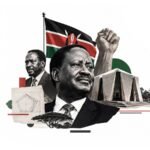
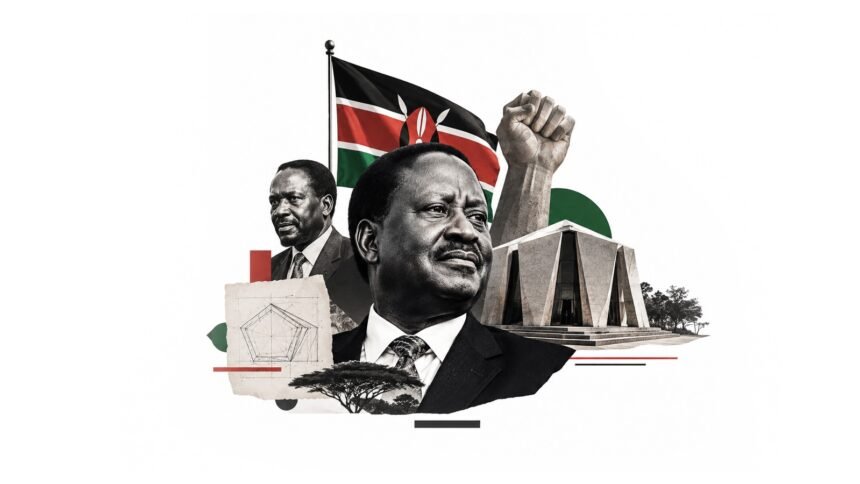
Nations carve in stone what they cannot settle in words. On 7 October, at Kang’o ka Jaramogi in Bondo, Siaya County, Kenya, a mausoleum was dedicated to Raila Odinga, the former prime minister and long-time opposition leader who died on 15 October 2025 at age 80, according to the Star. Its most striking feature is its shape: the building has five sides, and that was a deliberate choice.
Monuments are never neutral. They decide what a nation remembers about a person, who looks after that memory, and how future generations will meet it. Raila’s mausoleum makes those choices unusually visible.
A Fist Rendered in Geometry
Samson Malaki, a Kenya Defense Forces officer who guided President William Ruto and other dignitaries through the facility, explained that the five-sided form draws on the raised fist that became one of Odinga’s most recognizable gestures, Capital FM reported. According to Malaki, the five fingers of the raised hand inspired the pentagon, and the fist was meant not as defiance but as a call for Kenyans to unite.
That reading is itself an act of interpretation. A gesture many Kenyans associated with mobilization and protest is recast, in stone, as a symbol of unity. Whether that reading holds for the many Kenyans who followed Odinga’s long career is a question the building cannot answer, but its form invites the debate.
Father and Son in Dialogue
The design also links Raila to his father. Jaramogi Oginga Odinga, Kenya’s first vice-president, according to Y News, is buried in a neighboring hexagonal mausoleum. Malaki told Capital FM that the architects deliberately worked with the two shapes, six sides for the father and five for the son, to create architectural harmony between the two structures. The result is a dynastic composition: two generations of opposition politics placed side by side, in a shared geometric language, at Kang’o ka Jaramogi.
That pairing carries political weight. The Odinga name has spanned Kenya’s independence era and its constitutional era, and setting the two tombs in deliberate relation turns family history into national history.
From Party Faction to Monument
The number five has its own political history. Capital FM recalled that in the run-up to the 2007 general election, the Orange Democratic Movement’s senior leadership became known as the Pentagon, a group of five prominent politicians positioning themselves for the party’s presidential nomination before the contest at Kasarani. Odinga won the ticket, and the others backed his campaign. Nearly two decades later, the outlet noted, the pentagon has taken on a different meaning at his resting place.
There is irony in a term born of competition inside a party ending up on the tomb of the man who won that competition, recast as a symbol of national unity. Memory, in this sense, smooths the rough edges of political history.
The State as Custodian of Opposition Memory
Perhaps the most significant feature of the project is who built it and who will keep it. The Star and Y News reported that the Kenya Defense Forces completed the mausoleum and that, at the 7 October ceremony led by President Ruto, it was handed to the National Museums of Kenya for management and preservation; Capital FM described the handover as being to the Odinga family. Gender, Culture, the Arts and Heritage Cabinet Secretary Hannah Cheptumo told the Star that a mausoleum is not merely a structure but a repository of memory, history and identity, and that the museum body would be responsible for conserving, documenting, interpreting and protecting the site.
For a politician who spent much of his career in opposition, state custody of his memory is significant. It signals institutional recognition, and it gives the state a lasting role in how that memory is told. Y News reported that the ceremony was restricted to guests, carried full military honors, and was broadcast on public screens in Bondo, with members of the public advised not to travel to the site because of space and security limits.
Heritage, Education and the Public
The site’s future depends on public access. Y News reported that it will serve as a heritage and education center documenting the lives of Raila and Jaramogi, and that it opens to the public on Thursday 8 October. The Star said the dedication took place during Mwezi wa Baba, a month set aside to honor Odinga’s life, and that Cheptumo linked his legacy to Kenya’s democratic and constitutional development and to Pan-African ideals.
Cultural Sovereignty and the Ownership of Memory
Cultural sovereignty, one dimension of structural sovereignty, is the capacity of a society to tell its own history on its own terms. Raila Odinga’s mausoleum was built by Kenyan institutions and carries symbols drawn from Kenyan political life, and that is significant at a time when much African heritage is still interpreted from elsewhere. The harder question is whose interpretation prevails. A mausoleum that reads the raised fist only as unity risks smoothing over the more confrontational chapters of a long opposition career. If the National Museums of Kenya make room for that full and often uncomfortable record, the five sides of this building could become a place where Kenyans debate the trajectory of their democracy rather than commemorate it.