




An Aging Housing Stock, Unenforced Repair Orders and a Familiar Pattern of Collapses in Egypt’s Capital
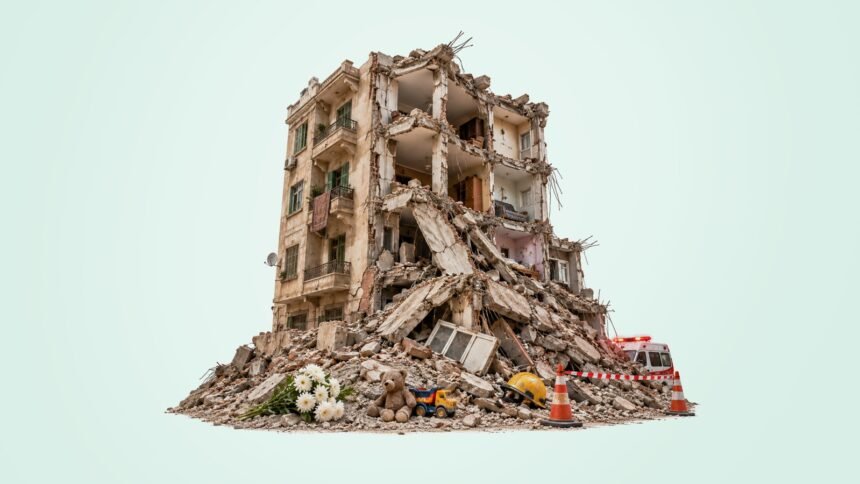
The building went up in the 1950s, when Cairo was a far smaller city than the sprawling capital of today. It had a ground floor and four upper floors held up by load-bearing walls, the Cairo Governorate said. Some seventy years later, on Tuesday afternoon, 13 October, it collapsed in the Hadayek El-Qobba district, killing six people and injuring seven.
The dead included three children, aged 13, nine and two, as well as two women and a man in their sixties. Among them was Gamal Hosni, the building’s owner. Investigators ordered an autopsy to establish whether injuries from the collapse caused his death. The seven injured, one of them a child, were taken to Al-Zaitoun Hospital. Civil defense teams recovered the bodies after a search that one official account says lasted 24 hours; another local account puts it at 48 hours. Rescuers continued checking the debris on Wednesday for anyone still trapped, and officials said the search would continue until the final toll was confirmed.
What Officials Have Done
Police, civil defense crews and ambulances were sent to the scene, and Cairo Governor Ibrahim Saber went to oversee the rescue. Neighboring buildings were evacuated as a precaution, and temporary steel supports were installed to shore them up and protect residents and passers-by. On Wednesday, the governor ordered an engineering committee to assess whether nearby buildings had been damaged. He directed that the debris be cleared only after the public prosecution and criminal investigators had finished examining the site. The governorate says legal proceedings have begun and the cause is under investigation.
Accounts of the exact address differ slightly: one places the building at 5 Haret Abdel Ghaffar, off Teret El-Gabal Street, while the emergency alert was reported as coming from Al-Khaleej Street. Both accounts place it in Hadayek El-Qobba. The difference does not change the central facts: an old, occupied building fell, and children were among the dead. But it is a reminder that early reporting on such disasters is still settling, and that the official investigation will need to establish the full record.
An Order That Was Never Carried Out
The most important question is whether this collapse was foreseeable. One early local account says initial inspections found that the building had previously been subject to a renovation order and to measures to remove building violations, and that these had not been carried out before it fell. The governorate has not confirmed this publicly, and it should be treated as unverified until the prosecution’s findings are released. If it is confirmed, the case would be less a sudden accident than a known risk left in place.
That pattern is familiar. Building collapses are not uncommon in Egypt, where poor construction practices, inadequate maintenance and lax enforcement of building rules have left many residential buildings unsafe. The authorities have tried to crack down on illegal construction and to move residents out of buildings at risk of collapse. But orders on paper do not repair walls. Owners may lack the money or the will to repair, tenants may have nowhere else to go, and officials may hesitate to empty a building of families with no alternative housing.
The Hard Choices Behind Unsafe Homes
Every city with an aging housing stock faces the same dilemma. Strict enforcement can mean evicting low-income families from homes that are dangerous but affordable. Weak enforcement leaves them living under the risk. The way out is not to choose between the two, but to pair enforcement with support: inspections that set clear deadlines, help for owners to pay for structural repairs, and temporary housing for residents while the work is done. Without that support, a repair order becomes a document that waits in a file until the building comes down.
There is also a question of information. Residents of an old building rarely know whether it has been inspected, whether an order has been issued, or what the engineers found. Publishing those decisions, block by block, would let families judge their own risk and press owners and officials to act. Transparency costs little compared with the price paid in Hadayek El-Qobba this week. It would also give the many families who live in similar mid-century blocks across the capital a way to ask the right questions before, not after, a disaster.
Safe Shelter as a Public Duty
Cairo’s governor has promised an engineering review and the prosecution has opened an inquiry, and both deserve to report quickly and in public. The families of a 13-year-old, a nine-year-old and a two-year-old are owed an answer to a simple question: did anyone know this building was unsafe, and if so, why were people still living in it? Across North Africa’s fast-growing cities, the right to safe housing will not be secured by demolition drives or by sympathy after each collapse. It depends on a state that inspects, enforces, and helps people repair the homes they live in before the walls give way.