




Two Rival Authorities, Military Courts Trying Civilians, and a Supreme Court Ruling That Was Ignored
What does it take to end a moratorium that lasted more than fifteen years? In eastern Libya, it appears to have taken a few weeks. Human Rights Watch said on Wednesday, 14 October, that the Libyan Arab Armed Forces, which control eastern and southern Libya under General Khalifa Haftar, have executed at least 31 people since late August 2026. They are the first known executions in Libya since 2010, and they followed military trials the rights group describes as “grossly unfair”. At least 50 more people held in Gernada military prison are at imminent risk of execution, the organization warned.
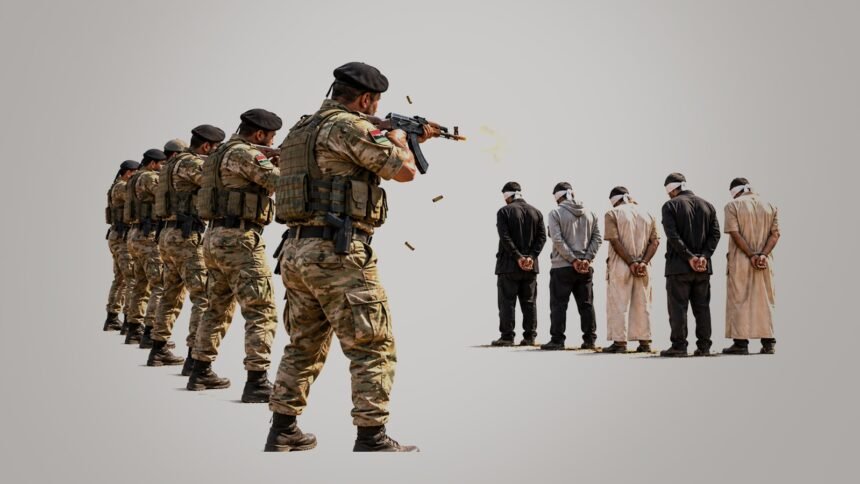
The figures rest on the work of rights monitors rather than on any official tally. On 23 August, the military prosecutor of the Libyan Arab Armed Forces announced that 10 people had been executed by firing squad after being convicted of murder and terrorism-related offenses. Human rights groups say they had documented at least 31 executions in total by 10 September. The prosecutor’s announcement framed the executions as punishment following convictions for murder and terrorism-related offenses; the rights groups dispute that the trials met basic standards of fairness.
Trials Behind Closed Doors
The rights group’s case rests on how the trials were conducted. According to local human rights groups, hearings were held in secret and without prior notice. Families, journalists, and rights organizations were not allowed to attend. Several defendants were denied lawyers of their choice, and those who did have their own lawyers were refused visits before and during trial and could not speak with them privately. Defendants apparently could not present their cases or examine the evidence against them, and verdicts were handed down without written, reasoned judgments.
Many of those executed had been arrested in Derna and Benghazi during or after the armed conflict between Haftar’s forces and rival armed groups from 2014 to 2018. Between 2018 and 2021, military courts in eastern Libya convicted hundreds of civilians in secret trials that targeted real or perceived critics, sentencing at least 22 to death. Amnesty International has said many of those sentences were based on confessions allegedly extracted under torture by the Internal Security Agency, an armed group affiliated with Haftar’s forces. The torture claims are allegations that have not been tested in an independent court, which is precisely the problem the rights groups describe.
A Supreme Court Ruling Set Aside
Two details sharpen the charge that the executions ignored Libya’s own law. At least two death sentences were reduced to life imprisonment on appeal by a higher military court in 2019, yet those defendants were put to death this year regardless. And in November 2025, the constitutional chamber of Libya’s Supreme Court ruled that Law No. 4/2017 is unconstitutional insofar as it gives military courts jurisdiction to try civilians for terrorism and crimes against the state. “The Libyan Arab Armed Forces are putting people to death after secret trials built on confessions allegedly extracted through torture, in courts that Libya’s own Supreme Court has said should not be trying civilians,” said Bassam Khawaja, deputy Middle East and North Africa director at Human Rights Watch.
The treatment of families compounds the harm. Relatives were not told in advance that executions would take place. The authorities refused to hand over the bodies, asked relatives to confirm the identities of the dead, buried them without families present, and warned relatives not to hold funerals. The rights group argues that secret executions and the denial of a last visit breach international law, including the prohibition of torture and other ill-treatment, because of the suffering they inflict on the condemned and on their families.
A Country with Two Justice Systems
Libya has been unstable since the overthrow of Muammar Gaddafi in 2011, and it remains split between two rival authorities. The internationally recognized Government of National Unity, based in Tripoli, controls the west; Haftar’s forces and affiliated militias control the east and south. Both sides operate with near-total impunity, the rights group says, and the justice sector is fragmented and deeply polarised, with militias controlling prisons that are only nominally under state ministries. The United Nations and the Government of National Unity have condemned the executions.
That division matters for accountability. Institutions in the west cannot easily review a death sentence handed down by a military court in the east, and the Supreme Court’s 2025 ruling has carried little weight where Haftar’s forces hold power. The rights group calls on authorities on both sides to restrict military courts to military offenses committed by military personnel, to review the cases of civilians prosecuted before them, and to offer remedies including release, transfer to civilian courts or fair retrials.
Justice That Cannot Be Undone Must Be Beyond Doubt
Human Rights Watch opposes the death penalty in all circumstances and is calling on the Libyan Arab Armed Forces to halt all executions and impose an immediate moratorium. “Libya went more than 15 years without an execution, and the LAAF has shattered that moratorium in a matter of weeks,” Khawaja said. “The lives of at least 50 more people now depend on whether Haftar’s forces, and the governments that back them, choose to stop this.” One need not share that absolute position to see the core issue. A state, or a force acting as one, that claims authority over its territory must show that authority through courts its people can trust. Executions after secret trials, in defiance of the country’s highest court, do the opposite, and they cannot be reversed if the convictions prove unsafe.