


A Church Whose Growth Has Moved South, and the Question of Whether Its Leadership and Priorities Will Follow
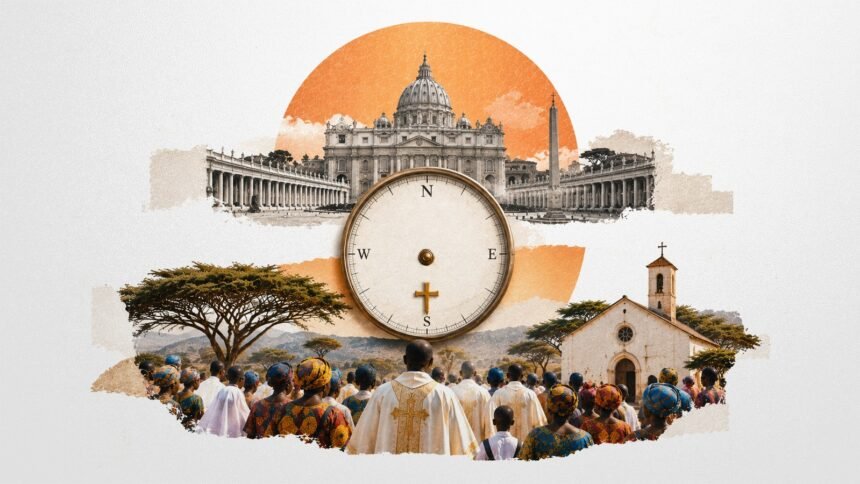
288,312,000 against 287,240,000. Those two numbers, released by the Vatican on Friday, 16 October, mark a quiet turning point in the history of the world’s largest church. According to the Vatican’s annual Church statistics, Africa is now home to more Catholics than Europe. The margin is narrow, a little over one million people, but the direction behind it is not. Africa added 7.58 million Catholics in a single year, more than any other continent, while Europe added 911,000.
The figures come from the Catholic Church Statistics 2026 dossier, compiled by the Vatican’s own news agency from the latest edition of the Church’s statistical yearbook and published ahead of the 100th World Mission Sunday on 18 October. Worldwide, the number of Catholics rose by 16.69 million to 1.422 billion, which is 17.8 percent of a global population of almost 8 billion. The Americas remain far ahead, with about 678.9 million Catholics, followed now by Africa, then Europe, Asia with about 156.2 million and Oceania with about 11.6 million.
What the Numbers Measure
Some care is needed with the dates. The population and Catholic counts refer to 30 June 2024, while the figures for clergy, schools and hospitals refer to 31 December 2024. So the crossover the Vatican announced this week describes the church as it stood more than two years ago; it is a finding about a trend already under way, not an event of this month. The counts are the Church’s own, drawn from its statistical yearbook, and they have not been independently verified.
Measured as a share of the world’s Catholics, Africa now accounts for about 20.3 percent and Europe for about 20.2 percent, with the Americas at about 47.7 percent, Asia at 11 percent and Oceania at 0.8 percent. A year earlier, in the figures for mid-2023, Africa’s share stood at about 20 percent and Europe’s at about 20.4 percent. The overtaking, in other words, came from a gap of less than half a percentage point closing in one year.
The comparison looks very different from inside each continent. Catholics make up about 39.7 percent of Europe’s population but only about 19.9 percent of Africa’s. Africa has overtaken Europe in absolute numbers because its population is growing fast, not because the faith dominates the continent.
Where the Clergy Are Coming From
The more revealing figures may be the ones about people who serve the church. For the first time in five years, the worldwide number of priests rose by 425 to 407,421. That small net gain hides two opposite movements. Africa gained 1,676 priests and Asia 1,065, while Europe lost 2,483. Africa was also the only continent where the number of women religious grew by 2,190, while the global total fell by 9,292 to 580,131, with Europe recording the largest drop at 6,473.
The same pattern holds for the next generation. The number of major seminarians, the men training for the priesthood, fell worldwide from 2,891 to 103,604. Africa was the only continent to record an increase of 786, bringing its total to 35,710, roughly a third of the world’s major seminarians. The average number of Catholics per priest rose worldwide to 3,491, yet the ratio improved in Africa and Asia while it worsened in the Americas, Europe and Oceania. If these trends hold, a growing share of the priests serving parishes in Europe and the Americas will have been trained in Africa.
A Church That Runs Schools and Clinics
For many Africans, the Catholic Church is encountered less through the pulpit than through the classroom and the clinic. The dossier counts 103,666 Catholic primary schools worldwide with more than 36.3 million pupils, and Africa has the largest enrolment of any continent, at 21,292,853 pupils, well over half the global total. Africa also has the largest number of Catholic hospitals and dispensaries; worldwide the Church runs 5,397 hospitals and 13,646 dispensaries.
These figures matter for policy as much as for faith. Where public schools and health services are stretched, church-run facilities can carry part of the load. That gives the Church a practical role in education and health outcomes, and it also gives governments a stake in how the Church plans, staffs and finances that network. A church whose members, priests and pupils are increasingly African will face pressure to match its budgets and institutions to where its people actually are.
Signs of Attention from Rome
The shift has not gone unnoticed at the top of the Church. In April 2026, Pope Leo XIV made an 11-day pastoral tour of Africa that included a stop at the stadium in Bata, Equatorial Guinea. Visits of that kind signal recognition. Whether recognition becomes influence is a separate question: decisions on doctrine, appointments and finance are still taken in Rome, and the statistics say nothing about how far African bishops, theologians and lay leaders shape them.
There are also limits to what growth alone can deliver. The dossier records that catechists, the lay teachers who carry much of the Church’s work in places with few priests, declined slightly in Africa, by 206, even as they rose by more than 22,000 worldwide. Of the 111,602 mission stations counted, the vast majority, 107,415, have no resident priest. Rapid growth in members can outpace the people and money needed to serve them.
Numbers Are Not Yet a Voice
Africa’s new place in the Catholic statistics is a reminder that the continent’s demographic weight is reshaping global institutions, from churches to markets. But a larger share of members does not automatically bring a larger share of decisions. For African Catholics, and for the governments that depend on Church schools and clinics, the real test will be whether the continent’s growing numbers translate into a stronger say over the priorities, resources and leadership of an institution that increasingly depends on them. The count has moved south; the question now is whether the center of decision-making will follow.