





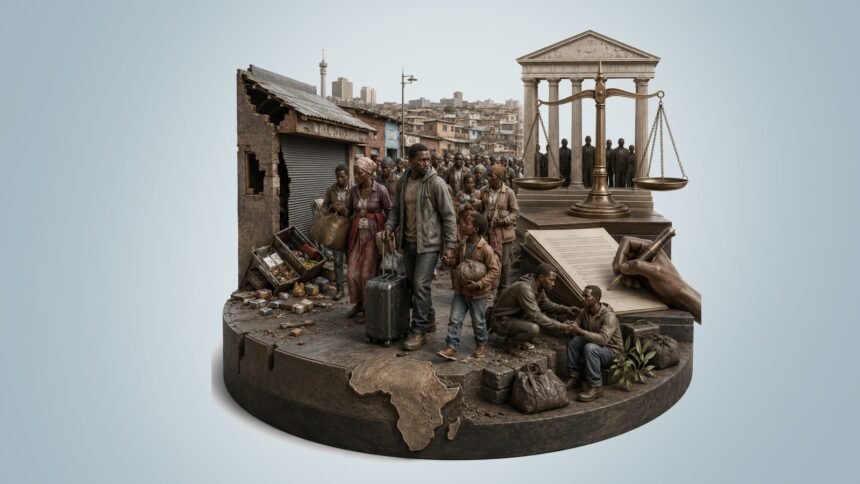
The Pan-African Paradigm of Migrant Protection and Intra-Continental Solidarity
Across the African landscape, few contradictions cut as deeply as violence between African nations against each other’s citizens, and the petition filed this month by two Ghanaian nationals asking the International Criminal Court to investigate xenophobic attacks in South Africa has forced that contradiction into sharp continental focus. The petition, submitted on July 15 by former Ghanaian government spokesperson Palgrave Boakye-Danquah and counter-terrorism analyst Emmanuel Kotin, alleges a ‘pattern of widespread and systematic attacks’ against foreign nationals that could constitute crimes against humanity, and accuses President Cyril Ramaphosa’s government of failing to prevent or punish violence that has killed migrants, destroyed homes and shops, and driven tens of thousands to flee the country. This is the Pan-African paradigm of migrant protection and intra-continental solidarity under direct strain: a vision of African unity and free movement repeatedly undermined by episodic but recurring violence targeting African migrants by fellow Africans, in a nation that has itself long positioned its constitution as a global human rights benchmark. Reclaiming that solidarity requires South Africa, and the continent more broadly, to confront xenophobic violence not as an isolated domestic policing failure but as a structural test of Pan-African commitments made in principle but too often unmet in practice.
The Architecture of the Petition: Naming a Pattern
The petition’s core legal claim rests on establishing that South Africa’s recent surge in anti-immigrant violence constitutes not sporadic criminality but a ‘pattern of widespread and systematic attacks’, the specific legal threshold required for crimes against humanity under the Rome Statute. Boakye-Danquah and Kotin, in a press release accompanying the filing, stated plainly: ‘For years, African brothers and sisters have been killed, beaten, and driven from their homes in South Africa.’ They further argued that ‘the pattern, scale, and recurrence of the violence raise serious questions about the failure of state authorities to prevent, investigate, and punish these crimes.’ This framing deliberately shifts the analytical burden away from individual perpetrators of mob violence and onto the structural question of state failure, whether South African authorities have systematically under-enforced existing protections in a way that has allowed the violence to recur and escalate over successive waves of anti-immigrant sentiment.
South Africa’s Rebuttal: Sovereignty and the Sufficiency of Domestic Law
Pretoria’s response has been to characterize the petition as opportunistic and unnecessary, given existing domestic legal safeguards. Foreign affairs ministry spokesperson Chrispin Phiri told Reuters that ‘South Africa has a sophisticated domestic legal framework and legislation provides comprehensive safeguards and enforcement measures against discrimination of any kind, including intolerance on the grounds of social origin.’ This defense invokes a familiar sovereignty argument: that a nation’s own constitutional and legislative architecture, rather than external judicial intervention, is the appropriate mechanism for addressing internal social violence. Ramaphosa himself has previously condemned the attacks directly and warned against scapegoating immigrants for the country’s deep-rooted unemployment and crime challenges, positioning his government as sympathetic to migrants’ plight even while resisting the framing that state failure rises to the level of crimes against humanity.
The Numbers Behind the Narrative: Scale and Proportion
Central to the credibility contest between petitioners and the South African state is the actual demographic scale of the phenomenon. Reuters reporting notes that migrants constitute roughly 5 percent of South Africa’s population, a proportion low by international standards, undercutting narratives that frame migration itself as the primary driver of the country’s economic strain. Yet it is precisely this disproportion between migrants’ modest demographic footprint and the intensity of the violence directed against them that petitioners argue exposes xenophobia as a structural scapegoating mechanism rather than a rational response to demographic pressure. Understanding this gap between perceived and actual migrant presence is central to any serious policy response, since interventions aimed at addressing genuine resource competition will do little to address violence rooted primarily in political scapegoating.
Institutional Silence and the ICC’s Threshold Test
Notably, neither the ICC nor Ramaphosa’s spokesperson had responded to requests for comment at the time of the petition’s disclosure, leaving the matter in a state of institutional limbo that, in turn, illustrates the structural challenge facing any effort to internationalize accountability for intra-African violence. The ICC’s threshold for opening even a preliminary investigation is deliberately high, and its historical caution in pursuing cases against sitting democratic governments, rather than authoritarian regimes or active conflict actors, suggests the petition faces a steep evidentiary and political climb before triggering formal action. Nonetheless, the mere filing forces a public reckoning: it places South Africa’s domestic handling of xenophobic violence under an international evidentiary lens, regardless of whether the court ultimately proceeds.
Reclaiming the Continental Solidarity Compact
Whatever the ICC ultimately decides, the Ghanaian petition has already accomplished something structurally significant: it has placed South Africa’s recurring xenophobic violence within an explicitly Pan-African accountability framework, rather than treating it as a purely domestic policing matter. As Ramaphosa’s government defends its legislative safeguards and petitioners press their case in The Hague, the deeper continental narrative concerns whether African states can build enforcement mechanisms, whether domestic, continental, or international, capable of protecting African migrants from African hosts with the same seriousness applied to protecting them from external threats. Reclaiming that solidarity compact, and closing the gap between South Africa’s stated legal sophistication and the lived experience of migrants fleeing violence in the tens of thousands, remains the unfinished work at the heart of this case.