






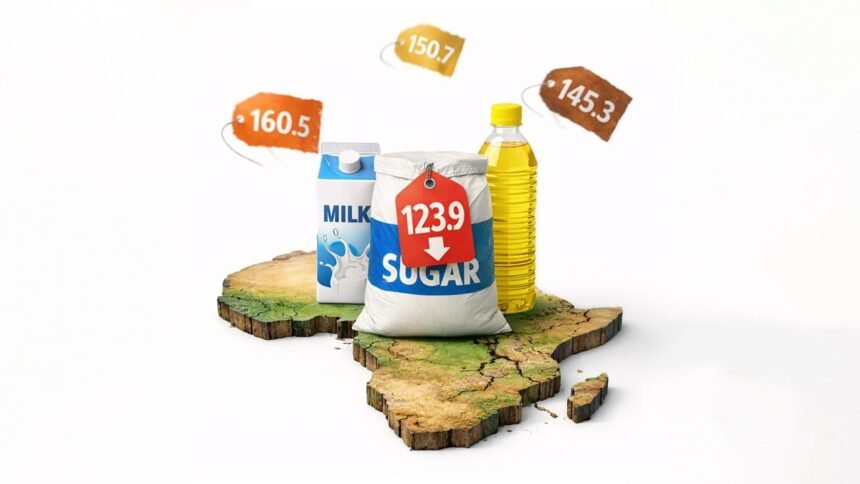
The benchmark measure of world food commodity prices fell again in January 2026, extending a downward streak that offers cautious relief amid persistent economic pressure and cost‑of‑living concerns worldwide. The Food and Agriculture Organization of the United Nations (FAO) Food Price Index averaged 123.9 points last month, down 0.4 percent from December 2025, as declines in dairy, meat, and sugar prices outweighed modest increases in cereals and vegetable oils.
January’s reading marked the fifth consecutive monthly decline and left the index 22.7 percent below its all‑time high in March 2022, when Russia’s full‑scale invasion of Ukraine sent shockwaves through global grain and vegetable oil markets. FAO data also show the index standing 0.5 percent lower than a year earlier, indicating a slow but measurable easing in international prices after several years of sharp volatility.
The FAO Dairy Price Index registered the sharpest drop in January, falling around 5 percent compared with December as increased export availability and softer import demand weighed on quotations. Meat prices slipped by about 0.4 percent, with lower pig meat prices offsetting broadly stable bovine and ovine values.
Sugar prices declined by roughly 1 percent, driven largely by expectations of increased global supplies this season, underpinned by a production rebound in India, favorable output prospects in Thailand, and a generally positive outlook for Brazil’s 2025/26 harvest. These declines more than counterbalanced marginal gains in cereals and vegetable oils, where markets remain highly sensitive to weather conditions, trade policy shifts, and energy prices.
For many households, especially in low‑ and middle‑income countries, the recent easing in global benchmarks has yet to translate into a noticeable reduction in retail food prices. Supply chain costs, domestic taxes, currency depreciation, and local weather shocks frequently dull or delay the pass‑through from international markets to supermarket shelves. Still, analysts note that lower global quotations help take pressure off import bills and can gradually ease headline inflation, provided the trend continues, and domestic bottlenecks are addressed.
The implications are particularly significant for Africa, where many countries are net food importers, and households spend a high share of their income on food. The FAO report does not explicitly link the January decline to immediate relief in African markets, where domestic prices often remain elevated due to localized conflict, recurrent droughts, high transport costs, and policy distortions. In parts of East and West Africa, for example, crop losses, insecurity along trade corridors, and high fuel prices continue to push up the cost of staples even as global indices edge downward.
Nonetheless, the easing of international prices, especially for imported products such as sugar, dairy, and some meats, could gradually reduce import bills for African governments and private traders. If shipping, insurance, and financing costs stabilize and exchange rates do not deteriorate further, those savings may eventually filter through to consumers in the form of slower price increases or, in some cases, outright price cuts.
In highly import‑dependent economies like Nigeria, where food inflation has been driven by both global shocks and domestic factors, including currency weakness and insecurity, lower global prices offer at least a counterweight to some of those pressures, even if they cannot fully offset them.
Experts caution that the current respite in global food prices remains fragile. Weather extremes linked to climate variability, geopolitical tensions, export restrictions, and energy market swings could quickly reverse the trend, particularly for cereals and vegetable oils that are central to African diets.
For policymakers, the latest FAO figures underscore the importance of using any breathing space to strengthen resilience by investing in local production, storage, and transport infrastructure; diversifying import sources; and improving social protection systems that shield vulnerable households from future price spikes.
For now, the fifth straight monthly decline in the FAO Food Price Index offers a rare piece of good news in a challenging global economic landscape. Whether that statistical relief turns into real, felt change in markets from Lagos to Lusaka will depend not only on what happens to prices on international exchanges, but also on the policies and investments that connect those markets to African dinner tables.


