



The Pan-African Paradigm of Environmental Justice and Extractive Self-Determination
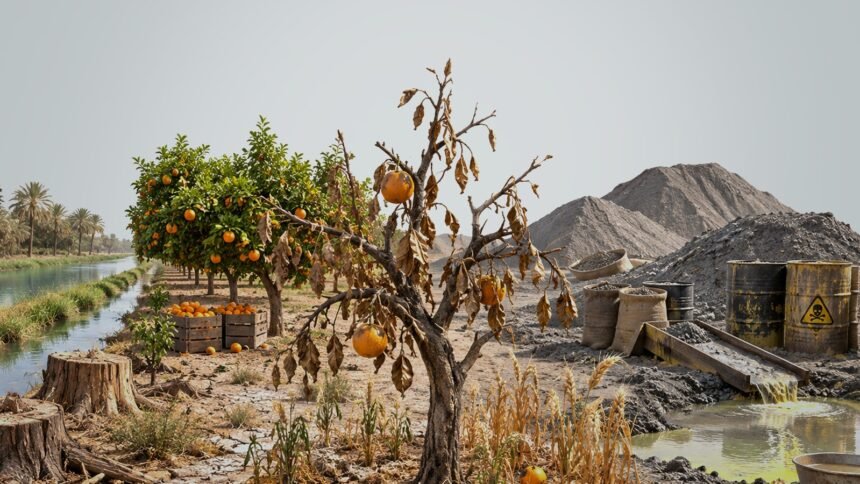
Where four truckloads of oranges once rolled out of Abu Hamad’s orchards after a single harvest, farmers today count themselves fortunate to fill half a truckload, a collapse in yield that traces, almost mound by mound, to the more than seven hundred piles of toxic mining waste now ringing this Nile-side town in Sudan’s River Nile state. Abu Hamad’s transformation from a fertile agricultural hub feeding Khartoum and Port Sudan into one of the country’s largest artisanal gold-mining and trading towns is a story about war, poverty and desperation. Still, it is also a story about the absence of any institutional mechanism to weigh short-term survival against long-term environmental and public-health catastrophe. Across a continent where extractive industries routinely externalize their costs onto land, water and the bodies of people who see little of the resulting revenue, Sudan’s gold rush is an especially stark instance of a broader Pan-African reckoning: genuine resource self-determination has to include the right of communities not to have their food systems poisoned in the process of extraction, and reclaiming that right means confronting the war economy and institutional collapse that made artisanal mining the only viable livelihood left.
From Orchards to Waste Mounds: Two Decades of Artisanal Mining
Artisanal gold mining first appeared around Abu Hamad in roughly 2008 but has intensified sharply over the past six years, driven by conflict-fuelled economic collapse that has left few alternative livelihoods. By 2024, artisanal operations accounted for more than 90% of Sudan’s total gold production, and Abu Hamad had become one of the country’s largest mining and trading centers for the metal. The physical transformation is visible and severe: trees cut down, agricultural land cleared, farms replaced by commercial buildings, and more than seven hundred grey mounds of mining waste dotted through the town and its outskirts, each one a slow-release source of contamination into the surrounding soil, water table and air.
Cyanide, Mercury, Thiourea: The Chemistry of Desperation
The waste mounds are not inert; they are byproducts of a specific, hazardous extraction process. Locals process tailings, the leftover material from artisanal mining, which still contains roughly 70% of the gold, using chemicals including cyanide, mercury and thiourea, the last of which was initially believed to be relatively safe but is now understood to carry serious health risks of its own. That people continue reprocessing this waste despite the danger shows how thoroughly conflict and poverty have narrowed the range of viable choices for Abu Hamad’s residents, for whom the toxic tailings represent one of the only remaining sources of cash income in a wartime economy.
Four Truckloads to Half a Truckload: The Collapse of the Harvest
The agricultural toll is measured, farmer by farmer, in shrinking harvests. Mohamed Fathi al-Rahman al-Khalifa, a local farmer, told the Guardian that when his orchard’s trees were still young, the first harvest produced nearly four truckloads of oranges; today, production does not exceed half a truckload. The pattern repeats across staple crops: a single acre of wheat that historically yielded between forty and sixty sacks now produces just twelve to eighteen. In comparison, fava bean yields have similarly collapsed from an average of forty to fifty sacks per feddan to a fraction of that figure. These are not marginal declines but the wholesale collapse of a farming economy that once anchored the town’s identity and its food supply to two of Sudan’s largest cities.
Salt in the Soil: Flood Runoff and a Public Health Emergency
The mechanism behind the collapse compounds the direct chemical contamination: floodwaters carrying runoff from the mining sites have caused dramatic spikes in soil salinity across Abu Hamad’s remaining farmland, rendering fields progressively less capable of sustaining the crops that once thrived there. Public health researchers and local observers describe the cumulative effect as a full-blown public health emergency, with contamination reaching soil, water, and air simultaneously and residents caught between the immediate economic necessity of mining and its slow, compounding damage to the very land and water they depend on for food and drinking supply, a trap with no clear exit while the underlying war economy persists.
Reclaiming the Nile’s Banks from the Logic of Extraction
What Abu Hamad needs, and what its residents have had almost no institutional means of securing, is a framework that treats artisanal mining’s environmental and health costs as seriously as its short-term economic necessity, formalized processing standards, remediation funding for the hundreds of existing waste mounds, and pathways back to agricultural livelihoods once conflict conditions allow. None of that is available while Sudan’s broader war continues to hollow out state capacity and push more communities toward the same desperate calculus that transformed Abu Hamad’s orchards into waste fields. Reclaiming the Nile’s banks for food production rather than toxic extraction is, in the end, inseparable from the larger structural project of ending the conflict that made the trade-off necessary in the first place, a reminder that environmental justice and peace are, on the ground, often the same demand wearing different names.