





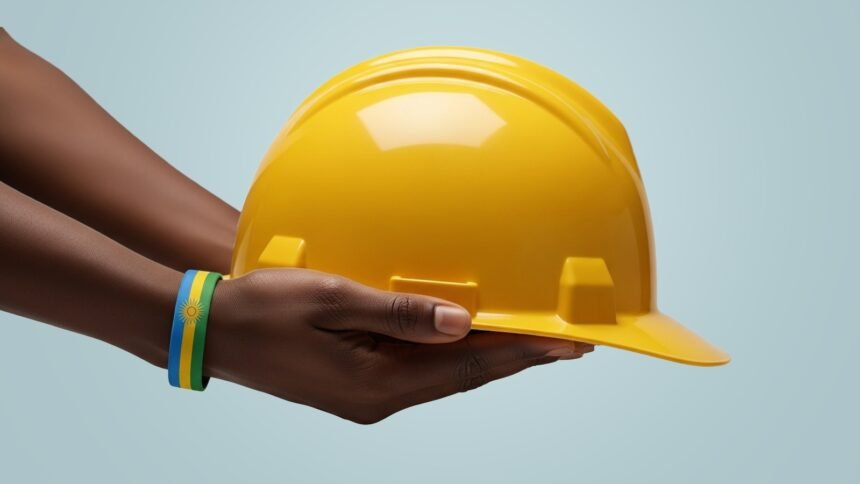
Rwanda has made progress in strengthening workplace safety and compliance, but significant shortcomings persist, especially in the mining and construction sectors, leaving many workers vulnerable to avoidable hazards, a new study by the Institute of Policy Analysis and Research (IPAR–Rwanda) has revealed.
The report, titled “Strengthening Labour Inspections for Decent Work and Enterprise Compliance in Rwanda,” which was released on November 4, highlights both commendable progress and pressing challenges within Rwanda’s labour inspection system.
While also offering insights relevant to other developing economies striving to protect workers’ rights while fostering business competitiveness.
Eugenie Kayitesi, Executive Director of IPAR–Rwanda, said the research recognises the government’s notable progress in developing strong legal frameworks but pointed to ongoing risks in high-hazard industries.
“The government has really done a good job, however, in some risky sectors, safety gear requirements such as helmets and protective clothing are often ignored, especially by illegal miners. We recommend that such illegal operations should not be tolerated,” Kayitesi said.
Kayitesi added that while the Ministry of Public Service and Labour (MIFOTRA) has built solid policy foundations, there is still room for improvement, particularly in ensuring that workers in high-risk areas have full protective coverage and security.”
The study found a critical imbalance in Rwanda’s inspection system, where administrative compliance often takes precedence over life-saving safety checks.
About 58 percent of inspections focus on wages and pensions, while only 7 percent address chemical safety and just 4 percent involve specialised safety officers.
Limited resources have also weakened enforcement, 90 percent of inspectors lack essential tools or transport, restricting their capacity to reach more than 60 percent of workplaces.
This imbalance leaves thousands of workers unprotected. According to IPAR’s findings, over 90 percent of Rwandan workers remain unaware of their legal rights, allowing practices like unpaid overtime and unsafe working conditions to persist.
Andre Mutsindashyaka, Secretary-General of the Rwanda Extractive Industry Workers Union (REWU), said the report mirrors the realities on the ground.
“It reflects what we see daily in the field, especially regarding inclusion and working conditions,” he said.
He highlighted positive reforms in the mining sector, including the establishment of community centres and Early Childhood Development (ECD) facilities near mining sites.
These have increased women’s participation in mining from 11 to 24 percent, enabling mothers to work while keeping their children nearby.
REWU has also been instrumental in pushing for fairer wages and better working terms.
“Previously, miners who didn’t find minerals were not paid, it was a form of exploitation. Now, with support from MIFOTRA and employers, we’ve agreed on a daily incentive of Rwf1,500 even for workers who fail to find minerals. This helps reduce poverty and promote fairness in the sector.”
The report underscores the urgent need to upskill Rwanda’s workforce. Of the 92,000 workers in mining, fewer than 1,000 hold higher education qualifications.
Mutsindashyaka cited the Work Plus Learning programme, a partnership between trade unions, Rwanda TVET Board, and Rwanda Polytechnic, as a model for recognising and upgrading workers’ technical skills acquired on the job.
Meanwhile, experts called for greater formalisation in other sectors such as construction and tourism, which generate many jobs but remain largely informal.
Bernard Nsanzimana, a consultant at GEMICO Mining Company and university lecturer, warned that the lack of formal contracts leaves workers excluded from social protection schemes.
“Many construction workers have no contracts or pension contributions. When they retire, they have nothing to rely on. Formalisation is essential to protect their future,” Mutsindashyaka explained.
Experts also called for stronger coordination between inspection bodies. Nsanzimana noted that agencies such as the Labour Inspectorate and Rwanda Mines Petroleum and Gas Board often work in silos, leading to duplication or conflicting enforcement.
“If inspectors worked together under a harmonised framework, it would improve efficiency and reduce confusion,” he added.
The IPAR study concludes that while Rwanda’s labour inspection reforms are commendable, stronger coordination, resources, and awareness campaigns are vital to sustain decent work standards, an effort that resonates across developing economies pursuing the same goal, a safer, fairer, and more dignified workplace for all.