





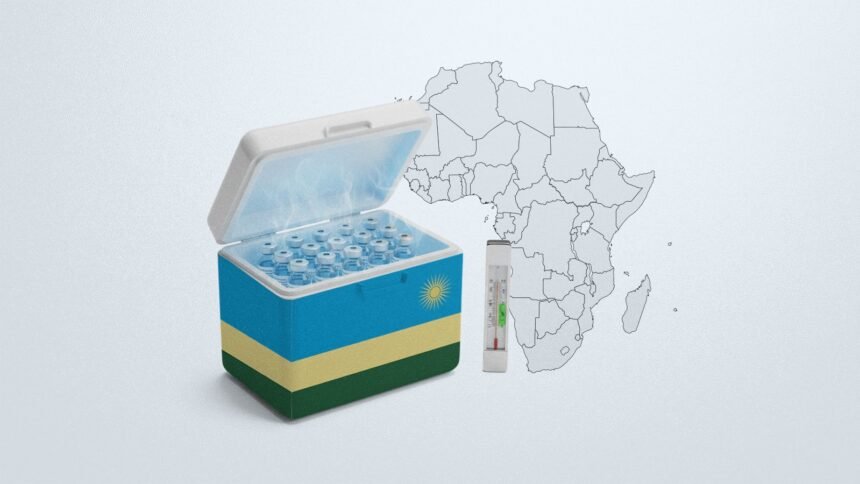
The vision of Africa to be capable of producing its own vaccines is gaining momentum, but scientists caution that the continent’s fragile cold-chain systems threaten to derail it. Without reliable refrigeration and distribution infrastructure, the push for local vaccine manufacturing risks being compromised before it takes off entirely.
While governments and global partners have poured billions into local vaccine production, including Rwanda’s BioNTech vaccine factory, experts say the production is only half the equation. No matter how advanced, vaccines lose potency when exposed to temperatures outside the recommended range of +2°C to +8 °C.
And across the continent, that fragile temperature window is thrown off daily by weak storage, hot climates, unreliable electricity, and outdated equipment.
The World Health Organisation (WHO) estimates that up to 50% of vaccines are wasted each year because of failures in temperature control and logistics. This stark figure highlights that Africa cannot achieve vaccine self-sufficiency without first fixing its cold chain.
This is the central theme driving a three-day Vaccine Symposium taking place from November 17 to 19 at the Africa Centre of Excellence for Sustainable Cooling and Cold-Chain (ACES) in Kigali. The event brings together scientists, policymakers, industry experts, and researchers to confront the cold-chain gap head-on and outline how Africa can secure its vaccine future beyond manufacturing.
Rwanda is one of the few African countries to build a comprehensive ecosystem for vaccine sustainability, combining production, research, and cold-chain innovation. Yet even with these investments, the country is not immune to the challenges facing the continent.
Prof Claude Mambo Muvunyi, Director General of the Rwanda Biomedical Centre (RBC), says the growing demand for temperature-sensitive vaccines and laboratory reagents means the cold chain is no longer a behind-the-scenes logistics issue but has become a frontline public health priority.
“Reliable cooling ensures the potency of vaccines and pharmaceuticals, prevents stock losses, and supports uninterrupted services in health facilities and laboratories. At the same time, climate change is increasing the pressure on an already strained system. We need energy-efficient, solar-powered, and environmentally friendly cooling technologies to ensure long-term resilience,” he said.
WHO’s Effective Vaccine Management (EVM) data from 2009–2020 revealed that more than one in 20 storage facilities globally reported losing vaccines to temperature damage in a single year. For health systems in Africa, where every dose counts, such losses represent both financial setbacks and missed opportunities to protect populations from preventable diseases.
At the Rubirizi Campus of ACES, a first-of-its-kind hub in Africa dedicated to sustainable cooling, researchers are developing and testing climate-smart systems tailored to African conditions. Their focus spans solar refrigeration, low-GWP refrigerants, real-time temperature monitoring tools, and integrated systems for both human and animal vaccines.
“Vaccination programmes across the continent are under pressure from emerging diseases, supply-chain disruptions, and financing gaps. What we are building here is a practical and multidisciplinary approach that allows Africa to protect the vaccines it produces,” explained Dr Jean Pierre
Musabyimana, Research Lead for the One Health programme at ACES.
He adds that if Africa succeeds in manufacturing vaccines but fails to deliver them safely, the continent would only be solving half the problem.
The symposium, themed Building the Next Generation of Vaccine Cold-Chain in Africa, seeks to answer a pressing question: Can Africa achieve vaccine sovereignty if it continues to lose doses to temperature damage?
Over three days, delegates are exploring strategies that integrate climate resilience, sustainable energy, vaccine logistics, and One Health. Expected outcomes include a continent-wide roadmap for cold-chain innovation and local production, new research collaborations between ACES, RBC, RAB, global agencies, and private industry, clear recommendations on financing, energy-efficient systems, and sustainability models, and capacity-building efforts to equip technicians, scientists, and health workers with modern cold-chain skills.