


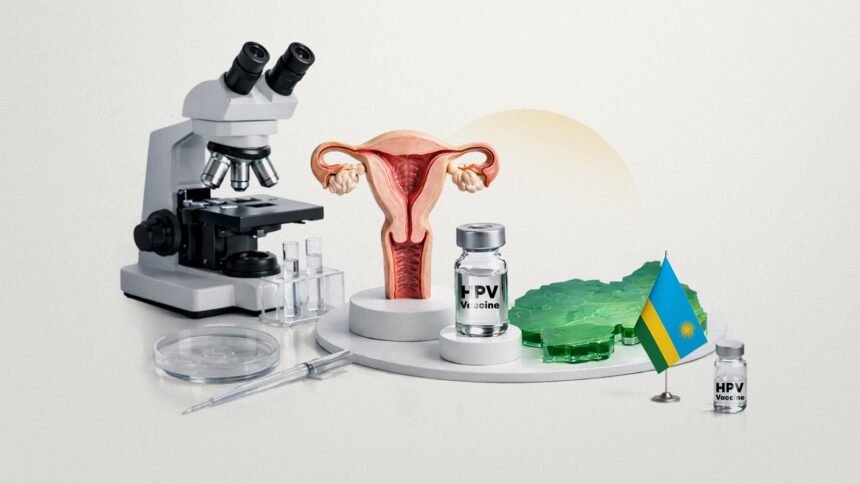
Rwanda is preparing to introduce Gardasil 9, an advanced human papillomavirus (HPV) vaccine that provides protection against a broader range of cancer-causing HPV strains, in a move that could place the country at the forefront of cervical cancer prevention efforts in Africa.
Health authorities say the vaccine rollout, expected to begin in 2026, forms part of Rwanda’s national strategy to eliminate cervical cancer by 2027. If implemented as planned, Rwanda would become the first African country to integrate Gardasil 9 into its routine national immunization programme, according to the Rwanda Biomedical Center (RBC).
Gardasil 9 protects against nine strains of HPV, including those responsible for most cervical cancer cases, as well as cancers of the vagina, vulva, anus, penis, and throat. It also prevents genital warts. The vaccine offers broader protection than Gardasil 4, which Rwanda has used for more than a decade.
“The planned rollout aligns with updated World Health Organization (WHO) guidance issued in December 2022, which expanded HPV vaccination recommendations to include adults,” said Hassan Sibomana, Director of the Vaccine Programmes Unit at RBC.
He explained that the revised WHO guidance removed previous age limits, opening the door for countries to vaccinate women who were not eligible when HPV vaccination programmes were first introduced.
Rwanda launched its HPV vaccination programme in 2011, initially targeting girls aged 9-14. While the programme has been widely recognized as a public health success, women who were older at the time were left out.
“To close that gap, we now plan to vaccinate women aged 29 to 35 who missed earlier vaccination and remain at risk of HPV infection,” Sibomana said, noting that the final age range will depend on vaccine availability.
Priority, he added, will be given to women who have never received any HPV vaccine doses.
The decision to adopt Gardasil 9 is also informed by local research. Studies conducted at Butaro Hospital and other health facilities in Rwanda indicate that HPV type 45, which accounts for about 13.6 per cent of cervical cancer cases in the country, is not covered by Gardasil 4. Gardasil 9, however, includes protection against this strain.
Cervical cancer remains one of the leading causes of cancer-related deaths among women in Africa, mainly due to limited access to screening, vaccination, and early treatment. According to WHO data, the continent accounts for nearly one quarter of global cervical cancer deaths, despite having a much smaller share of the world’s female population.
In response, several African countries have scaled up HPV vaccination for adolescent girls, often with support from global health partners. However, adult vaccination and access to newer-generation vaccines remain limited across much of the region.
Although Gardasil 9 is priced at approximately $330 per dose globally, Rwandan authorities have stated that it will be provided free of charge in public health facilities.
“We are working closely with partners to ensure the vaccine is accessible to the population,” Sibomana said.
Preparations are ongoing, with procurement still underway. Training for healthcare workers will begin once the vaccines arrive, ahead of nationwide distribution.
Public health experts say Rwanda’s move could serve as a model for other African countries seeking to accelerate progress toward WHO targets to eliminate cervical cancer as a public health problem.