



Pan African: The Quest for Financial Autonomy
Across the African landscape, the discourse on economic development has reached a definitive turning point where the pursuit of financial sovereignty is no longer a peripheral concern but the central pillar of the “Pan African” agenda. For decades, the continent has grappled with the dual reality of immense resource wealth and systemic fiscal vulnerability. In the 2026 global order, characterized by shifting geopolitical alliances and volatile energy markets, the imperative for African nations to achieve self-sufficiency in financing has never been more acute. True liberation in the 21st century is predicated on the ability of African states to negotiate with global financial institutions from a position of structural strength, ensuring that developmental capital serves the long-term interests of the continent’s people rather than the short-term requirements of external creditors.
Liberia’s Economic Outlook: Growth Amidst Global Headwinds
The economic outlook for Liberia in 2026 is defined by a remarkable degree of resilience, with the International Monetary Fund (IMF) confirming a growth rate of $5.1\%$ for the current fiscal year. This expansion, up from $4.0\%$ in 2024, is primarily driven by robust activity in the mining sector alongside a moderate expansion in agriculture and services. Macroeconomic stability has been further bolstered by a significant decline in inflation, which dropped to an average of $4.4\%$ in late 2025 from a peak of $12.5\%$ earlier that year. Despite these positive indicators, the national economy remains sensitive to external shocks, particularly the rising costs of fuel and fertilizers linked to ongoing conflicts in the Middle East, necessitating a cautious and disciplined approach to fiscal management.
Loans & Debt in Liberia: The Strategic Architecture of Support
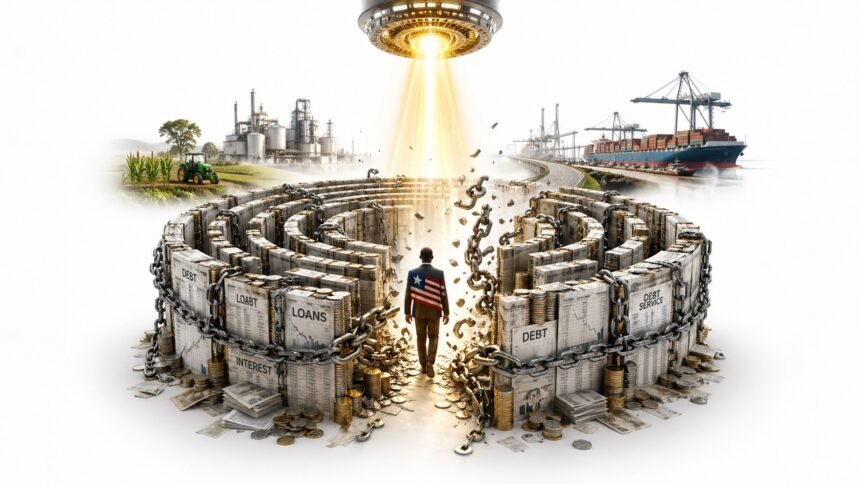
Liberia’s engagement with international credit markets reached a significant milestone in April 2026, as the IMF Executive Board approved a new 21-month arrangement under the Resilience and Sustainability Facility (RSF) totaling approximately $\$266$ million. This arrangement, equivalent to $75\%$ of Liberia’s quota, is designed to strengthen macroeconomic resilience by building buffers against climate-related risks and enhancing pandemic preparedness. Simultaneously, the successful conclusion of the third review under the 40-month Extended Credit Facility (ECF) allowed for an immediate disbursement of approximately $\$26.49$ million. These strategic loans are not merely infusions of liquidity; they are intended to catalyze external financing and support a reform program aimed at restoring stability and ensuring debt sustainability in a nation navigating the “post-conflict” developmental curve.
IMF & World Bank Projects: Engineering an Infrastructure Revolution
The collaboration between the Government of Liberia and multilateral institutions like the World Bank has manifested in a series of transformative mega-projects designed to redefine the nation’s economic landscape. Central to this infrastructure revolution is the $950$ MW Malaikah Energy Project, a staggering installation poised to eliminate chronic power shortages and turn Liberia into a net energy exporter via the West African Power Pool. Complementing this is the $400$ km Coastal Highway and the $\$550$ million National Ports Modernization Plan, both of which are critical for bridging the gap between isolated resource zones and global markets. These projects, often supported by the Global Agriculture and Food Security Program (GAFSP), represent a coordinated effort to transition Liberia from a resource-exporting nation to a regional logistical powerhouse.
Debt Crisis in Africa: The $90 Billion Debt Wall
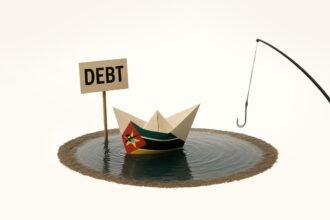
The broader African continent faces a formidable “debt wall” in 2026, with sovereign obligations in hard-currency terms expected to exceed $\$90$ billion. This figure represents a more than three-fold increase since 2012, highlighting a systemic challenge where the cost of borrowing is often misaligned with the actual financial potential of the region. Many African nations find themselves in a precarious cycle, borrowing heavily to finance essential infrastructure while facing high interest rates that divert revenue from social services to debt servicing. The current global financial architecture, while providing necessary capital, often leaves African economies vulnerable to “debt traps” that can stall development for decades, necessitating a radical rethinking of how the continent accesses and manages international credit.
Industrialization & Development: Value Addition and Economic Sovereignty
To escape the cycle of primary commodity dependence, Liberia is prioritizing industrialization through the development of Special Agro-Industrial Processing Zones (SAPZ) near Buchanan. These zones are designed to ensure that raw commodities, such as rubber and palm oil, undergo local value addition before export, maximizing economic returns and creating sustainable employment. By focusing on “energy independence” through the Mt. Coffee Hydropower extension and the Harrisburg Solar Farm, Liberia is building the resilient green energy grid required to sustain heavy industry. This shift toward a manufacturing-led economy is essential for creating the fiscal space needed to reduce long-term debt and achieve a more sovereign developmental trajectory.
AfDB & AU Efforts: Strengthening Domestic Resource Mobilization
The African Development Bank (AfDB) and the African Union (AU) are leading a continental push for “Domestic Resource Mobilization” as a key lever for development. The AfDB has urged African finance ministers to ramp up efforts to unlock hundreds of billions of dollars in domestic revenue through the strengthening of tax policies and the diversification of revenue bases. Initiatives like the Debt Management Forum for Africa (DeMFA) and the African Debt Manager’s Initiative Network (ADMIN) are providing the technical scaffolding for states to manage their debt more effectively. By focusing on collection efficiency and reducing illicit financial flows, these regional bodies aim to reinforce the sovereignty of African states and reduce their reliance on volatile external lending.
African Homegrown Solutions: Reforming the Global Financial Narrative
The ultimate path toward financial freedom lies in the implementation of “African Homegrown Solutions” that challenge the prevailing global financial narrative. A cornerstone of this effort is the establishment of the Africa Credit Ratings Agency (AfCRA) by the African Union, intended to reform credit rating methodologies that often penalize African nations with inflated risk premiums. Furthermore, networks like the African Sovereign Debt Justice Network (AfSDJN) are advocating for debt cancellation and the “decolonization” of narratives surrounding African debt. By investing in in-country intelligence and prioritizing natural capital in wealth accounting, the continent is moving toward a future where its economic story is told by its own people, ensuring that development is financed with dignity and transparency.