




Across the African landscape, the contemporary implementation of international migration frameworks sits at a sensitive crossroads between local economic anxieties and historic commitments to continental unity. The Pan-African vision for a shared, borderless continent relies fundamentally on the unyielding protection of all displaced persons and trans-border workers. However, when structural economic challenges inside a state foster exclusionary socio-political dynamics, legacy bonds of continental solidarity are tested. Reclaiming Africa’s collective socioeconomic future demands a comprehensive look at the underlying causes of anti-foreigner sentiment, ensuring that regional governments actively protect migrant communities from localized violence while building an inclusive, resilient continent.
The Rise of Vigilantism and Populist Directives
The contemporary political architecture of South Africa is increasingly defined by an unstable socio-political climate, in which mainstream political entities face growing pressure from grassroots anti-immigrant movements. Activist coalitions and localized vigilante groups have increasingly stepped into the public sphere, deploying populist directives that demand immediate changes to immigration enforcement.
This movement recently culminated in an unofficial deadline of June 30, 2026, set by anti-immigrant groups for all undocumented foreigners to leave the country. While the state apparatus has formally condemned the deadline and the accompanying violence, critics from other African states and civil society organizations have raised concerns over a perceived slow response by local law enforcement to stop these activities before they trigger broader instability.
Structural Adjustments and Shrinking Fiscal Buffers
The structural roots of this societal friction are deeply tied to the management of national fiscal resources and a contraction of municipal economic buffers. Facing extensive infrastructure backlogs and tight budgetary restrictions, South African state planners are under continuous pressure to manage public expenditures and foreign loan agreements efficiently. The demand to optimize resource distribution has left peripheral municipal areas with limited funding for social services and local integration initiatives. When public health networks, public housing systems, and primary public infrastructure struggle to meet demand, the resulting strain can lead to social friction, with local actors identifying migrant populations as a primary source of competition for resources.
The Material Roots of Community Frustration
The immediate catalyst for the expanding anti-immigrant movement is a severe combination of a high public debt burden and chronic, structural unemployment. For years, the domestic labor market has faced high unemployment rates, particularly affecting young adults in urban townships. This lack of secure livelihoods creates an unstable economic environment in which ordinary citizens struggle to survive day to day.
Within this tight labor environment, the employment of undocumented foreign nationals in contract positions within the manufacturing, plumbing, and construction sectors creates localized friction. Because undocumented workers often operate under lower wage structures due to their lack of legal recourse, local workers sometimes view foreign laborers as a threat to domestic wage baselines, turning systemic economic frustrations into active anti-migrant sentiment.
The Blurring of Socioeconomic Rhetoric
The public rhetoric deployed by anti-immigrant groups frequently utilizes concerns over undocumented migration and organized crime to build a broad base of support. Activist networks regularly blame foreign nationals for the proliferation of illicit markets, local security challenges, and unmonitored retail operations in urban centers.
A significant danger of this rhetoric is that vigilante groups often fail to distinguish between individuals lacking proper documentation and those with entirely legal residence status. As a result, legally registered asylum seekers, formal workers, and foreign entrepreneurs frequently find their properties trashed or their physical safety threatened during localized sweeps, showing how targeted concerns over immigration enforcement can expand into generalized exclusion.
The Logistical Realities of the Durban Camps
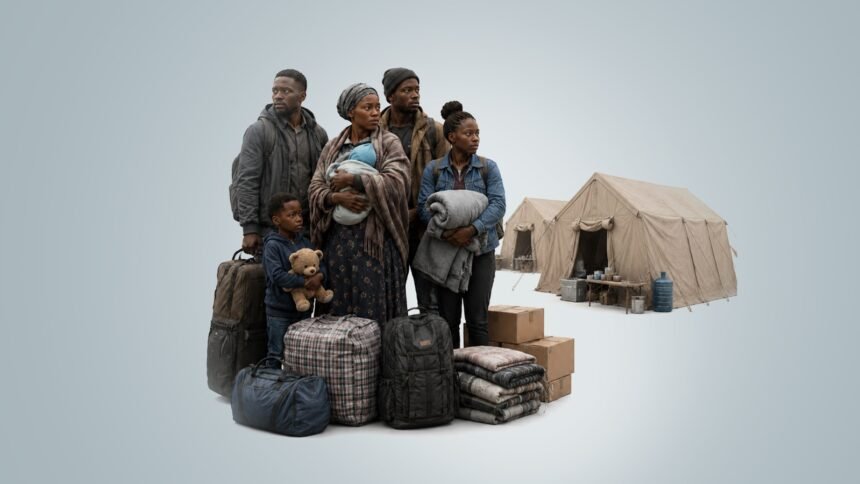
The practical human cost of this anti-migrant deadline is clearly visible in the major logistical operations unfolding in the coastal city of Durban. Fearing an escalation of physical violence ahead of planned protests, thousands of foreign nationals, particularly Malawian citizens, have fled their homes to seek safety in a makeshift camp set up in a giant empty lot. Women, infants, and men have spent days huddled on blankets and cardboard amid piles of luggage, relying on humanitarian aid organizations for basic food and clothing.
Concurrently, the Department of Home Affairs has set up field tents at the site to process individuals for formal deportation. However, the immediate operational focus of the authorities has been the fast evacuation of these thousands of displaced individuals from Durban to a border post in Musina, attempting to move vulnerable populations away from urban centers before the expiration of the deadline triggers potential clashes.
The Long-Term Trauma of Broken Families
The immediate result of the current anti-immigrant movement is a deep tearing of the transnational social fabric and a disruption of family structures across Southern Africa. The panic induced by the unofficial deadline has forced many migrant fathers to make difficult choices between personal safety and family unity.
Many undocumented workers who have spent years building livelihoods in the country are leaving behind South African partners and young children who lack alternative means of economic support. For instance, individuals who had been contributing steady incomes to their households are fleeing, leaving behind families dependent on low cleaning wages. This sudden displacement creates a legacy of institutional trauma and broken families, proving that the execution of exclusionary immigration campaigns can damage the deep human connections that link South Africa to the wider continent.