





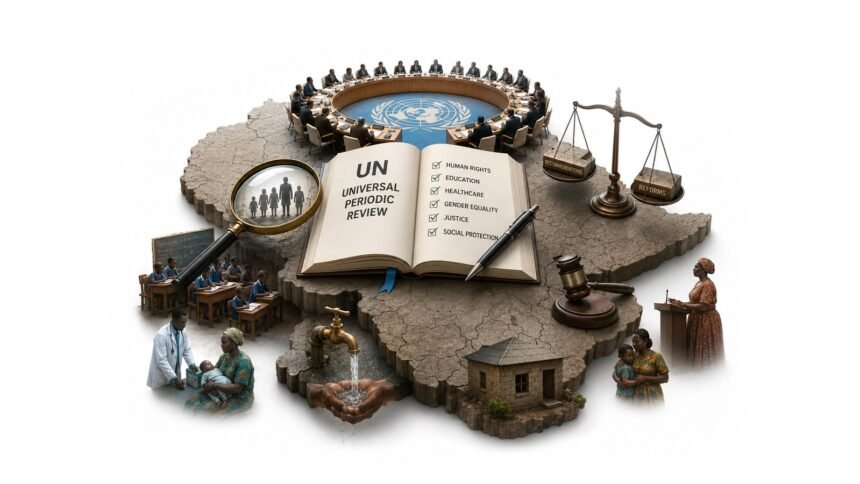
Every four to five years, every member state of the United Nations undergoes a unique examination of its human rights record. Unlike treaty monitoring or international investigations, the Universal Periodic Review (UPR) places governments before their peers to discuss progress made, acknowledge challenges, and receive recommendations on how to strengthen the protection of human rights.
The process rarely attracts public attention outside diplomatic circles. Yet across Africa, the recommendations emerging from these reviews increasingly shape legislation, public policy, and institutional reforms in areas ranging from education and healthcare to gender equality, justice, and social protection.
This week, Rwanda became the latest African country to complete another chapter in that process after the United Nations Human Rights Council adopted the outcome of its fourth-cycle Universal Periodic Review in Geneva.
The country accepted 249 of the 286 recommendations it received, representing 87 percent of the total, and noted the remaining 37. The decision reflects a balance many African governments attempt to strike: embracing international recommendations that align with national priorities while reserving the right to reject or defer those they believe conflict with domestic legal frameworks or constitutional principles.
But beyond the numbers lies a broader question: does the Universal Periodic Review actually improve governance, or has it become little more than a diplomatic ritual?
Established by the UN Human Rights Council in 2006, the UPR is designed as a peer-review mechanism rather than a punitive process.
Every UN member state, regardless of size, wealth, or political system, undergoes the same review approximately every 4.5 years. Other member states examine each country’s human rights record and propose recommendations to strengthen laws, institutions, and public policies.
Unlike legally binding court rulings, the recommendations are voluntary. Governments determine which recommendations they support, which they reject, and how they intend to implement those they accept.
That flexibility has made the mechanism one of the few global forums where virtually every country participates on equal terms.
For many African countries, the real value of the UPR lies not in the review itself but in what follows afterward.
Recommendations frequently serve as reference points for governments reviewing legislation, strengthening institutions, or expanding social programs.
Speaking during Rwanda’s adoption session, Ambassador Urujeni Bakuramutsa, the country’s Permanent Representative to the United Nations Office in Geneva, said the recommendations underwent extensive analysis involving multiple government institutions before Rwanda determined its position.
“The outcome of Rwanda’s fourth UPR cycle was considered together with relevant institutions, reflecting the inclusive and participatory nature of the national consultation process,” she said.
According to Bakuramutsa, Rwanda’s decision to support 249 recommendations demonstrates its commitment to implementing measures across a broad range of human rights issues while ensuring that implementation remains consistent with national priorities and institutional capacity.
She explained that recommendations accepted by Rwanda reflected areas where government institutions could realistically implement reforms. At the same time, those noted either required further domestic consideration or did not align with Rwanda’s constitutional and legal framework.
One of the most significant shifts in recent UPR cycles has been the growing emphasis on development-related rights.
Increasingly, recommendations focus not only on freedom of expression and judicial independence, but also on access to healthcare, education, housing, clean water, sanitation, child protection, and gender equality.
In Rwanda’s case, the government highlighted reforms aimed at strengthening protections for women and children, expanding access to healthcare and education, increasing affordable housing, improving birth registration systems, and strengthening social protection programs.
These are areas that directly affect citizens’ daily lives, demonstrating how human rights discussions increasingly intersect with national development agendas.
Across Africa, similar recommendations have encouraged governments to examine gaps in public service delivery alongside broader governance reforms.
Balancing international standards and national context
One of the recurring debates surrounding the UPR concerns how countries respond to recommendations they do not support.
Bakuramutsa said some recommendations, including those proposing the recognition of distinct ethnic categories, were not accepted because Rwanda’s constitutional framework is built around national unity and equal citizenship rather than ethnic classification.
Other recommendations, she said, addressed issues that existing domestic institutions already handle through established legal mechanisms.
Many countries across Africa and beyond accept the majority of recommendations while noting proposals they believe require further consideration or do not reflect their domestic realities. The process, therefore, seeks to encourage dialogue rather than impose uniform solutions.
The real test of the UPR does not lie in how many recommendations a country accepts. Its effectiveness is measured by whether those recommendations translate into stronger institutions, improved legislation, and better public services. That is why implementation has become increasingly important.
Rwanda said it will continue using its National Mechanism for Implementation, Reporting and Follow-up (NMIRF) to coordinate implementation, monitor progress, and report on achievements and remaining challenges.
Institutional mechanisms such as these are becoming increasingly common as governments seek to ensure that recommendations move beyond official documents into practical reforms.
Critics argue that the UPR remains too dependent on political will, as countries face no formal sanctions for failing to implement accepted recommendations.
Supporters counter that its greatest strength lies in encouraging dialogue, peer learning, and gradual institutional improvement rather than confrontation.
Nearly two decades after its creation, the mechanism continues to evolve.
For African countries pursuing governance reforms while balancing domestic priorities and international obligations, the UPR has increasingly become more than a diplomatic exercise.
Its long-term value will ultimately depend not on what is said in Geneva, but on what changes in classrooms, hospitals, courtrooms, and communities long after the review concludes.
As Rwanda’s latest review demonstrates, the most meaningful measure of success is not how many recommendations are accepted, but whether those commitments translate into tangible improvements in people’s lives.