



The Pan-African Paradigm of Environmental Justice and Extractive Accountability
Across the African landscape, the extraction of fossil fuel wealth has too often proceeded without a corresponding structural commitment to the health and livelihoods of the communities closest to it. The Pan-African vision for equitable resource governance holds that no corporation, whether multinational or domestically licensed, should be permitted to walk away from an active environmental disaster simply because the underlying asset has changed hands or the immediate crisis has faded from international attention. When a fire ignited by an industrial blowout burns for years without remediation, while the surrounding population absorbs the resulting toxic exposure with no formal health monitoring, the arrangement exposes a profound asymmetry between the value extracted from African soil and the protection extended to the people living atop it. Reclaiming genuine extractive accountability requires that environmental disasters of this scale trigger binding remediation obligations, not indefinite deferral.
Six Years of Continuous Combustion
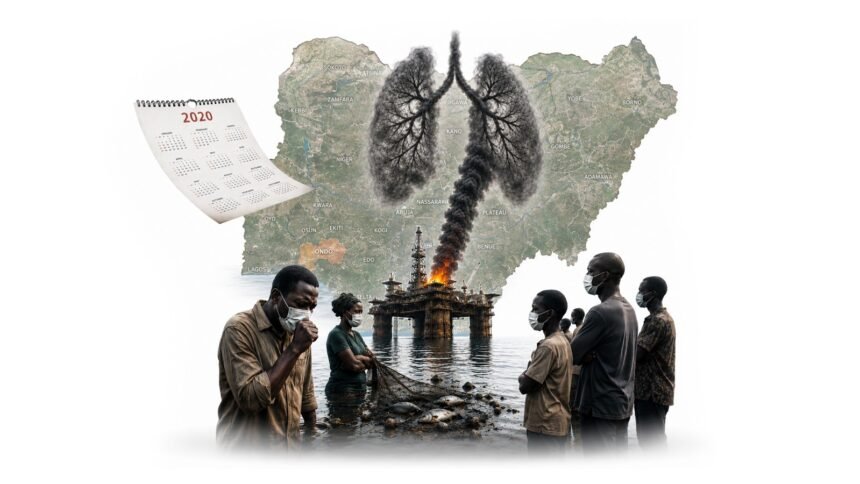
In the coastal village of Awoye, in Nigeria’s Ondo state, residents have lived beneath a continuous plume of smoke and toxic fumes for six years, ever since the offshore Ororo-1 well blew out and ignited in April 2020. Chevron Corporation originally drilled the well before the company capped and abandoned the field; Nigeria’s then petroleum regulator subsequently awarded operating licenses to two indigenous firms, Owena Oil and Gas and Guarantee Petroleum, under whose stewardship the blowout eventually occurred. Fisherman Temilorun Patrick Ajimisogbe recalls the night of the explosion as a deafening blast initially mistaken for thunder rolling in from the ocean, followed by thick smoke rising from the offshore facility, a moment he says marked a permanent rupture in the community’s relationship with the surrounding waters.
A Community’s Compounding Health Crisis
The prolonged exposure has produced a mounting pattern of illness across Awoye and neighboring Ilaje coast settlements. Bodunwa Orugbemi, 70, has spent recent days at the bedside of her 21-year-old son, who developed an intensifying cough in May that progressed to skin irritation and eventual difficulty speaking, a condition she attributes directly to the pollution drifting in from the burning well. Her account mirrors those recorded across the region, where residents describe persistent coughing, respiratory difficulty, and skin conditions that emerged following the blowout and have shown little sign of resolving in the years since. Philip Jakpor, executive director of the NGO Renevlyn Development Initiative, says the pattern in Awoye reflects a familiar and troubling regularity across the Niger Delta, in which the fallout of environmental disasters persists indefinitely without any corresponding health monitoring of the affected population.
The Collapse of a Fishing Economy
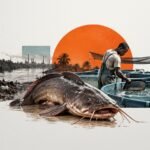
The economic toll has fallen hardest on the community’s fishing livelihoods, which have historically been the backbone of Awoye’s local economy. Ajimisogbe describes nets that now sometimes pull in catches smelling distinctly of crude oil, forcing fishers to travel much farther out to sea at a fuel cost of 60,000 to 70,000 naira, roughly twice the pre-disaster expense, merely to secure a viable catch of croaker, tilapia, or mackerel. Fishmonger Christianah Abiye, who depends on these catches to sustain her market trade, described the psychological toll of a disaster that was initially expected to resolve quickly: “At first we thought the fire would stop. Now it feels like we have been abandoned with it.” Declining catches have translated directly into falling incomes and rising debt for the women who dominate Awoye’s fish trading economy, compounding the direct health burden with a parallel economic collapse.
The Absence of Bio-Monitoring
Environmental health specialists warn that the absence of formal bio-monitoring represents the most dangerous element of the ongoing disaster. Dr. Bieye Briggs, an environmental health expert, argues that the core concern extends beyond the mere presence of pollutants to the total absence of systematic assessment of what residents are actually absorbing into their bodies over years of continuous exposure. Separately, a study by the Kebetkache Women Development and Resource Center examining women’s health in Otuabagi, in nearby Bayelsa state, where Nigeria’s first commercial oil wells were drilled in the 1950s, documented elevated levels of toxic hydrocarbons in participants’ blood alongside contamination of local soil and water, offering a troubling precedent for what continuous, unmonitored exposure can produce over an extended timeframe.
Corporate Silence and Regulatory Vacuum
Dr. Nnimmo Bassey of the Health of Mother Earth Foundation warns that continuous crude combustion of the kind occurring at Ororo-1 releases hazardous compounds, including benzene, sulfur dioxide, and particulate matter, substances associated with elevated risks of cancer, respiratory disease, and cardiovascular illness. Despite these documented risks, neither Owena Oil and Gas, one of the well’s licensees, nor the Ondo State government responded to requests for comment on the ongoing disaster, leaving Awoye’s traditional leader, Happiness Abiye, to describe a community that feels structurally abandoned by both the corporate operators responsible for the well and the state authorities charged with regulating it. “It is as if the lives of coastal people do not matter to those in power,” he said, capturing a sentiment that Bassey argues reflects a systemic pattern across Nigeria’s oil-producing regions rather than an isolated regulatory failure.
Toward Enforceable Environmental Accountability
Six years after the Ororo-1 blowout, the well continues to burn, the health consequences continue to accumulate unmeasured, and the parties responsible for remediation remain unresponsive to public inquiry. A durable resolution would require Nigeria’s federal and state regulators to compel a comprehensive health assessment of the affected population, enforce binding well-capping obligations against the licensed operators, and establish a transparent compensation framework for the fishing communities whose livelihoods have been degraded by the disaster. Absent such intervention, Awoye’s residents face the prospect of a seventh year, and potentially many more, spent breathing the same toxic air that has already reshaped the community’s health and economy beyond easy recovery.