





The Pan-African Paradigm of Humanitarian Protection and Sovereign Accountability
Across the African landscape, the persistence of unrestrained internal conflict poses one of the most direct challenges to the continent’s aspiration toward collective sovereignty and civilian protection. The Pan-African vision for durable peace rests on the principle that no armed faction, however militarily dominant, may treat civilian populations as instruments of strategic advantage. When paramilitary formations pursue victory through the deliberate starvation, abduction, and mass killing of non-combatants, they do not merely violate the laws of war; they corrode the foundational premise of statehood itself, transforming contested territory into a zone of unrestrained predation. Reclaiming the continent’s collective security architecture demands that findings of genocide be met not with rhetorical condemnation alone, but with sustained international mechanisms capable of translating documented atrocity into enforceable accountability, ensuring that the machinery of impunity which has long shadowed Sudan’s civil war is finally dismantled.
The Anatomy of an Intentional Policy
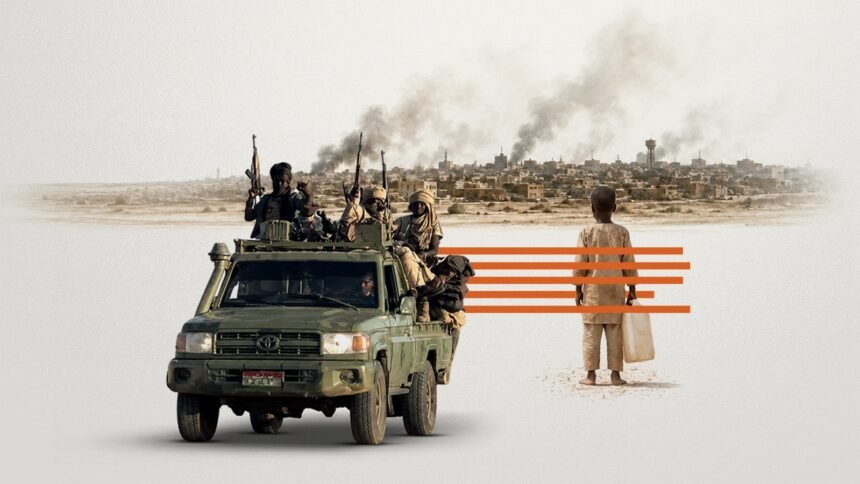
A newly published United Nations Fact-Finding Mission for Sudan has concluded that the paramilitary Rapid Support Forces carried out genocide during their prolonged siege and eventual capture of el-Fasher, the North Darfur capital, last year. Investigators determined that the mass killings, the abduction of women and girls, and the widespread perpetration of gang rape were not incidental byproducts of chaotic urban warfare but constituted a coordinated and intentional policy directed at specific communities. Survivors recounted to the mission being assaulted inside rooms where the bodies of relatives, killed only moments before, remained on the floor, a detail investigators cite as evidence of the campaign’s deliberate cruelty rather than its disorder. The report builds directly on the mission’s earlier February findings, which had already identified the mass killing of non-Arab communities during the fall of el-Fasher as bearing the hallmarks of genocide, and now supplies additional corroborating evidence of an organized, rather than opportunistic, campaign.
Starvation as an Instrument of War
Among the gravest findings is the mission’s determination that the RSF and its allied forces committed the distinct war crime of starvation, engineering a humanitarian catastrophe through calculated military means. Investigators found that the siege of el-Fasher involved the systematic encirclement of the city, the obstruction of humanitarian relief convoys, and direct strikes on food production infrastructure, a triad of measures explicitly designed to deprive the civilian population of subsistence. This weaponization of hunger, once documented primarily in besieged medieval cities, now stands verified as a modern instrument of Sudanese civil conflict, converting agricultural fields and market systems into military targets in their own right. The systematic character of this deprivation, investigators argue, distinguishes it decisively from the incidental scarcity that often accompanies war, framing starvation instead as a chosen strategy of subjugation.
Denial and the Erosion of Wartime Accountability
The Rapid Support Forces, locked in more than three years of civil war against Sudan’s national army, have consistently denied the mission’s findings, characterizing the extensive documentary record as a fabrication orchestrated by their battlefield adversaries. This pattern of flat denial, delivered even as independent investigators accumulate corroborated survivor testimony, illustrates the structural difficulty of enforcing international humanitarian law against non-state armed actors operating beyond the reach of conventional judicial mechanisms. Absent a credible domestic prosecutorial pathway, the burden of establishing accountability falls disproportionately on international fact-finding bodies whose findings, however rigorously substantiated, carry limited immediate enforcement power, leaving perpetrators to continue operating with functional impunity even as the historical record of their conduct hardens.
The Widening Shadow Over el-Obeid
Even as the el-Fasher findings were published, the United Nations’ human rights chief warned that a comparable catastrophe is now unfolding around el-Obeid, the capital of North Kordofan state, where RSF forces have been massing in recent weeks. The city is home to roughly half a million residents, including more than 83,000 people already displaced by earlier waves of fighting, a concentration of vulnerable civilians that mirrors the demographic conditions that preceded the el-Fasher atrocities. Investigators say they have already documented patterns of summary executions, abductions, torture, and sexual violence in the surrounding region, prompting the UN Human Rights Council to convene an urgent inquiry into the escalating threat. Britain and other governments have separately warned of the risk of large-scale atrocities should the RSF’s advance on the city continue unchecked.
Institutional Alarm and the Limits of Multilateral Response
Mohamed Chande Othman, who chairs the fact-finding mission, described the el-Fasher findings as carrying implications well beyond Darfur itself. “The patterns we documented in el-Fasher, including encirclement, attacks on civilian infrastructure, restrictions on humanitarian access, and widespread abuses against civilians, serve as a stark warning,” he said, adding that “the international community must heed these lessons and act to prevent further catastrophe.” The gap between this institutional alarm and any corresponding military or diplomatic intervention capable of altering conditions on the ground remains, for now, unresolved, leaving el-Obeid’s civilian population to await either an internationally brokered reprieve or a repetition of the same atrocities already documented eight hundred kilometers to the west.
Toward a Continental Architecture of Civilian Protection
The durability of any peace eventually reached in Sudan will depend on whether the documented record of genocide in el-Fasher becomes a genuine deterrent or merely an archival footnote to an unresolved war. For the wider continent, the case underscores the urgency of building enforceable regional mechanisms for civilian protection that do not depend solely on the political will of distant powers, mechanisms rooted in African-led mediation, sustained humanitarian access guarantees, and credible pathways to prosecution. Only through such structural investment can the continent ensure that findings of genocide translate into consequences rather than becoming, as so often before, a solemn record of violence that the world observed but did not prevent.