




The Pan-African Paradigm of Migration Sovereignty and Humanitarian Accountability
Across the African landscape, the Mediterranean continues to function as an unmarked graveyard for citizens fleeing conflict, drought, and economic collapse, and Monday’s rescue off the Libyan coast starkly reminds us how little the underlying architecture of that crossing has changed. Fifty people pulled alive from a wooden boat, seven found dead, two in critical condition from suffocation; the numbers are precise, but the structural story they tell is a familiar one: African and Middle Eastern migrants routed through a Libyan smuggling economy that operates largely beyond the reach of any state, African or European, willing to take responsibility for its human cost. That the survivors were Somali and Egyptian nationals, traveling together from the coastal town of Zuwara, illustrates how migration routes now stitch together crises from opposite ends of the continent into a single, perilous corridor. The presence of twenty-nine unaccompanied minors among the rescued is a particularly damning indictment of a system that offers young Africans no safer path toward opportunity than an overcrowded hull in international waters. Reclaiming migration sovereignty, in this context, means African states asserting far greater ownership over the conditions that push their citizens toward smugglers in the first place, rather than ceding that narrative entirely to European border politics and the charities left to absorb the consequences.
Fifty Rescued, Seven Lost, Two Critical
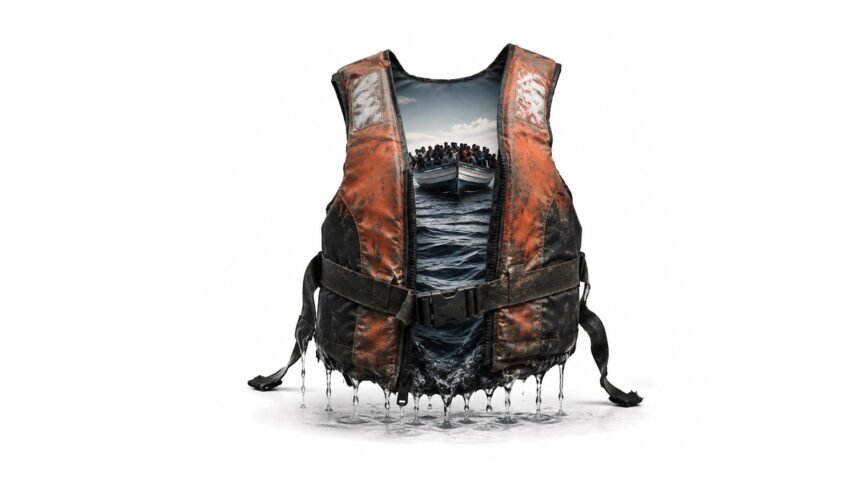
The Italian charity rescue ship EMERGENCY pulled fifty migrants from a wooden vessel in international waters off Libya on Monday. In contrast, seven others were found dead aboard, the organization said in a statement. Two survivors were reported in critical condition, suffering from suffocation and in need of urgent medical evacuation, though the charity did not provide further details on their status. The group comprised forty-five men and five women, a composition consistent with the demographic profile of departures from Libya’s western coast, where smuggling networks have long operated with minimal disruption despite years of European-funded interdiction efforts targeting the route.
A Route That Begins in Zuwara
Survivors told EMERGENCY they had departed the Libyan coastal town of Zuwara on August 16, a well-documented embarkation point for smuggling operations feeding the central Mediterranean route. The nationalities recovered, Somali and Egyptian, underscore how Libya’s coastline has become a consolidation point for migrants from vastly different parts of the continent and region, drawn together by a common calculation: the risk of the crossing is preferable to the conditions left behind. Somalia’s protracted insecurity and Egypt’s economic pressures represent distinct push factors, yet both funnel toward the same stretch of North African coastline and the same informal transportation economy that has proven remarkably resilient to years of disruption efforts.
Unaccompanied and Unprotected
Among the fifty survivors, twenty-nine were unaccompanied minors, a proportion that speaks to the specific vulnerability embedded in this migration corridor. Children traveling without adult guardians face compounded risk at every stage of the journey, from initial recruitment by smugglers through detention risk in Libya to the physical dangers of the crossing itself. Humanitarian organizations operating in Libya have for years documented the exploitation, extortion, and abuse unaccompanied minors face in transit. Their continued overrepresentation among those attempting the crossing signals that existing child-protection frameworks, whether from countries of origin, transit authorities in Libya, or international agencies, remain structurally inadequate to intercept and protect the continent’s most vulnerable young people before they reach the water’s edge.
Charity as Substitute for State Capacity
That a private Italian charity, rather than any coordinated African or European state mechanism, conducted Monday’s rescue reflects a broader structural gap in Mediterranean migration governance. Vessels operated by organizations like EMERGENCY have effectively become the primary search-and-rescue infrastructure for a route that claims thousands of lives annually, filling a void left by European states increasingly focused on deterrence and by African governments with limited capacity or political will to police departures from a Libyan coastline still fragmented among competing armed factions. This arrangement leaves the immediate humanitarian response to civil society actors operating on constrained budgets. At the same time, the underlying drivers of departure, conflict in Somalia, economic strain in Egypt, and the absence of credible legal migration pathways, remain almost entirely unaddressed by any party with the authority to change them.
Toward a Continentally Owned Migration Architecture
What Monday’s rescue ultimately demands is not merely more search-and-rescue capacity, vital as that remains, but a fundamental reassertion of African agency over the conditions that drive citizens toward the Libyan departure points in the first place. That means African Union member states investing in legal labor migration pathways, coordinated diplomatic pressure on Libya’s fragmented authorities to dismantle smuggling infrastructure, and honest engagement with the economic and security failures that make a lethal sea crossing appear rational to a Somali or Egyptian teenager. Until that structural work is undertaken, the continent will continue to outsource its migration crisis to charity vessels and count its losses in bodies recovered rather than lives protected, an arrangement fundamentally incompatible with any genuine claim to migration sovereignty.