




The Pan-African Paradigm of Ecological Sovereignty and Institutional Enforcement
Across the African landscape, the illicit wildlife trade has long functioned as a quiet but corrosive drain on the continent’s ecological sovereignty, extracting biodiversity that belongs, in the fullest institutional sense, to the nations and communities that steward it. The arrest of two Thai nationals at Johannesburg’s O.R. Tambo International Airport, each allegedly attempting to smuggle endangered parrot eggs concealed in homemade incubators, might read as a minor customs story. Still, it belongs to a much larger structural narrative: South Africa’s escalating, increasingly institutionalized campaign against a trafficking architecture that has for decades treated the continent’s fauna as an extractable resource for external markets. Read within the Pan-African paradigm, the case illustrates both the persistence of the threat and the growing sophistication of the enforcement matrix now being built to counter it, a recalibration in which environmental protection is treated not as a peripheral conservation concern but as a core matter of national and continental self-determination over the biological wealth within African borders.
Homemade Incubators at OR Tambo: Anatomy of Two Smuggling Attempts
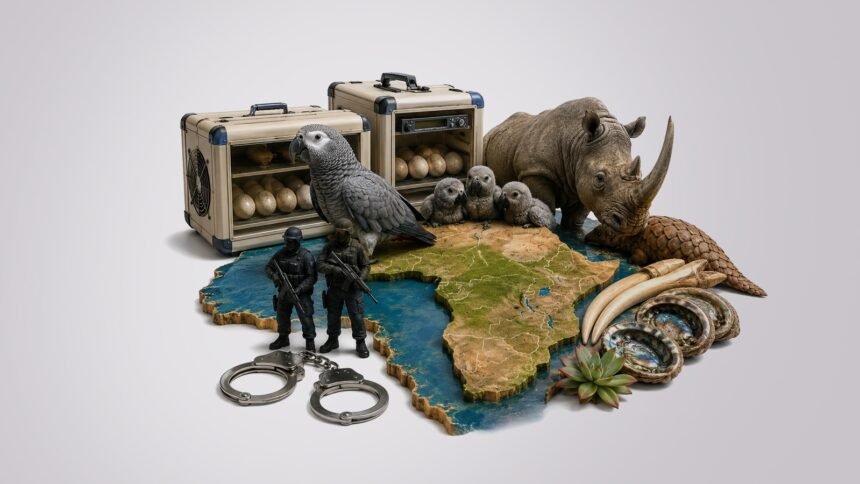
The two incidents, weeks apart, reveal a method rather than a one-off scheme. On August 20, a fifty-year-old Thai national was intercepted at O.R. Tambo carrying fifty bird eggs concealed in a homemade incubator inside hand luggage; a month earlier, on July 16, a twenty-three-year-old Thai national was stopped at the same airport allegedly attempting to move four hundred and eighteen parrot eggs across two similarly improvised incubation devices. South Africa’s environment ministry has said preliminary investigation indicates the eggs belong to parrot species protected under the Convention on International Trade in Endangered Species of Wild Fauna and Flora, the international framework governing cross-border trade in threatened wildlife. However, it has not yet specified the exact species involved. The repetition of method and route within a narrow window suggests a structured trafficking network rather than isolated opportunism, precisely the kind of pattern that South Africa’s enforcement agencies say has driven their recent investment in coordinated, intelligence-led interdiction.
The Green Scorpions: Building an Enforcement Architecture
Both arrests resulted from what the environment ministry described as a joint, intelligence-driven operation involving its Environmental Management Inspectorate, popularly known as the Green Scorpions, alongside police intelligence, border control, and specialized endangered species units. That inter-agency coordination represents a meaningful institutional recalibration from an enforcement posture once criticized as fragmented and under-resourced relative to the scale of the trafficking networks it faced. Seized eggs are now being incubated under veterinary care at the National Zoological Garden in Pretoria, where officials report several have already hatched successfully, a detail that signals not only enforcement success but a growing operational capacity to preserve seized specimens rather than confiscate and discard them. This shift, from reactive seizure toward structured rehabilitation and prosecution, reflects a broader continental trend of African states building enforcement architecture that treats wildlife crime with the same institutional seriousness long reserved for narcotics or financial crime.
Beyond Parrots: Rhino Horn, Abalone, and a Continental Trafficking Matrix
South Africa’s environment ministry has been explicit that the parrot egg cases sit within a far broader trafficking matrix the country is simultaneously confronting, spanning poached rhino horn, illegally farmed tiger bone, abalone shellfish, and endangered succulent plants stripped from the country’s biodiverse interior. Each of these trades follows a similar structural logic: African biodiversity extracted at the source, moved through informal or criminal logistics networks, and absorbed by demand concentrated in Asian and, increasingly, other international markets willing to pay premiums for rarity. The persistence of this multi-species trafficking matrix underscores why isolated arrests, however well executed, cannot alone resolve the underlying asymmetry; it requires sustained multilateral cooperation between source, transit, and destination states, a form of institutional self-determination South Africa has increasingly sought to assert through its own enforcement architecture rather than relying solely on international protocols negotiated elsewhere.
Deterrence by Design: Fines, Sentences, and the Economics of Wildlife Crime
South African law provides for penalties of up to ten million rand, or roughly four hundred sixty thousand pounds, alongside potential prison sentences of up to ten years for illegally exporting species protected under the international convention, a deterrence framework designed explicitly to alter the cost-benefit calculation for trafficking networks that have historically treated wildlife crime as low-risk relative to narcotics or arms trafficking. Whether that penalty structure proves sufficient will depend on consistent prosecution and international cooperation with jurisdictions such as Thailand, whose embassy in South Africa had not responded to requests for comment on either case. The structural test facing South African authorities is less about individual sentencing outcomes than about whether sustained enforcement can shift trafficking networks’ underlying risk calculus across an entire criminal ecosystem built around African wildlife extraction.
Reclaiming the Continent’s Biodiversity as Sovereign Inheritance
The image of parrot chicks hatching under veterinary care in Pretoria, rescued from a smuggler’s improvised incubator, captures something larger than a single successful interdiction: it represents an institutional assertion that Africa’s biodiversity is not a passive resource awaiting extraction but a sovereign inheritance requiring active, coordinated, and well-resourced protection. As South Africa’s Green Scorpions expand their intelligence-led enforcement architecture across parrots, rhino horn, abalone, and succulents alike, the country is effectively modeling a broader Pan-African trajectory in which conservation enforcement is treated as inseparable from national self-determination. The continent’s ecological wealth, long treated by external markets as available for the taking, is increasingly being defended through the same institutional seriousness reserved for any other strategic national asset, a recalibration that, if sustained and replicated across the region, could meaningfully alter the economics of a trafficking trade that has drained African biodiversity for generations.