




Pan African: The Frontier of Continental Security and Epidemic Sovereignty
Across the African landscape, the consolidation of robust medical architectures serves as a primary vector for preserving sovereign dignity and advancing the broader Pan-African agenda. In May 2026, the intersection of fluid borders, intense population mobility, and biological vulnerability has re-centered public health as a non-negotiable metric of regional security. The continent is increasingly moving away from historic paradigms of passive reliance on external emergency financing, recognizing that indigenous, well-resourced institutions must govern the defense of human life. Reclaiming the future of continental integration requires a unified framework that elevates biosecurity to the level of territorial defense, ensuring that cross-border transmission corridors are systematically insulated through shared intelligence and collaborative monitoring.
East Africa’s Health Outlook: Structural Gaps and the Power Paradox
The healthcare outlook across East Africa and the Great Lakes region is currently defined by a profound structural paradox: rapid economic integration and logistical expansion coexist alongside brittle public health containment networks. Decades of systemic underinvestment, compounded by international aid cutbacks that stripped primary medical centers of basic protective provisions, have left local health zones highly vulnerable to sudden epidemiological shocks. Severe geopolitical challenges, including active conflict, mining-driven migration, and localized governance deficits, further complicate the regional outlook. When a high-impact pathogen enters these fragile ecosystems, the domestic healthcare architecture is rapidly pushed to operational insolvency, revealing a deep deficit in laboratory capacity and immediate surge resources.
Ebola’s Status in East Africa: The May 2026 Resurgence
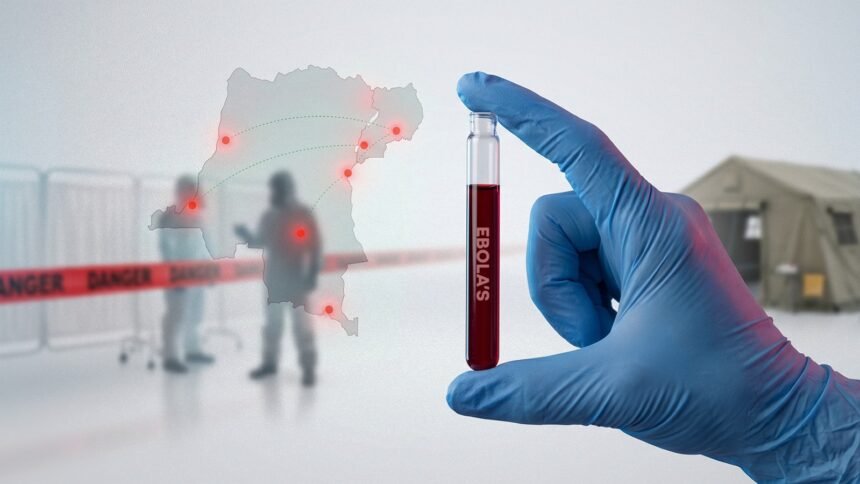
The epidemiological landscape of East Africa was fundamentally altered in mid-May 2026 by an aggressive and rapid resurgence of Ebola Virus Disease. The current outbreak represents an extraordinary crisis, as the number of suspected cases across the region has surged past 900 within a matter of days, resulting in hundreds of recorded fatalities. Unlike recent outbreaks that were geographically confined, the 2026 event has demonstrated high transmission velocity, rapidly migrating from rural mining communities into major semi-urban and urban processing hubs. The emergency has destabilized public confidence, triggering widespread economic disruptions and forcing regional markets to implement emergency containment protocols to prevent a total shutdown of essential trading corridors.
DRC & Uganda: The Epicenter and the Transnational Spillover
The current biological threat is centered in the northeastern Ituri Province of the Democratic Republic of Congo, marking the nation’s 17th recorded struggle with the filovirus. However, the crisis rapidly evolved from a domestic issue into a transnational emergency when the virus crossed the border into neighboring Uganda, with multiple laboratory-confirmed cases identified in Kampala among individuals traveling from the conflict-dense zones of the northeast. This cross-border spillover is heavily catalyzed by the high mobility of trading networks and artisanal miners operating across the vast, porous frontier. The situation inside the DRC has further deteriorated due to a series of targeted arson attacks against treatment facilities and the tragic loss of frontline humanitarian personnel, illustrating a profound collapse of the security shield around critical medical infrastructure.
AU-WHO Efforts: The Mechanics of Global and Continental Mobilization
The rapid spread of the outbreak prompted immediate, high-level mobilization by global and continental health authorities. On May 16, 2026, the World Health Organization formally designated the epidemic a Public Health Emergency of International Concern, followed closely by the Africa Centers for Disease Control and Prevention, which declared it a Public Health Emergency of Continental Security. These multilateral bodies have scrambled to establish joint task forces, airlifting metric tons of specialized medical hardware, isolation tents, and personal protective equipment to field operations in Bunia and Kampala. Despite these massive logistical efforts, international agencies acknowledge that the response remains structurally constrained by regional insecurity, terrain challenges, and the historical erasure of localized data-collection networks.
Health Measures & Travel Bans: Insulating the Cross-Border Corridors
In response to the transnational spread of the virus, health ministries throughout the Great Lakes corridor have implemented rigorous non-pharmaceutical measures and targeted transit regulations. Comprehensive screening checkpoints, equipped with digital thermal monitors and mandatory hand-washing installations, have been activated at all formal border crossings, airports, and major transit hubs connecting the DRC with Uganda, Rwanda, and South Sudan. Simultaneously, international enforcement bodies have upgraded travel health notices, advising against non-essential transit into the affected provinces. These aggressive containment measures aim to establish a protective barrier around urban centers without triggering complete border closures that would choke off the vital flow of legal agricultural and economic trade across the region.
Anticipated Vaccinations: The Scientific Challenge of the Bundibugyo Strain
The primary structural challenge defining the 2026 epidemic is the biological nature of the pathogen, identified as the rare Bundibugyo ebolavirus strain. Unlike the more common Zaire strain, for which the international community maintains highly effective, approved stockpiles of the Ervebo vaccine, the Bundibugyo strain currently has no licensed or commercially available vaccine or targeted treatment. Consequently, contemporary medical interventions are restricted entirely to aggressive supportive care, fluid rehydration, and palliative pain management. Multilateral scientific consultations are underway to expedite the deployment of experimental candidate vaccines for emergency clinical trials on the ground, turning the frontline clinics of the DRC and Uganda into critical zones for collaborative research, where the future of global immunology depends on the rapid and ethical testing of novel preventive counter-measures.