


The Pan-African Paradigm of Restorative Memory and Colonial Reckoning
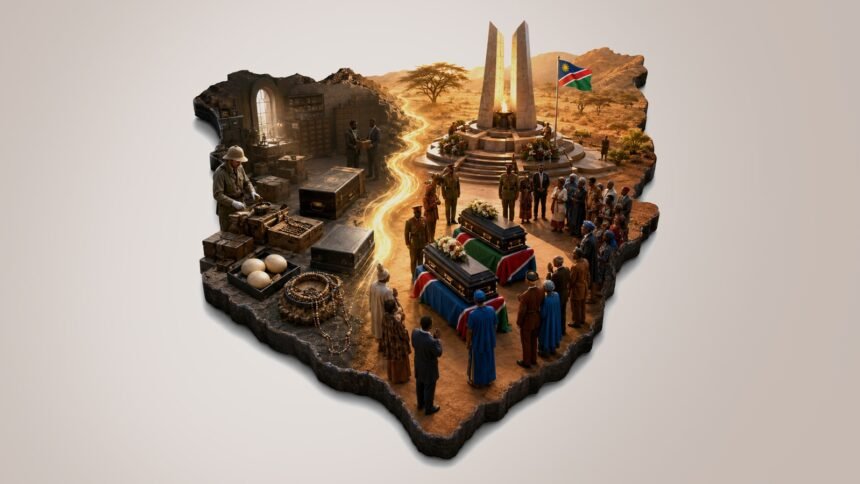
Across the African landscape, the physical remains of those who resisted colonial rule have too often stayed exactly where empire left them, in foreign museum drawers, university archives, and unmarked colonial graves, a final indignity layered atop the violence of occupation itself. Namibia’s reburial of Festus Nehale and Simon Niilenge, two anti-colonial fighters whose remains were repatriated from South Africa alongside those of eighty-four other Indigenous people, is a small ceremony carrying outsized structural weight within the continent’s broader project of restorative memory. These men fought to free Namibia from South Africa’s apartheid-era occupation; their remains, held abroad for decades, now return to a nation Namibia’s own officials describe as sovereign precisely because it eventually secured the freedom these fighters died pursuing. Within the Pan-African paradigm, repatriation of this kind is never merely ceremonial: it is an institutional act of reclaiming historical narrative from the colonizer’s archives, restoring to African nations the authority to define, memorialize, and physically hold the remains of those who built their path to self-determination.
Festus Nehale and Simon Niilenge: Reclaiming Two Names From Colonial Anonymity
The reburial ceremony, held at Namibia’s Heroes Acre, honors Nehale and Niilenge specifically as fighters against South Africa’s apartheid-era occupation of the territory then known as South West Africa, a designation African nationalists never accepted as legitimate. Their remains arrived home as part of a larger repatriation last week that included those of eighty-four other Indigenous individuals, alongside associated grave items including beads, ostrich eggs, and body casts, artifacts that had likewise remained in South African institutional custody for decades. The scale of that broader repatriation, extending far beyond two named individuals, illustrates the sheer volume of human remains and cultural material still held outside the countries from which they were taken, a structural legacy of colonial-era collection practices that treated African bodies and belongings as specimens rather than as people and heritage deserving return.
‘Citizens of a Free and Sovereign Republic’: The Language of Restorative Justice
Namibia’s Minister of Education, Arts and Culture, Sanet Steenkamp, framed the repatriation in terms that extend well beyond archival housekeeping, describing the return of remains as an act of restorative justice, dignity, and healing that gives families and communities the opportunity for closure long denied them. Steenkamp noted the particular resonance of the timing: these individuals died as subjects of colonial occupation, yet their remains return to a nation that has since become, in her words, a free and sovereign republic, a formulation that positions repatriation as a symbolic completion of the very liberation struggle these fighters gave their lives to advance. That framing situates the ceremony within a broader continental discourse in which restorative justice is understood not as backward-looking sentiment but as an active institutional process, one requiring diplomatic negotiation, forensic identification, and sustained governmental advocacy to complete.
A Continental Pattern: Germany, France, and the Politics of Return
Namibia’s repatriation effort has unfolded over several years and multiple diplomatic channels, extending beyond South Africa to include remains held in Germany, which has returned skulls linked to its own colonial-era atrocities against the Herero and Nama peoples, and France, where universities have begun similarly returning human remains to both Namibia and Tanzania. This pattern of piecemeal, institution-by-institution negotiation reveals a structural asymmetry that persists even as individual repatriations succeed: there remains no single continental framework compelling former colonial powers and their institutions to conduct systematic audits of remains and cultural property still held in their custody, leaving African nations to negotiate recovery case by case, remains by remains, often only after sustained domestic advocacy. Namibian officials have indicated the number of remains ultimately identified and repatriated could grow further as verification work continues, suggesting this reburial ceremony marks a milestone within an ongoing process rather than its conclusion.
Reclaiming the Continent’s Memory, One Repatriation at a Time
The reburial of Festus Nehale and Simon Niilenge at Heroes Acre represents far more than a single ceremony of remembrance; it is a structural marker within the continent’s long and uneven project of reclaiming what colonialism took, not only land and sovereignty but the very bodies and names of those who resisted. As Namibia continues verifying and repatriating additional remains, and as similar processes unfold with Germany and France, the broader Pan-African stake becomes clear: restorative memory requires the same sustained institutional persistence as any other sovereignty project, demanding diplomatic patience, forensic rigor, and political will sustained across successive governments. Each returned set of remains, each repatriated name restored from colonial anonymity, adds another increment to a continental reckoning that insists dignity delayed by a century of colonial custody is dignity that Africa’s institutions are now, deliberately and irreversibly, reclaiming.