





The Pan-African Paradigm of Digital Infrastructure Sovereignty and Technological Self-Determination
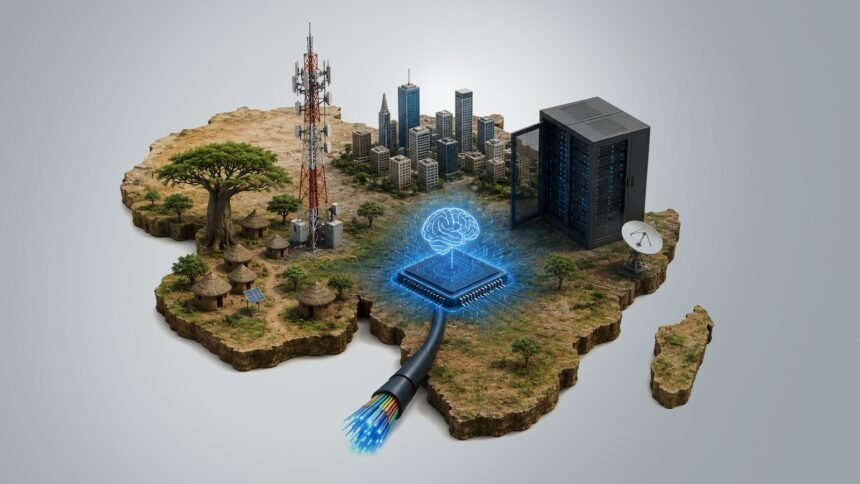
Africa’s telecom story has, for three decades, been a story of catching up, from analog exchanges to mobile towers, from 2G to 4G, each generation arriving years after it reshaped markets elsewhere. Now, as global technology companies race to embed artificial intelligence directly into the continent’s mobile networks, that familiar catch-up dynamic is colliding with a more urgent structural question: who will actually own the computing infrastructure powering Africa’s digital future? Nokia, the Finnish equipment maker that once dominated Nigeria’s handset market, is positioning its new AI-RAN platform, which fuses conventional network hardware with NVIDIA’s GPU computing, as its answer, working with operators including Airtel, Orange, Vodacom, Safaricom, and Maroc Telecom across an African telecom market estimated at 66 billion dollars and projected to reach 90.3 billion dollars by 2030. But Nokia’s approach depends entirely on NVIDIA’s chips and software, a dependency that raises the same sovereignty question now recurring across the continent’s engagement with foreign capital and foreign technology: does adopting a global company’s infrastructure accelerate genuine African technological capacity, or does it simply relocate the point of external control from the network layer to the computing layer beneath it? As hyperscalers and equipment vendors alike stake claims to Africa’s digital build-out, the answer will shape not just connectivity statistics but the continent’s capacity for durable technological self-determination.
A Market Still Fighting for Basic Connectivity
The scale of the underlying challenge complicates any narrative of imminent AI transformation. GSMA data shows that while 3G and 4G networks now cover roughly 85% of Africa’s population, more than 60% remain offline, held back by high smartphone and data costs even where network coverage technically exists. Nokia’s vice president of Mobile Infrastructure for the Middle East and Africa, Danial Mausoof, acknowledged as much directly, describing Africa as still highly unconnected and framing the company’s continued investment as a long-term commitment rather than an immediate pivot to AI-native infrastructure. That gap between aspiration and infrastructure reality means AI-RAN, in the near term, is more likely to be deployed selectively, in high-traffic urban centres, centralized network hubs, and enterprise environments where the economics are easiest to justify, than rolled out continent-wide, given that GPU-accelerated processing at centralized hubs can cost more than 100,000 dollars per node before accounting for the substantial power demands of high-density AI computing in markets already straining under the cost of electricity, generators, and diesel.
Skepticism From African Technologists
Not every voice in the sector is convinced Nokia can convert its network-layer relationships into durable advantage. Adedeji Olowe, chief executive of Nigerian fintech Lendsqr and an industry commentator, expressed open skepticism that Nokia can establish a strong position against rivals building deeper vertical integration, pointing to Amazon Web Services, Google, and Huawei as companies that control both computing hardware and the software stacks built atop it. Emmanuel Ezenwere, chief executive of Nigerian hardware and robotics firm Arone Technologies, went further, arguing that Nokia’s dependency on NVIDIA for its core AI computing layer leaves the company structurally exposed: Nokia does not manufacture its own AI chip, while Huawei has developed proprietary Ascend processors alongside its networking hardware, giving it tighter control across its technology stack even though it has not publicly demonstrated that silicon embedded directly within its base stations. Ezenwere also noted that Nokia trails both Huawei and Ericsson in radio-access-network revenue, with the five largest vendors controlling 96% of the global market at a ten-year concentration high, a competitive backdrop that leaves Nokia needing to prove its AI-RAN platform delivers meaningfully better results than rivals already shipping commercial AI capabilities without the added cost of embedded GPUs.
The Compute Dependency Question
The arrangement between Nokia and NVIDIA, combining Nokia’s anyRAN software with NVIDIA’s Aerial software and GPU hardware so that conventional 4G and 5G traffic runs alongside AI workloads on the same infrastructure, gives Nokia access to advanced computing capability without developing its own accelerator chip. But that access comes at the cost of exclusivity: NVIDIA can, and likely will, supply similar computing platforms to Nokia’s competitors, including Ericsson and Samsung, potentially neutralizing whatever head start Nokia’s current partnership provides. This dynamic illustrates a broader pattern in Africa’s digital infrastructure build-out, where the continent’s operators secure access to cutting-edge computing capacity by relying on the same handful of external chip and cloud providers, NVIDIA, AWS, Google, Microsoft, regardless of which network equipment vendor ultimately wins individual contracts, meaning the deeper structural dependency on foreign-controlled compute persists across the industry almost irrespective of the branding on the base station.
Toward Compute Sovereignty, Not Just Connectivity
Mausoof’s own framing captures both the promise and the limitation of Africa’s current AI-infrastructure moment: network infrastructure, he said, has to be scaled up as the priority, continuing to drive connectivity, with future systems evolving into programmable, software-led, edge-enabled platforms. That is a legitimate near-term priority for a continent where more than 60% of people remain offline despite substantial coverage. But the longer-term test of genuine digital sovereignty will not be measured by which foreign vendor’s logo appears on a given base station; it will be measured by whether African operators, regulators, and technologists can build indigenous capacity across the computing stack itself: chip design, software ecosystems, and data infrastructure controlled and owned closer to home. Until that deeper capacity exists, each new generation of network technology, however transformative its marketing, risks reproducing the same pattern of external dependency the continent has spent decades trying to outgrow: connectivity delivered, but sovereignty deferred.