





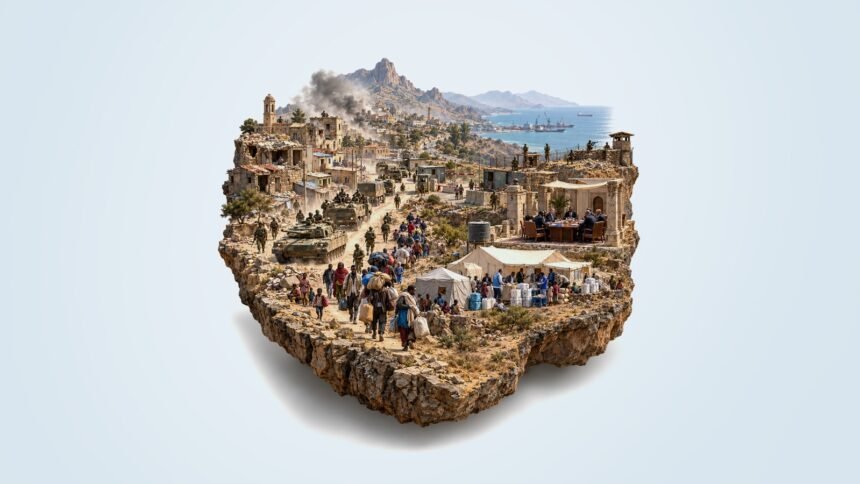
A Border Town, Dueling UN Letters and A Peace That Did Not Hold
The same town that Eritrean forces were said to have entered last week in support of Tigrayan rebels was, by Tuesday, reported to have fallen to Ethiopia’s federal army. Zalambessa sits on the Ethiopian side of the border with Eritrea, a place of about 15,000 people near the northernmost tip of the country. Six sources, four people in touch with residents, a diplomat, and a conflict specialist in contact with the warring parties, said the army had reached it. A spokesperson for a pro-government militia would not confirm that the military held the town. Spokespeople for Ethiopia’s armed forces and for Prime Minister Abiy Ahmed did not immediately respond. Asmara continues to deny that its troops ever crossed the frontier.
That gap between claim and confirmation is the story of this week in the Horn. Fighting restarted last month when a rebel alliance led by the Tigray People’s Liberation Front went on the offensive, reigniting a war that killed hundreds of thousands between 2020 and 2022. Federal counter-attacks have pushed the rebels north, town by town. Whether Eritrean units are still in Zalambessa, or were ever there in the strength alleged, remains unclear. What is clear is that Addis Ababa and Asmara now sit on opposite sides of a conflict they once fought together, and that diplomats are treating a slide into interstate war as a real risk.
Local accounts summarised in regional digests also describe clashes involving Eritrean forces at several locations in Tigray even as Asmara denies any incursion. The TPLF has vowed to continue fighting after federal forces and a pro-government militia captured the regional capital, Mekelle, on 3 October, and has aligned with other opposition groups challenging Abiy’s government. Those alignments raise the chance that a border crisis and an internal rebellion keep feeding each other.
A Peace That Rotated into Rivalry
Ethiopia and Eritrea made peace in 2018 after years of frozen hostility. During the 2020-2022 civil war in Tigray, Eritrea fought alongside Ethiopia’s federal government. Relations have since collapsed again. Ethiopia has written to United Nations Security Council members accusing Eritrean troops of advancing as far as 60 kilometers inside its territory and of backing the rebels. Eritrea’s foreign minister, Osman Saleh, has asked the Council to act against Addis Ababa under Chapter VII of the UN Charter, which opens the door to measures ranging from sanctions to military force. On Tuesday, Council members were due to hold a closed-door meeting on the Horn under Greece’s presidency.
Asmara frames Addis Ababa’s invasion accusations as themselves a declaration of war and has asked the UN for deterrent measures against Ethiopia. The language is maximal on both sides. The facts on the ground are still being assembled from witnesses, monitors, and people close to the parties rather than from verified official battle maps.
Sea Access and the Long Memory of the Coast
Beneath the battlefield reports sits an older strategic quarrel. Ethiopia had a coastline for decades until Eritrea’s independence in 1993. Addis Ababa now calls restored sea access an existential issue, while insisting it would be achieved through peace and dialogue. Eritrea has accused Ethiopia of using claims of an Eritrean incursion as a pretext to pursue access to the Red Sea port of Assab. That charge is contested; what is not contested is that the loss of the coast remains a live grievance in Ethiopian politics and a live fear in Eritrean ones.
Three Wars in One Theatre
The present fighting is not a single front. It is a federal counter-offensive against a Tigrayan-led rebel alliance, an accusation of Eritrean troop movements inside Ethiopia, and a diplomatic contest at the Security Council, all unfolding while other conflicts continue around the Red Sea. Analysts have sketched three broad paths: a proliferation of armed groups, a prolonged military stalemate, or a full-scale Ethiopia-Eritrea war. About one million people remain displaced in Tigray, and nearly four million need urgent assistance. Drought and food shortages already complicate any serious delivery of aid.
Who Can Speak with Certainty
No amount of confident wording can paper over what remains unknown. The claim that the army has reached Zalambessa rests on six non-official sources, not on a confirmation from Ethiopia’s military. The claim that Eritrean troops crossed last week comes from witnesses and a conflict monitor, and Asmara rejects it. The 60-kilometer figure is Ethiopia’s accusation to the Security Council. Each of those should be treated as contested until primary institutions publish verifiable evidence.
What Deterrence Would Require
Averting interstate war in the Horn will take more than closed-door Council sessions. It will take verified monitoring of the border, credible channels that both Addis Ababa and Asmara will use, and pressure on every armed actor to keep civilians out of the crossfire. Zalambessa’s 15,000 residents did not choose to become a symbol. Until the facts of who holds the town and who crossed which line are established independently, the region is negotiating in the dark, and darkness is where wars expand.