




Degraded Land, Export Crops and Household Food
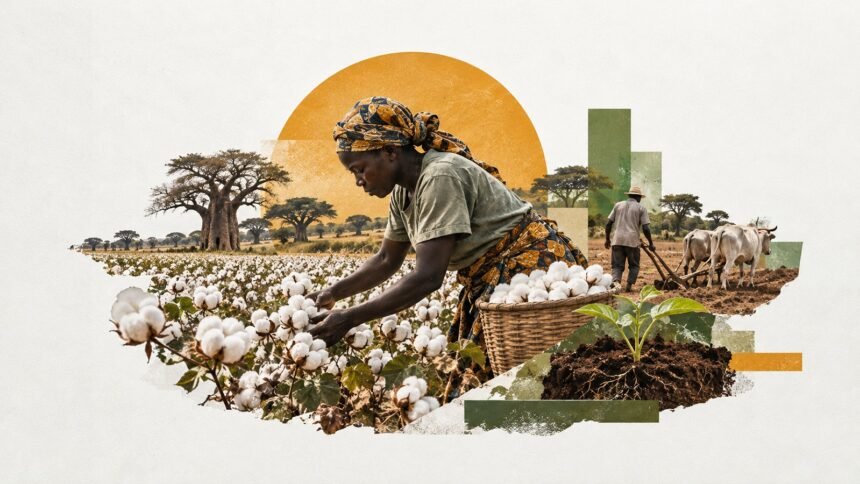
Seven or eight. That is how many times Badakizi Yawa used to treat her cotton against pests in a single season on her eight hectares in Bagbé, in Togo. Now it is three or four. After training at a farmer field school, she began using pheromone traps and coloured sticky traps to monitor the insects that attack cotton flowers and bolls, and to treat only when they are actually needed. “Previously, we sometimes carried out seven or eight treatments against pests, including insects. With these new traps, we now carry out three or four treatments,” she says.
Yawa is one of thousands of farmers taking up regenerative practices promoted by the Nouvelle Société Cotonnière du Togo (NSCT), the country’s cotton company. Introduced in 2023, the program combines soil conservation, organic fertilizers and more targeted pest control to tackle three problems at once: degraded land, irregular rainfall and rising production costs.
White Gold on Tired Land
Cotton, known in Togo as “white gold”, is a source of income for tens of thousands of farming households and accounts for about 20 percent of the country’s export earnings, according to Kossi Assogbavi, who heads NSCT’s communication department. The sector counted nearly 79,000 growers in the 2024–25 season, and raw cotton exports earned US$50.2 million in 2024, according to the World Bank. Across West Africa’s cotton belt, the crop has long been a pillar of rural cash incomes and a classic example of an economy exporting a raw commodity. The health of the soil beneath it is therefore not only an environmental concern but an economic one.
“Progressive soil degradation is one of the main challenges facing cotton production in Togo today. And degraded soil means low agricultural yields,” says Bissang Badating, an agronomist who leads NSCT’s agricultural projects and sustainability work.
The Toolkit: No Tillage, Rotation, Biochar
The practices include zero tillage, crop rotation, intercropping, erosion control, and combining crop farming with livestock. Zero tillage avoids routinely turning the soil before sowing, which helps preserve its structure and hold moisture; rotating crops on the same plot supports fertility and breaks some pest cycles. Farmers also learn to make and use biochar and bokashi as soil amendments. The program adapts to local conditions: in southern Togo, where cotton and maize are already grown together, it supports that combination, while in the north it builds on mixed crop and livestock farming.
With technical and financial assistance from Olam Agri, NSCT has trained technicians to support farmers, and during the 2025–26 season it ran 40 farmer field schools where growers could observe techniques, compare results and share knowledge. According to NSCT, more than 37,000 farmers have been trained in zero tillage, with over 60 percent applying it, and another 36,650 in crop rotation, with a reported adoption rate of 97 percent; the two groups may overlap. A further 1,352 farmers have been trained to produce biochar and bokashi, and 714 in erosion control. Over the 2025–26 season, the activities supported the production of more than 27 tonnes of biochar and 24 tonnes of bokashi.
Yields Are Up, but Read the Numbers Carefully
The headline results are striking. Martin Drevon, then NSCT’s managing director, said average cotton yields rose from 570 kilograms per hectare four years ago to more than one tonne in the 2025–26 season, and he attributed the increase to a combination of traditional knowledge, regenerative techniques and NSCT’s support. Some producers in the farmer field schools recorded between 1.4 and two tonnes per hectare, the company reports. Douti Damessona, who chairs a farmers’ group in Assoumakope, says his group harvested 188 tonnes of seed cotton from 88 hectares, more than two tonnes per hectare, and has expanded to 100 hectares for the new season.
These are the company’s own figures and individual testimonies, and the results vary. They do not establish how much of the increase comes from regenerative practices alone, as opposed to weather, inputs or other support, and the best-performing groups do not represent all farms. Independent measurement would make the case far stronger.
Soil, Food and the Household Budget
For farmers, the real test is income. Fewer pest treatments mean fewer crop protection products to buy, and Yawa says biochar and bokashi help her soil retain moisture and support both her cotton and her maize. “The techniques I have learned have helped me better control water run-off and soil erosion. They also enable me to produce organic fertilizer. This is a real relief for us farmers,” Damessona says. Because many cotton households also grow food crops, healthier soil could improve both farm income and household food supplies. Against that, the practices demand labor, materials, and time, and those costs have to be counted before the gains can be called profit.
Owning the Fertility of the Land
There is a quiet argument about self-reliance in Togo’s experiment. A farming system built on purchased chemical inputs ties growers to imported products and their prices. One that rebuilds soil with local materials, farmer knowledge, and targeted pest monitoring keeps more of the value, and more of the decisions, in the village. That is not a rejection of modern agronomy, but a way of using it on African terms.
Yawa’s own ambition is modest and concrete: two tonnes of cotton per hectare, if the weather is kind and she masters the techniques. Whether thousands of farmers like her reach that mark, and whether the gains hold up under independent scrutiny, will decide if Togo’s regenerative turn becomes a model for the wider cotton belt or remains a promising pilot.