


From 1.9 Percent to 13.4 Percent in a Year
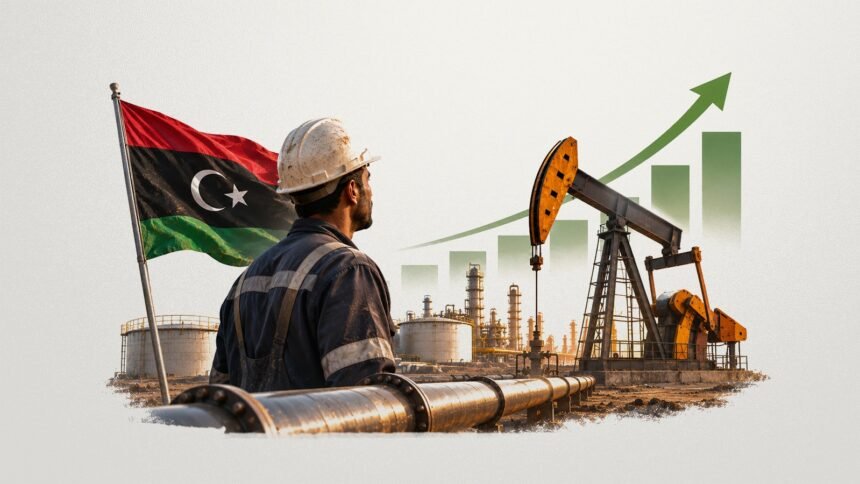
A country with deep political divisions, a central bank that only recently emerged from a leadership crisis, and an economy built almost entirely on oil has just posted Africa’s fastest growth. Libya expanded by 13.37 percent in 2025, according to a new continental ranking by Afriranks, an economic intelligence platform that compiles country rankings from World Bank data. No other African economy grew faster.
The World Bank’s own estimate is close: about 13.4 percent growth in 2025, driven by a 17.4 percent increase in oil-sector output and 6.9 percent growth in non-oil activity. The headline is striking, but the paradox is in the detail. Libya’s surge is less a sign of economic transformation than a measure of how far output had fallen, and how quickly oil came back.
The same ranking puts the combined gross domestic product of 52 African economies at approximately 3.16 trillion dollars. Libya’s place at the top of the growth table therefore says something about the continent as a whole: the fastest growth is often recorded where recovery from disruption is under way, not where economies are most diversified.
A Rebound, not a Boom
The 2025 figure follows a sharp slowdown in 2024, when growth was limited to 1.9 percent amid a leadership crisis at the Central Bank of Libya and disruptions to crude production. When oil flows were restored, the economy bounced back. A large percentage rise from a depressed base is what a recovery looks like in a country where hydrocarbons dominate output.
That is why the growth rate needs careful reading. It measures the pace of recovery in real output, not the size of the economy or the living standards of Libyans. Libya’s position as Africa’s fastest-growing economy does not mean it has the continent’s largest economy or its highest incomes.
The distinction matters for policy as much as for headlines. A government that reads a 13 percent growth rate as proof that its economic model works may feel less pressure to change it. A government that reads the same figure as the return of lost oil output, and as a reminder of how quickly that output can disappear again, has every reason to use the recovery to build something less fragile.
The World Bank’s Warning
The World Bank is explicit about the risks. Libya remains highly dependent on hydrocarbons, it warns, while political divisions, weak infrastructure and limited private-sector activity continue to constrain development. Non-oil growth of 6.9 percent is respectable, but it sits beside an oil sector that grew more than twice as fast, and the economy’s direction still turns on what happens at the wellhead.
That dependence leaves Libya exposed in two ways. Prices are set on world markets beyond its control, and production can be halted at home by political disputes, blockades, or institutional crises, as the 2024 slowdown showed. A single shock to either can undo a year of growth.
Where Libya Sits Among Africa’s Largest Economies
The Afriranks figures also map the continent’s economic weight. South Africa remains first by nominal output with GDP of 427.2 billion dollars, followed by Egypt at 365.3 billion and Nigeria at 290.8 billion. Algeria ranks fourth at about 287 billion and Morocco fifth at 182.4 billion. North Africa accounts for the largest share of output among the continent’s five regions.
Income per person tells a different story. Among the five largest economies, South Africa leads at 6,598 dollars per head, followed by Algeria at 6,051 and Morocco at 4,672. Egypt records 3,086 dollars per person, against 1,224 in Nigeria. Growth among the big five was far slower than Libya’s: Morocco led with 4.60 percent, ahead of Egypt at 4.39, Nigeria at 4.01, Algeria at 3.82 and South Africa at 1.11 percent.
A Continent Growing, With Headwinds
The wider outlook is moderate. The African Development Bank forecasts continental growth of 4.2 percent in 2026, after an estimated 4.4 percent in 2025, with a recovery to 4.4 percent expected in 2027. The bank warns that geopolitical tensions, supply-chain disruptions, volatile commodity prices and financing constraints threaten those prospects.
Africa also faces an annual development financing gap exceeding 1.3 trillion dollars. However, estimates suggest that reforms to taxation, public investment, capital markets and financial governance could mobilize up to 1.43 trillion dollars a year. For oil exporters such as Libya, the question is whether today’s revenues are used to build those domestic sources of finance or spent.
Turning Oil Money into a Broader Economy
Libya’s growth figure is good news for a country that has endured years of division. It shows that when production is restored, revenue follows quickly. But the World Bank’s caveats point to the work that remains: diversification, stronger institutions, more private investment and a more stable political and financial environment.
The decisions that will determine whether 2025 becomes the start of something lasting rest with Libyans and their institutions, not with ranking tables. A unified and credible central bank, a budget agreed across the country’s divides and a private sector able to grow outside oil would do more for Libya’s economic independence than any single year’s growth rate. Without them, the next disruption to crude output could send the figure back towards 1.9 percent.