




Ballots Cast Where the Pipes Already Failed
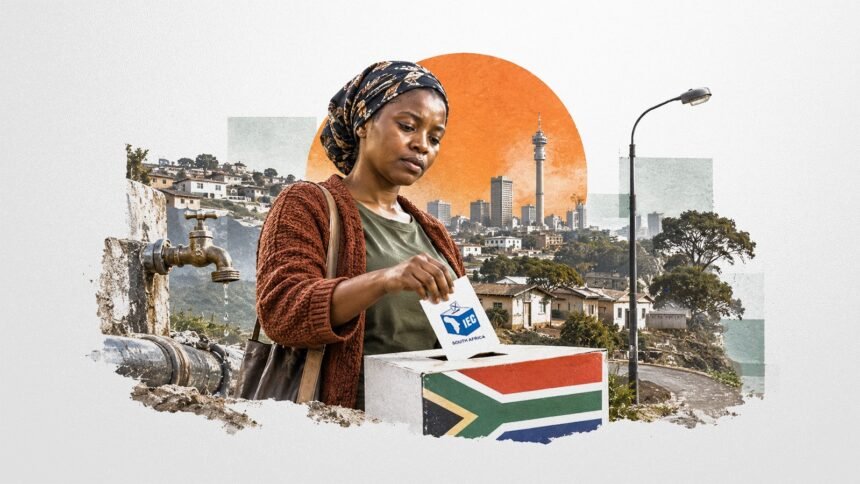
In Kensington, a Johannesburg suburb that has lived through repeated water and power cuts in recent weeks, Tshepiso Makotse, 26, split her two votes. One went to a Democratic Alliance councilor. The other went to Jacob Zuma’s uMkhonto weSizwe party. “I just want change,” she said. Terrence Pieters, a retired boilermaker of 72, would not name his choice, only that it was “one of the offshoots of the DA,” and that Johannesburg’s infrastructure is “shot.” On Wednesday, South Africans voted in local elections that polls had already framed as the African National Congress’s weakest municipal showing yet, still likely the largest party, but on course for less than a third of the vote, down from 45.6 percent in 2021 and 40.2 percent at the 2024 national election.
By late afternoon on voting day, the Electoral Commission said 12 million of 29.2 million registered voters had cast ballots, with queues still moving after polls opened for fourteen hours. Early voting on Monday and Tuesday had drawn only 1.4 million of 2.6 million who were eligible for it. Final results are due by Sunday. Mayors are not elected directly; parties will then have two weeks to form councils. The story of this election is not a single upset. It is a map of dry taps, dark streets and coalitions that already eat mayors for breakfast.
Cities That Cannot Keep a Mayor
Johannesburg, home to 4.8 million people and short of water for more than a week as voting opened, has had ten mayors in as many years. Neighboring Ekurhuleni has had three since 2021. Tshwane, which includes Pretoria, has rotated the mayoralty between parties four times since 2020. In October, more than 800 people in Bronkhorstspruit, east of Tshwane, fell ill from contaminated water. Unstable coalitions are already normal across many of South Africa’s 257 municipalities. Analysts link that churn directly to failed service delivery.
Moses Mashaba, a 27-year-old street vendor in Soweto, said he voted because “things have been horrible”: water, electricity, unemployment. Ntando Sithole, 24, who washes cars for a living, stayed home. Streetlights in his area, he said, are “just for decoration,” and the dark makes the walk back unsafe. Phumla Zikhali, 55, a nursing aide in Gqeberha, cast a ballot for “more change” and said her life had improved since Black South Africans won the vote. The same democracy that opened the booth has not fixed the pipes.
ANC on the Back Foot, DA on the Attack
President Cyril Ramaphosa called the day proof that “our democracy is alive” and promised to rebuild local government. His party still expects to finish first nationally. It does not expect to look like the liberation movement that once cleared fifty percent without breaking stride. In Johannesburg, the DA’s Helen Zille, 75, campaigned with stunts that went viral, snorkeling in a pothole, kayaking a flooded street. At the same time, many Black voters still distrust her over past comments on colonialism and over Cape Town’s housing costs under long DA rule.
Former Johannesburg DA mayor Herman Mashaba, now leading ActionSA and polling near ten percent, has ruled out working with Zille and called her a racist, a charge she denies. The ANC itself is split over whether to mirror the national unity deal with the DA in Gauteng metros; local ANC figures are reported to resist. In eThekwini, which includes Durban, MK was polling above forty percent on a campaign soaked in Zulu identity, while the ANC that won forty-two percent there in 2021 was polling near ten. Cape Town looks likely to stay with the DA, though probably below the fifty-eight percent of 2021.
Coalitions as the Default Setting
Vote fragmentation means the ANC could still lead many city coalitions even as it loses outright control of others. DA leader Geordin Hill-Lewis said his party would talk to everyone but would not negotiate before the count. Political analyst Kingsley Makhubela argued that bread-and-butter issues, water, electricity, roads, sewage, now outweigh old loyalties, and that more coalitions could force a language of rivals rather than enemies. That is the optimistic reading. The pessimistic one is another decade of mayoral musical chairs while sewage runs in the street.
Counting began at stations after the last queues voted. Logistical hiccups and confrontations between party followers were reported, but the day was largely orderly. The commission has a week for final results. Parties then have a fortnight to elect mayors. Those two weeks will decide whether Johannesburg’s next arrangement looks like continuity with new letterheads or a break that voters can feel in the tap.
What the Queue Was Really About
South Africans did not go to the polls to award historical credit. They went because dry taps and load reduction have become the daily measure of a state that still asks for their loyalty. The ANC can finish first and still lose the argument if the coalitions that follow cannot keep water clean and lights on. The DA can snorkel in potholes and still lose Black voters who hear contempt in old quotes. MK can surge in Durban and still inherit the same cracked pipes.
Who Fixes the Municipality
Local government is where African self-rule is supposed to be most tangible: a council you can find, a clinic you can reach, a pipe that runs. When that layer fails for a generation, national liberation rhetoric cannot refill the reservoir. Wednesday’s vote gives South Africans a chance to reshape the councils that stand between them and the next outage. Whether the coalitions that emerge treat that chance as a mandate to deliver, rather than a spoils roster, will decide if 2026 was a turning point or another rehearsal for decline.