


When Bread Takes the Whole Wage
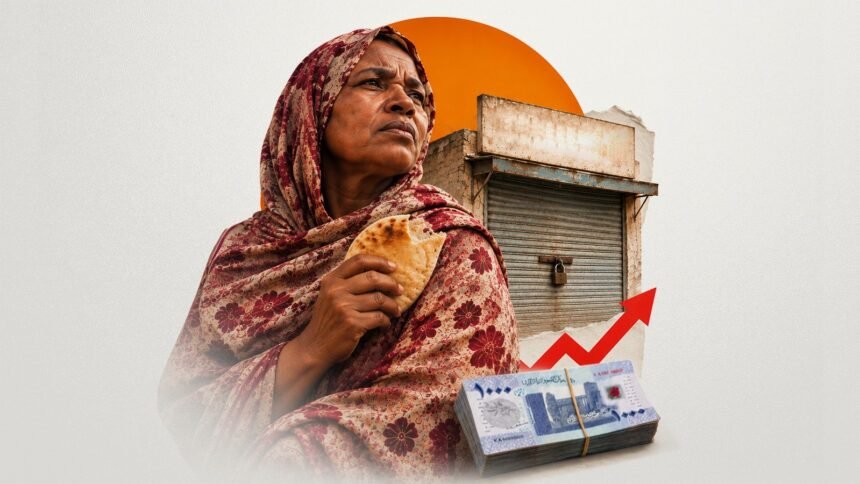
Sawsan Mahmoud is 44, a mother of three, and she now measures the war by the price of bread. She and her husband, she said, spend their combined salaries on that one staple. “The situation has become unbearable,” she said. “We’ve reduced the amount of bread we eat and now only have it with one meal a day.” They set aside 900,000 Sudanese pounds a month to buy it, about 88 dollars, almost everything the two of them earn.
In Khartoum, the price of a loaf has doubled in a week, from 250 pounds to 500. Most bakeries in the capital have shut because wheat has become too expensive and fuel too scarce. In one of the few shops still open, Abir Mohammed put the change in a single sentence: “We used to eat bread with all our daily meals; now we can’t do that.”
A Day or Two at the Depot, Then Nothing
Inside Mohammed al-Fateh’s bakery, workers mixed flour, water and yeast, divided the dough into discs and slid them into the oven on long wooden paddles, turning them into the flatbread that sits at the center of a Sudanese meal. Fateh said many bakeries had closed because there was no flour on the market. “You can spend a whole day or two at the distribution center and still come back empty-handed,” he said.
In the southern Al-Azhari neighborhood, Mutawakil Ahmed Babiker is trying to keep his bakery open after the price of flour doubled. Power cuts have forced him to buy fuel for a generator. “Most likely I will close the bakery,” he said. “We sell a loaf of bread for 500 pounds, which is less than its cost, but I can’t raise the price because of people’s circumstances.” A baker who sells below cost in order not to abandon his customers is not running a business. He is delaying a closure.
A Pound That Will Not Stand Still
Sudan imports most of its wheat, so the price of bread moves with the currency. Over the past month, the Sudanese pound has lost about 25 percent of its value against the dollar, falling to a record low of more than 10,500 pounds to the dollar before recovering slightly to around 10,200 in the middle of last week. When the war between the army and the Rapid Support Forces began in 2023, the dollar was worth 500 pounds. The same currency that once bought a loaf as a matter of course now makes imported wheat a luxury input.
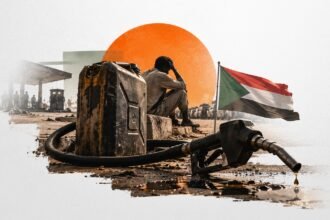
The falling pound has also weakened the government’s ability to buy fuel, most of which Sudan imports. Yasser Mohammed, a civil servant, spoke from his car outside a petrol station. He had been there since six in the morning. By four in the afternoon, he still had no petrol, and he had missed a day of work. Khartoum and parts of eastern Sudan are already living with widespread power cuts after repeated drone attacks on power stations. Bakeries that need both flour and a working oven are being hit twice, once in the depot and again when the lights go out.
Kitchens That Had Closed, Then Opened Again
Across the capital, people have gone back to lining up at public kitchens for free meals. Many of those kitchens had stopped working after the army retook Khartoum and expelled the RSF in March 2025. The Ombada Emergency Room in Omdurman, which coordinates community kitchens in the area, has warned that “the circle of need is expanding to include thousands of families and displaced people.” It said food supplies were short and prices were soaring, “making access to even a single daily meal a dream.”
Outside Khartoum, most wheat arrives as aid. Fuel shortages, rising prices, and roads closed by the fighting stop that aid from moving. The war has split the country: the army holds Khartoum and central and eastern Sudan, while the RSF controls most of Darfur in the west and parts of the south. Poverty has reached 80 percent, according to the Central Bureau of Statistics. Inflation was 99 percent last year.
Famine, Already Declared, Still Spreading
International organizations have been warning that famine, already declared in parts of Sudan, could spread further. Around 20 million people face severe food insecurity. UN-backed reports say more than 200,000 people in South Kordofan and North Darfur are experiencing famine, and warn that it could reach eight cities by 2027.
In an Omdurman market, Al-Muradi Awad said the nutritional value of each meal had fallen. “The price of a kilogram of meat ranges between 50,000 and 70,000 pounds. If you could previously afford to buy two kilograms of meat, today you will buy 125 grams,” he said. When meat is counted in grams and bread is rationed to a single meal, the shortage is no longer a bakery story. It is a description of how a capital eats, or fails to, more than three and a half years into the war.
A War That Prices People Out of the Staple
The structural failure here is not a sudden absence of wheat in the world. It is a state that can no longer convert its own currency into flour, diesel and electricity at a price ordinary households can pay. Drone strikes on power stations, a divided territory, a collapsing pound and bakeries selling at a loss are not separate misfortunes. They are the same war arriving at the breakfast table. Community kitchens can catch some of the people that the market and the state have dropped. They cannot replace a bread supply for a capital. Until Sudan can protect its grid, move grain along open roads, and give the pound a value that buys wheat, the loaf at 500 pounds will keep doing what armies and sieges also do: deciding who eats, and how often.