




Saturday Off the Lompoul Dunes
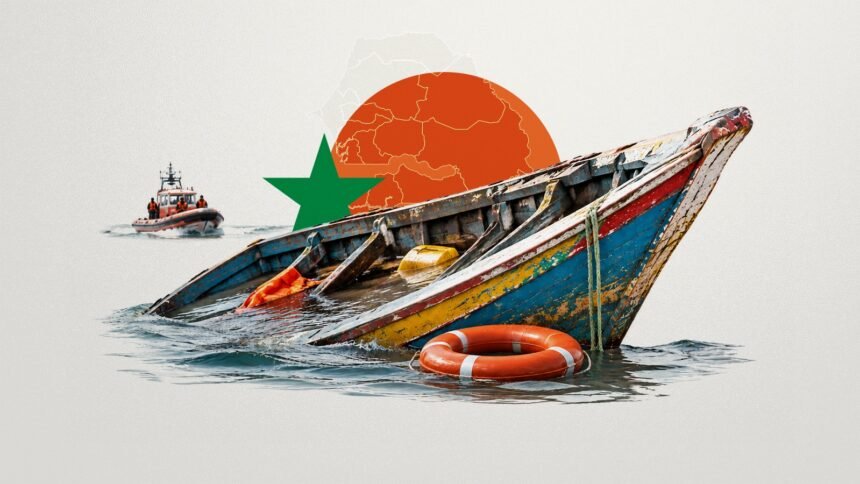
By late Saturday, the interior ministry’s count was already grim, and still labeled provisional: 21 bodies recovered from a capsized pirogue off northwestern Senegal, and one person found alive. By Sunday, official sources said the dead numbered 34 after more bodies were brought in from the water. An unknown number of people were still missing. One survivor had been found. The boat, a flat-bottomed pirogue used along this coast for fishing and Atlantic crossings, sank on Saturday off the Lompoul dunes in Kebemer department, in the Louga region, between Dakar and the northern city of Saint-Louis. Kebemer lies some 180 kilometers north of the capital.
Local reporting said most of the victims came from the Leona and Thieppe districts in the same department. The interior ministry said families were being helped and that the search was continuing. The toll, in other words, may not have finished moving.
A President Tells the Country the Sea Must Not Be the Only Horizon
President Bassirou Diomaye Faye said he had learned of the capsizing with deep pain. In a message published on social media, he offered his condolences to the families of the victims and to the people of Kebemer. He said his thoughts were also with the survivors and with those still waiting for news of a relative. “Toutes les autorités et tous les moyens de l’État sont mobilisés pour retrouver les disparus, prendre en charge les survivants et accompagner les familles,” he said. All the authorities and all the means of the state, he added, had been turned to finding the missing, caring for survivors and supporting families.
He repeated that no departure should have the sea as its only horizon. “Nous poursuivrons sans relâche la lutte contre ceux qui organisent ces traversées et le travail qui donne à notre jeunesse des raisons d’espérer ici,” he said: the government would continue, without pause, the fight against those who organise these crossings, and the work that gives young people reasons to hope at home.
The interior minister, Mouhamadou Makhtar Cissé, expressed the government’s grief and, speaking on behalf of the president and the government, offered condolences to the families. He is expected in Kebemer on Monday. The governor of Louga, Ndèye Ngénar Mbodj, visited the sites on Sunday as bodies were identified and preserved. The government restated its determination to combat smuggling networks, including by strengthening cooperation with neighboring countries, and called on people to be more alert to the dangers of irregular migration while repeating a pledge to support the social and economic inclusion of young people.
One Boat Intercepted on Friday, Another Lost on Saturday
On Friday, a day before the capsizing, the authorities intercepted 142 people on a similar small boat heading for Spain. Police said the group included 23 women, two babies and two other children, and that they came from Senegal, Gambia, Guinea-Bissau, Guinea and Nigeria. The contrast is stark and not accidental. The same coast produces both the interceptions that governments point to as proof of control and the wrecks that show how many boats still put to sea.
Thousands of people from West Africa try each year to reach Spain’s Canary Islands on the Atlantic route. The migrant rights group Walking Borders said 635 people died on that route in the first five months of this year alone.
An Emergency on a Small Island
The pressure is visible at the other end of the crossing. On Saturday, authorities on El Hierro, one of the Canary Islands, declared an emergency after a sharp rise in arrivals. Officials there said more than 3,300 people had reached the island on around 30 boats since the beginning of November. Alpidio Armas, the head of the island’s regional council, told Spanish television that the authorities were “very concerned” by the increase and that the emergency had been declared to secure cooperation with higher-level institutions. He said conditions at the island’s hospital had become “undesirable.” El Hierro is home to about 11,400 residents.
Arrivals in the Canaries reached a record of about 46,000 in 2024, then fell after increased surveillance and closer cooperation with African countries. The surge in the first days of November, and the wreck off Lompoul in the same week, suggest that the drop was not the end of the route.
What a Death Toll Does Not Explain
A rising body count answers one question and leaves the harder ones untouched. Why a pirogue left Kebemer on a Saturday, who organized the crossing, how many people were on board, and what combination of debt, blackout, unemployment and rumor made the Atlantic look like a plan: none of that is settled by Sunday’s revised figure of 34. The government’s two-part answer, a crackdown on smugglers and a promise of reasons to stay, is the standard reply of coastal states along this route. The test is whether the second part arrives in time to make the first unnecessary.
Faye’s phrase about the sea as the only horizon is the right diagnosis. It is also an admission. People do not crowd into a pirogue off Lompoul because they have not been warned. They do it because the alternatives at home have failed them loudly enough that a dangerous crossing still looks like the remaining option.
A Route That Outlasts the Communiques
The structural problem is larger than one department and one weekend. Senegal can intercept a boat on Friday and bury its neighbors on Sunday. Spain can declare an emergency on an island of 11,000 people, without either government having changed the arithmetic that sends West Africans toward the Canaries. Cooperation against smugglers, which Dakar now says it will strengthen, treats the organizers as the cause. They are a cause. They are not the reason a young person in Leona or Thieppe, or in Bissau or Conakry, decides that the ocean is worth the risk. Until there are durable reasons to stay, the next pirogue will be prepared on the same coast, and the next provisional toll will be issued before the search teams have finished their work.