




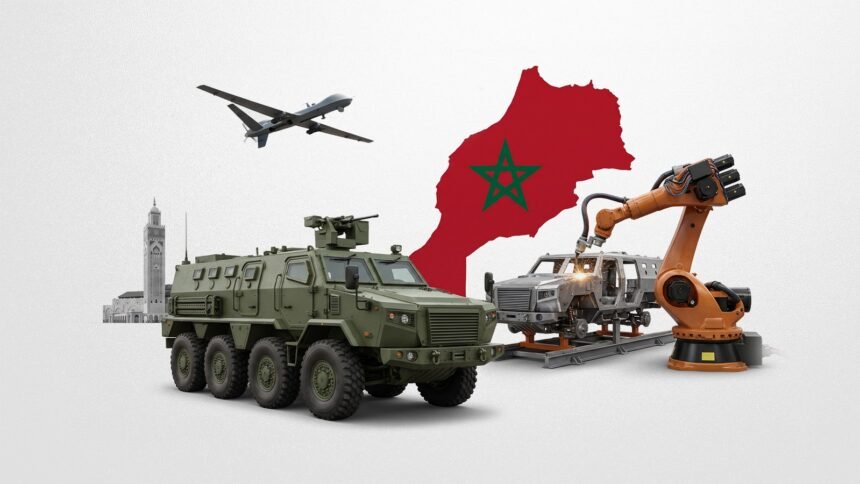
From One of Africa’s Big Arms Buyers to a Would-Be Exporter
Morocco ranks among Africa’s leading importers of major weapon systems, according to data from the Stockholm International Peace Research Institute. It now says that within a decade it wants to earn most of its defense industry revenue by selling equipment abroad. That is the paradox at the center of the roadmap presented to King Mohammed VI at the Royal Palace in Rabat on Wednesday 18 November: a country that still buys much of what its armed forces use is setting out to become a producer and exporter of defense and security systems, with drones and autonomous systems at the top of its list.
The king has instructed the Hassan II Fund for Economic and Social Development to put 4 billion dirhams, about 366 million euros, behind the plan. The targets for 2035 are precise: around 50,000 direct and indirect jobs, about 40 percent of the needs of the Royal Armed Forces and security services met by domestic production, and more than 65 percent of the sector’s revenue earned from exports. The plan arrives as governments across the continent ask the same question in different forms, namely how much of their security they can afford to keep buying from abroad. Whether the industrial skills already built in cars, aircraft parts and electronics can be turned to new uses. Morocco’s answer links industrial policy and security policy, and it rests on the bet that a manufacturing base built for European car and aircraft makers can also serve its own army.
What the Royal Office Announced
The working session, chaired by the king with Crown Prince Moulay El Hassan, heard presentations from Lieutenant General Mohammed Berrid, Inspector General of the Royal Armed Forces and Commander of the South Zone, and from Ali Seddiki, Director-General of the Moroccan Investment and Export Development Agency. Head of Government Fatima Ezzahra El Mansouri, Industry and Trade Minister Ryad Mezzour, and Abdeltif Loudyi, the minister delegate in charge of the National Defense Administration, also attended, according to the Royal Office statement.
The package, branded the “Morocco Offer”, is meant to cover the whole value chain, from design and production to maintenance, testing and storage. Priority areas named in the statement are drones and autonomous systems, land systems, naval systems, defense electronics and cyber defense, and artificial intelligence, with an explicit emphasis on dual-use technologies that serve both civilian and military markets. The king asked for governance bodies and a financing plan to be set up first, for investment procedures to be simplified and for private capital to be brought in.
An Agency, a Holding Company and Two New Zones
The roadmap creates two new institutions. A strategic agency will implement national defense industry policy and support investors. At the same time, an industrial holding company will organize the production ecosystem, mobilize public and private capital and, in the words of the statement, foster the emergence of local industrial leaders.
On the ground, Morocco already has two defense industrial acceleration zones, at Nouaceur and Sidi Yahya. The plan adds a new large-scale zone in Ben Guerir and another in Benslimane. The Royal Office said the king took note of progress on facilities already launched, on industrial projects under way and on investors who have shown interest in setting up in the kingdom, particularly for export.
Partners Already on the Factory Floor
The roadmap does not start from zero. India’s Tata Advanced Systems is working with Morocco to manufacture WhAP 8×8 armored vehicles in Berrechid, aiming to increase the share of locally made components steadily. The Moroccan company MMI produces military turrets and remotely operated weapon systems, which officials see as an early base for wider production.
The United Arab Emirates is also present. At the Marrakech Air Show in October, the Emirati defense group EDGE signed two agreements with Morocco’s National Defense Administration. One is a memorandum of understanding to explore making small arms and aircraft engines in Morocco through local partnerships. The other covers the supply of Desert Sting 16 and Thunder P-31 guided munitions for integration into the Royal Moroccan Air Force’s fleet of uncrewed combat aircraft. The mix of Indian and Emirati partners shows that Rabat is spreading its industrial relationships rather than tying the project to a single supplier.
People Before Production Lines
Factories need engineers, and the Royal Office devoted a large part of its statement to skills. The king ordered the creation of a specialized academy offering advanced training with industrial partners, drawing on Moroccan civilian and military expertise and on professionals in the Moroccan diaspora. He also called for earlier career guidance and for vocational training to be adapted to the sector, especially in engineering, electronics and digital fields.
This is where the job target will be tested. Fifty thousand direct and indirect jobs by 2035 is a large number for a sector that is still at an early stage, and much depends on whether the skills built in the automotive and aeronautics clusters can be redirected without stripping those industries of the technicians they already compete for.
Open Questions for an Export Strategy
Several questions remain unanswered in the public announcement. The statement gives no breakdown of how the 4 billion dirhams will be split between the agency, the holding company, the zones and the academy, and no list of the foreign investors said to be interested. The goal of drawing more than 65 percent of revenue from exports also implies that Moroccan-made systems will find buyers abroad, which will depend on price, quality, after-sales support and export licensing rules that have yet to be published.
There is also a regional dimension. North Africa’s security environment remains tense, and any expansion of military production will be read closely by neighbors. The roadmap presents the industry as a pillar of what it calls the kingdom’s strategic resilience and as a reliable supply platform, but how it handles export controls and end-use checks will shape how partners and rivals view it.
Making What the Army Uses
For a state that has spent heavily on imported equipment, the logic of the plan is about control as much as money: control over maintenance schedules, spare parts and upgrades that are otherwise decided in foreign capitals. If Morocco can meet even part of its 40 percent target, it will have moved a share of its defense decisions from the order book of foreign suppliers to its own industrial zones. The harder test will be whether the new agency and holding company publish clear figures on spending, local content and exports, so that Moroccans can judge whether 4 billion dirhams of public development money has built an industry rather than a showroom.