




A Rising Lake Pushes Hippos and People Into the Same Space
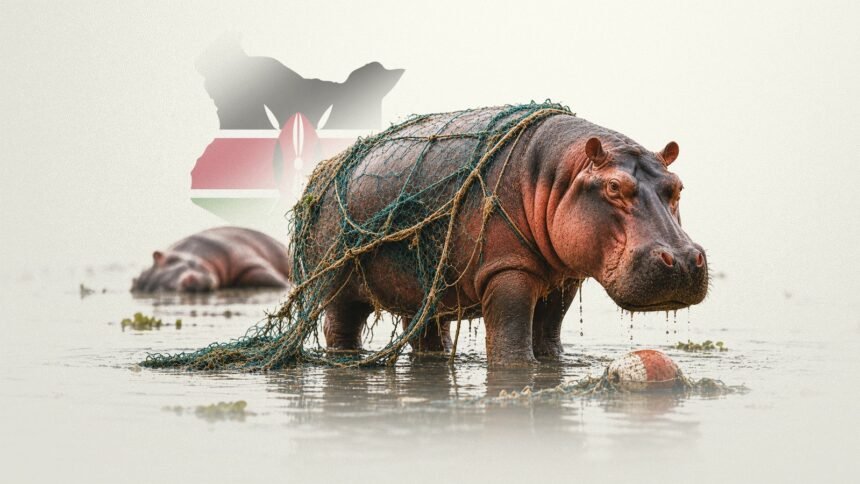
What kills a hippopotamus, an animal that few predators dare to approach? At Lake Naivasha, northwest of Nairobi, the first answers from veterinary examinations point not to disease or poaching but to rubbish and farm waste. The Kenya Wildlife Service (KWS) says one hippo died after swallowing a compacted mass of discarded synthetic fishing net, and another after eating so many maize stalks that its stomach swelled with gas and crushed its lungs. The findings have turned a local mystery into a wider warning about what happens when people, livestock feed and plastic crowd into the same shoreline as large wild animals.
The deaths come as wildlife agencies across the continent face a similar squeeze. Farms, fishing camps and settlements now ring lakes and rivers that once offered space, and the animals that depend on them are drawn into closer and more dangerous contact with people. Naivasha, a major freshwater ecosystem in the Rift Valley that also supports a busy fishing economy, is one of the clearest examples, and it shows how quickly the costs fall on both sides.
What the Post-Mortems Found
In a statement dated 19 November, KWS set out the results of two detailed post-mortems on hippos found dead at Kamere beach on 27 October. In the first case, a sub-adult female had a compacted mass of discarded synthetic fishing net that completely blocked the passage between the stomach and the small intestine. The veterinary team gave cardiopulmonary failure, hypovolemic shock, and endotoxemia, secondary to the obstruction, as the likely causes of death.
In the second case, an adult female’s multi-chambered stomach was severely distended with gas. The swelling pushed the diaphragm forward into the chest and compressed the lungs, interfering with breathing. The vets identified acute gastrointestinal bloat as the likely mechanism, and noted maize stalks among the stomach contents, which may have caused dietary overload and excessive fermentation. “The emerging threats highlight the need for responsible environmental practices and greater awareness among communities living and working around wildlife habitats,” KWS said.
Counting the Dead: Five, Nine or a Dozen
How many hippos have died is itself disputed. KWS spokesman Duncan Juma, Senior Assistant Director for Corporate Communication, said the agency had five confirmed cases and one unconfirmed. “We have a report of another carcass, but we are yet to confirm; as of now, we have five confirmed cases and one unconfirmed,” he said. One carcass, found in the Kibokoni area, was attributed by a vet to old age, and another near the Crayfish area was located but could not be examined because of heavy rain and difficult access.
Fishermen give higher figures. Labaan Ewoi of the Kamere Beach Management Unit said fishermen had counted nine dead hippos by Wednesday 18 November at Kamere Beach, Kibokoni, Malewa, and the Fisherman’s area, and said they had photographs. Another account puts the toll at about a dozen over the past two weeks. Local organizations, including the Kamere Beach Management Unit and the Lake Naivasha fishermen’s organization, say several other carcasses had abnormally swollen stomachs. At the same time, some dying animals appeared to struggle to breathe. Grace Nyambura, who chairs the fishermen’s organization, described it as the most serious series of hippo deaths in years. Only two deaths have so far been explained by post-mortem, so the cause of the others remains open.
A Lake That Keeps Rising
The deaths are part of a longer pattern of conflict between people and wildlife at Naivasha. Rising lake levels have flooded shoreline land, and the spread of farming has pushed hippos closer to where people live and work on a crowded shore, bringing them into maize plots and fishing grounds.
The risk runs in both directions. Illegal fishermen working on foot along the shore are growing in number, and they are exposed to attacks by these huge animals. According to local organizations, more than 20 people have been killed by hippos at Naivasha since the start of the year. Every hippo death caused by human waste, and every person killed by a hippo, deepens the mistrust between fishing communities and the agency responsible for the animals.
Nets, Stalks and Who Cleans Up
KWS has appealed to fishermen, local communities, beach management units and other users of the lake to handle and dispose of nets, gear and equipment properly so that wildlife cannot swallow them, and has warned against exposing wild animals to unsuitable food. “Protecting our wildlife is a shared responsibility by all Kenyans,” the agency said.
Appeals alone may not be enough. Discarded nets are often the product of illegal fishing, which by its nature avoids regulation, and maize stalks on the shore reflect farming pushed to the water’s edge. Pressure on KWS is growing from residents and fishermen who want answers on the remaining carcasses, and the gap between the agency’s confirmed count and the fishermen’s tally will not close until the outstanding post-mortems are completed and published.
Who Answers for Naivasha’s Shore
Kenya’s wildlife is a national asset, but many hands manage Naivasha’s shoreline: the wildlife service, county authorities, fisheries officers, farmers, and the beach units that represent fishermen. A credible response would publish the full post-mortem results, agree on a single count with the communities who found the carcasses, and pair net-disposal rules with enforcement against illegal fishing. Control over a natural resource is only real when the institutions that claim it can explain what is dying in it and why. Until then, the hippos of Naivasha remain a measure of how well, or how poorly, people and wildlife are sharing one lake.