






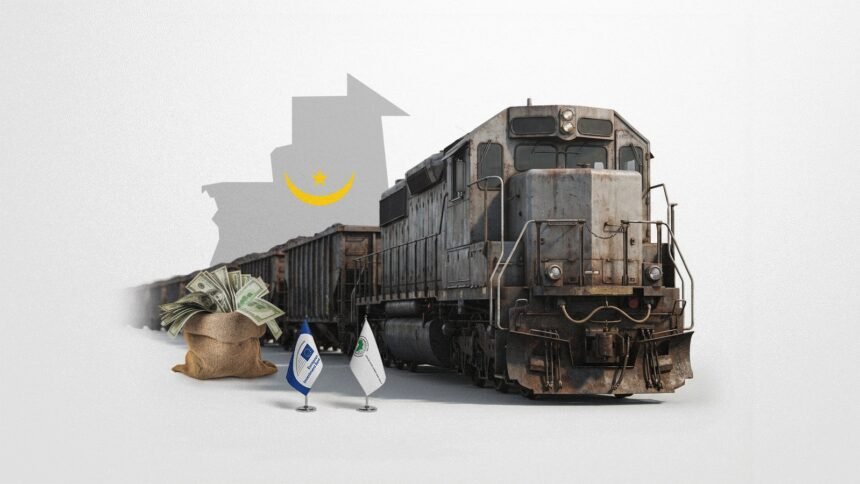
In Mauritania, amidst endless dunes, a 700-kilometre railway line has been constructed. This line carries some of the longest freight trains in the world, some reaching 3 kilometres in length, traversing the desert. It carries goods, including iron ore, from the Zouérat mines to the Atlantic coast. A fully loaded train can weigh up to 21,000 tons. Operating since 1963, the railway connects the port of Nouadhibou on the Atlantic coast with the iron ore mines in Zouérat.
The sand is one of the challenges hindering train movement, as is the movement of camels traversing the desert. This makes train travel in the desert extremely difficult, especially with temperatures that can reach 50 degrees Celsius, making the journey fraught with risks and hardships.
The train crews are responsible for regularly inspecting the train and ensuring its safety. The sand dredger attached to the train reduces the risk of derailment due to shifting sands.
The railway facilitates the transport of iron ore from the Fderik and Zouerate mines to international markets via the port of Nouadhibou. SNIM extracts and sells over 14 million tons of iron ore annually, often described as the country’s ‘black gold’. Each wagon holds around 80 -84 tons.
The city of Zouérat has a population of fifty thousand. The city’s residents rely on mining and iron ore as a primary source of income, as it is considered the cornerstone of the Mauritanian economy. Iron ore represents 6% of Mauritania’s GDP, nearly 30% of its exports, and around 11% of state budget revenues.
Major $275M Investment Secured during the African Investment Forum 2025
The African Investment Forum 2025, the seventh edition of the market days, was held in Rabat, Morocco, from November 26 to 28, 2025. During the forum, the European Investment Bank (EIB) signed a US$275 million joint financing package for Mauritania’s main railway corridor. The package comprises loans of US$150 million from the African Development Bank and US$125 million from the European Investment Bank, both guaranteed by the European Union. They are non-sovereign private sector financing for the benefit of the National Industrial and Mining Company (SNIM). The deal aims to support strategic infrastructure in Africa by restructuring Mauritania’s railway corridor. The financing will help build new tracks linking mining sites, which are expected to be an opportunity for the Mauritanian economy, especially in areas such as El Aouj and Atomai, where the tracks are 42 kilometers long. The sector needs modern carriages and maintenance equipment, aligning Mauritanian infrastructure with the European Union’s global strategy for infrastructure investment.
The National Industrial and Mining Company (SNIM) is a Mauritanian company that operates in the exploration, exploitation, processing, transportation, and export of iron ore. Its mining operations area is located near the city of Zouérat, in the Tiris Zemmour region of the Islamic Republic of Mauritania. SNIM’s annual sales volume exceeds 14 million tons of iron ore. As for the European Investment Bank (EIB), the EU’s long-term lending institution, it operates through its EIB Global division for non-EU activities. EIB Global focuses on financing investments outside the EU to advance sustainable development and infrastructure for international companies.
Mohamed Vall Mohamed Telmidy, CEO of SNIM, stated in the EIB Global press release, “The initiative to improve our logistics chain represents an important pillar of our strategic program. Its development contributes to achieving our production objectives. We are particularly grateful to our partners, EIB Global and AfDB, for their unwavering support.”
This financing is crucial to Mauritania’s economy and infrastructure. It strengthens Mauritania’s role as a key player in global value chains and a strategic hub on the continent by contributing to the African Continental Free Trade Area (AfCFTA). The project aligns with the European Union’s global strategy, which will enhance Mauritania’s integration into regional trade across the Sahel and Maghreb, opening opportunities for economic growth in the region. It is expected to help expand production and exports.
This landmark financing marks a pivotal step in Mauritania’s economic transformation, strengthening SNIM’s capacity to export more than 14 million tons of iron ore annually while also enhancing its ability to meet the challenges of the desert, such as sand accumulation and extreme heat. By rehabilitating the 700-kilometre corridor, adding 42 kilometers of new tracks to locations such as El Aouj and Atomai, and acquiring modern locomotives and maintenance equipment, the project aligns with the European Union’s “Global Gateway” strategy, which aims to promote sustainable infrastructure, create jobs, and foster regional integration in Africa. Ultimately, the project strengthens Mauritania’s position as a competitive player in value chains.


