






On April 8, 1946, Ethiopian Airlines was founded as Ethiopian Air Lines Inc., a joint venture with U.S. carrier TWA, using Ethiopian Airlines-Overview Skytrain aircraft from the U.S. government, and operated its inaugural scheduled flight from Addis Ababa to Cairo via Asmara.
Since then, Ethiopia has sought to develop its aviation sector, and according to OAG’s airline capacity data, Ethiopian Airlines is now the largest airline in Africa in terms of scheduled seats. The Ethiopian aviation sector has become a leader in aviation technology and piloting across Africa. Ethiopia is a pioneer in introducing the latest aircraft into its fleet, as it was the first to introduce Airbus aircraft in Africa.
Currently, Ethiopian Airlines operates a modern fleet of around 166 aircraft. The airline uses the motto “Bringing Africa Together and Beyond” to underscore its role as a pan-African carrier, connecting destinations within Africa and linking the continent to the rest of the world.
Ethiopian Airlines leads the air connectivity network linking Africa through its hub in Ethiopia to the rest of the world. The company facilitates travel to over 145 international destinations and 65 African cities, transporting both passengers and cargo. Ethiopian Airlines is a member of Star Alliance, the world’s largest airline alliance, and connects to 26 other member airlines, providing access to over 1,300 destinations with seamless travel and coordinated services.
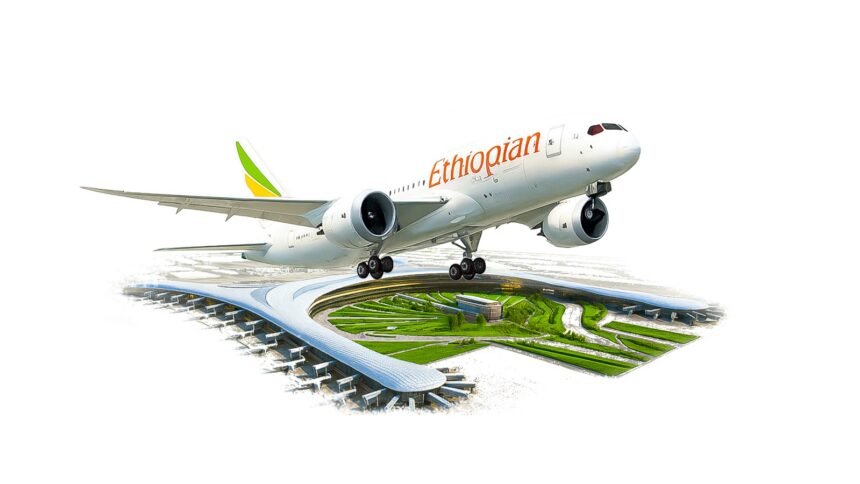
Phased Development of Bishoftu International Airport Will Transform Africa’s Aviation Landscape, Says Ethiopian Airlines Group CEO Mesfin Tasew.
The implementation of the Bishoftu International Airport project is proceeding in several phases. The first phase, valued at approximately USD 12.5 billion, is expected to be completed by 2030 and will accommodate around 60 million passengers annually, with total capacity projected to reach 110 million passengers per year upon full development. With its cutting-edge technology, sustainable design, and unparalleled connectivity, the new airport positions Ethiopia to become the aviation capital of Africa, serving as a significant gateway connecting the continent to the world.
‘Bishoftu International Airport marks a historic leap in Africa’s aviation journey, significantly enhancing trade, tourism, and business across the continent and beyond. I urge financiers around the globe to join us in supporting this ambitious project and to take part in this momentous milestone,’ said Mesfin Tasew, Group CEO of Ethiopian Airlines.
Upon completion, Bishoftu International Airport will have the capacity to handle 110 million passengers annually, making it one of the largest airports in Africa and a powerful catalyst for regional trade, tourism, and investment. Ethiopia is taking concrete steps to pre-qualify engineering, procurement, and construction (EPC) contractors, with bid submission expected. Before 2025. Demonstrating a strong commitment to advancing the project into the implementation phase.
The airport will be constructed near Abusera, about 40 kilometers south of Addis Ababa, on an estimated 3,975 hectares of land. Phase one is designed for a capacity of around 60 million passengers annually, with future expansions planned to raise total capacity to approximately 110 million passengers per year. Once operational, the airport is expected to become a central hub for international and domestic flights and a key facilitator of cargo traffic to and from Africa.
Shaping Africa’s Largest Aviation Mega-Hub
In the aviation sector, a Mega-Hub refers to one of the world’s largest and most highly connected international airports, serving as a primary global transfer point for passengers. The Official Airline Guide (OAG) popularized this term through its annual Megahubs Index, published. In the 2015 Megahubs Index, London Heathrow Airport (LHR) ranked as the world’s most connected airport. It remained Europe’s busiest hub, and the latest OAG Megahubs Index, confirming Heathrow as the world’s most connected airport, was published in September 2025.
On 17 November 2025, at the Dubai Airshow, Ethiopian Airlines and Boeing announced that Africa’s largest carrier had committed to purchase 11 additional Boeing 737‑8 (MAX 8) aircraft. The agreement signed at the airshow in Dubai will support Ethiopian Airlines’ plans to expand its regional and international route network and grow its Addis Ababa hub, according to Group CEO Mesfin Tasew.
Bishoftu Impact as Mega-Hub:
The determination of Ethiopian Airlines to implement the Bishoftu International Airport
The mega-hub project positions Ethiopia as Africa’s aviation capital, and OAG defined a megahub as a highly connected transfer point, reinforcing Ethiopia’s pan-African leadership in technology, piloting, and connectivity. This translates the national vision into reality, reshaping passenger and cargo flows under the AfCFTA while creating jobs and sustainable growth.


