
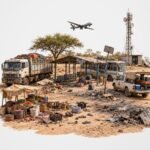



El Fasher, once the bustling capital of North Darfur and a refuge for displaced families, is now a graveyard of unburied hopes. Over the weekend, the Rapid Support Forces (RSF) seized the city’s central army base after months of siege, killing dozens and displacing thousands. For Sudan, this isn’t just another battlefield. It’s the slow cremation of what’s left of the state.
Witnesses in El Fasher describe scenes straight out of an apocalypse: the thud of mortars echoing through neighborhoods, black smoke swallowing the skyline, and terrified families fleeing on foot without knowing where to go. “We’ve lost everything our homes, our loved ones, and our sense of tomorrow,” said Amina, a nurse who has been volunteering in makeshift hospitals since the conflict began. Her words summarize the exhaustion of a region that has been trapped in cycles of war for two decades.
The RSF’s capture of the base is militarily significant — but politically disastrous. It effectively cuts off one of the Sudanese Armed Forces’ last strongholds in Darfur, tightening the paramilitary’s grip on the west. With Khartoum already a fragmented battlefield, the symbolic fall of El Fasher underscores a grim reality: the central government has lost almost all meaningful control over its territory. Sudan, in all but name, has fractured into warlord fiefdoms.
The roots of this disaster go deep. The RSF evolved from the notorious Janjaweed militias that terrorized Darfur in the early 2000s, accused of mass killings and ethnic cleansing. When Omar al-Bashir tried to formalize them into a paramilitary structure, he planted a time bomb that exploded after his fall. The group’s leader, Mohamed Hamdan Dagalo better known as Hemedti reinvented himself as both a national player and a warlord businessman, financing his operations through gold exports and foreign mercenary deals. His power, wealth, and ruthlessness made him indispensable until he became uncontrollable.
The current civil war began in April 2023, when tensions between Hemedti’s RSF and the Sudanese army, led by Abdel Fattah al-Burhan, boiled over. Both men once shared the spoils of the 2021 coup that derailed Sudan’s democratic transition. But like many uneasy alliances built on ambition, theirs collapsed into violence. What followed was a war with no front lines, no ceasefires that last longer than a news cycle, and no real winners — only corpses, rubble, and despair.
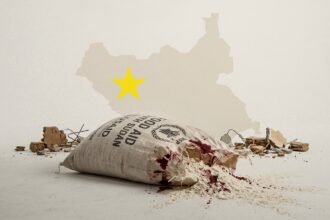
International responses remain frustratingly familiar: statements of concern, calls for restraint, and promises of aid that struggle to reach the besieged. The African Union’s mediation has faltered, and neighboring states from Chad to Egypt are mostly preoccupied with keeping the fire from spilling across their borders. The UN’s humanitarian corridors have been repeatedly targeted. In El Fasher, warehouses of the World Food Programme have been looted, while hospitals operate without electricity, antibiotics, or anesthetics.
The humanitarian cost is staggering. Over 10 million Sudanese are displaced, the world’s largest internal displacement crisis today. Entire towns in Darfur have been erased from the map. And in El Fasher, the massacre of civilians this week adds to a growing list of atrocities that may never see accountability. “It’s déjà vu,” said a regional analyst. “The world said ‘Never again’ after Darfur in 2004 and yet, here we are again, watching history repeat itself in blood and silence.”
The RSF’s latest victory also carries geopolitical undertones. Analysts warn of the deepening involvement of foreign actors: the Wagner Group’s lingering influence, regional arms trafficking through Libya, and Gulf money feeding the war economy. Each external hand makes the conflict harder to end and easier to exploit. Meanwhile, the Sudanese people are reduced to pawns in a proxy war they never asked for.
Still, amid the ashes, resilience flickers. Volunteer networks mostly young Sudanese are coordinating food supplies, evacuation routes, and makeshift schools in displacement camps. Artists are using murals and poetry to keep hope alive. Doctors without proper equipment are performing surgeries by flashlight. These quiet acts of defiance remind the world that Sudan’s story is not just one of collapse, but also of stubborn survival.
Yet, one can’t escape the haunting question: what’s left to save? El Fasher’s fall might not only mark a military defeat for the Sudanese army, but also a psychological one for the nation. The city was a symbol of the government’s presence in Darfur. Its loss signals that Sudan’s fragmentation is complete — and that rebuilding it, whenever the guns fall silent, will take more than peace agreements. It will take the return of trust, memory, and meaning to a country that’s forgotten what normal feels like.
As one weary aid worker put it, “Sudan isn’t dying in a single explosion. It’s dying slowly, in the silence between the bombs.”