



The Pan-African Paradigm of Fragile Peace and Federal Self-Determination
Across the African landscape, the aftermath of civil war often proves as precarious as the conflict itself, and Ethiopia’s Tigray region now stands as a stark illustration of how quickly a hard-won peace can fray under the weight of unresolved grievance. Authorities in Tigray have accused the federal government in Addis Ababa of striking a farmer training center near the regional capital Mekelle with a drone, an allegation that, whatever its ultimate veracity, reflects the depth of mistrust that persists less than four years after a 2022 peace agreement formally ended a civil war that claimed an estimated 600,000 lives. The pattern is familiar across post-conflict Africa: peace deals negotiated at the level of national elites leave structural grievances over regional autonomy, resource allocation, and security arrangements unresolved at the local level, where they continue to smolder until the next spark reignites open confrontation. As both Addis Ababa and Mekelle mass forces along their shared border, the imperative facing Ethiopia, and the continent watching its trajectory closely, is whether federal self-determination can be structured to accommodate regional grievance without perpetually risking a return to war.
A Strike Near Dandera
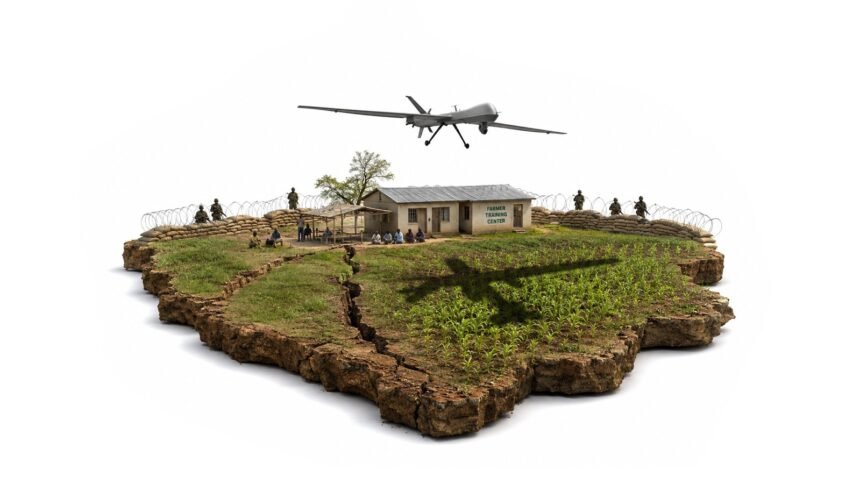
The specific allegations emerging from Tigray describe a drone strike on a farmer training center in Dandera village, situated approximately fifteen kilometers outside Mekelle. The Tigray People’s Liberation Front, which continues to govern the region under the terms of the 2022 peace settlement, stated in a social media announcement that no injuries had resulted from the strike, though it offered few further operational details. A local priest, speaking to AFP on condition of anonymity given the sensitivity of the security situation, offered a starkly different account, describing witnessing the body of a fighter being carried away from the scene and stating his belief that two additional people had been wounded. The priest further described the strike’s projectile as landing on farmland close to both a school and a watering hole used by local farmers’ livestock, a detail underscoring how quickly civilian agricultural and educational infrastructure can become entangled in a renewed security escalation, regardless of the strike’s intended military target. Ethiopia’s federal army had not issued any public comment on the allegations at the time of reporting.
A Peace Deal Under Mounting Strain
The Pretoria peace agreement of November 2022 formally ended two years of brutal civil war between federal forces, allied militias, and Tigrayan forces, a conflict widely regarded as one of the deadliest of the twenty-first century, with estimates of the death toll ranging as high as 600,000 when combining direct casualties, famine, and denied humanitarian access. The agreement established a fragile framework for Tigray’s reintegration into Ethiopia’s federal structure, including provisions for the withdrawal of external forces, restoration of federal services, and eventual political normalization. Yet the accusations exchanged in recent weeks, with this week’s report following an earlier allegation on 11 August of drone strikes amid fears of renewed war. An accusation from Tigrayan authorities as recently as 2 August that Addis Ababa was “launching open war” suggests that implementation of the deal’s underlying political commitments has lagged badly behind the ceasefire’s initial success in halting large-scale combat operations. Reports of both sides massing forces along their shared regional border in recent weeks compound the sense that the peace, while formally intact, rests on an increasingly thin foundation.
The Human Toll of Renewed Uncertainty
Beyond the immediate question of whether this particular strike occurred as described, the broader climate of accusation and counter-accusation is itself inflicting a measurable toll on Tigrayan civilians. In recent weeks, Ethiopians in the region have staged public demonstrations against what protesters describe as forced mobilization efforts tied to escalating tensions, reflecting a civilian population deeply reluctant to be drawn back into a conflict from which the region has not yet meaningfully recovered. Tigray’s infrastructure, healthcare system, and agricultural capacity remain profoundly degraded from the 2020-2022 war, meaning any resumption of hostilities, even at a limited or localized scale, would strike a population with far less resilience than before the original conflict began. The targeting, whether confirmed or alleged, of a farmer training center carries particular symbolic weight in this context: agricultural capacity-building represents precisely the kind of post-conflict recovery infrastructure that Tigray’s population most urgently needs, making any credible threat to such facilities a direct threat to the region’s broader reconstruction trajectory.
A Region Watched Closely Across the Continent
Ethiopia’s trajectory carries significance well beyond its own borders as one of the continent’s most populous nations, and a longstanding anchor of the African Union’s institutional presence in Addis Ababa; instability in Ethiopia reverberates across the Horn of Africa’s already fragile security architecture, with implications for neighboring Eritrea, Sudan, and Somalia, each grappling with its own overlapping crises. International partners who invested diplomatic capital in brokering and sustaining the 2022 Pretoria agreement, including the African Union itself, which hosted the original peace talks, now face renewed pressure to determine whether their continued engagement can help de-escalate the current tensions before they metastasize into open conflict once again. The credibility of African-led peace processes, a point of particular pride following the AU’s central role in the original Tigray negotiations, is itself implicated in whether this latest flashpoint can be defused through diplomatic channels rather than allowed to drift toward renewed confrontation.
Sustaining Peace as an Ongoing Act of Sovereignty
The unverified drone strike near Mekelle is, in the end, a reminder that peace agreements are not endpoints but ongoing processes requiring sustained political investment long after the guns fall silent. Ethiopia’s federal government and Tigray’s regional authorities each retain a choice in the weeks ahead: to let mutual accusation and troop mobilization harden into justification for renewed conflict, or to recommit to the structural work of federal reconciliation that the 2022 agreement promised but has not yet fully delivered. For a continent that has watched too many post-conflict settlements collapse back into violence, Ethiopia’s capacity to hold this fragile peace together represents a genuine test of whether African-brokered solutions can achieve not merely a ceasefire, but a durable and self-determined resolution to the grievances that produced the conflict in the first place. That, ultimately, is the deeper sovereignty at stake in Tigray, not merely the absence of war, but the presence of a peace resilient enough to withstand the next provocation.