


The Pan-African Paradigm of Reconciliation and Selective Justice
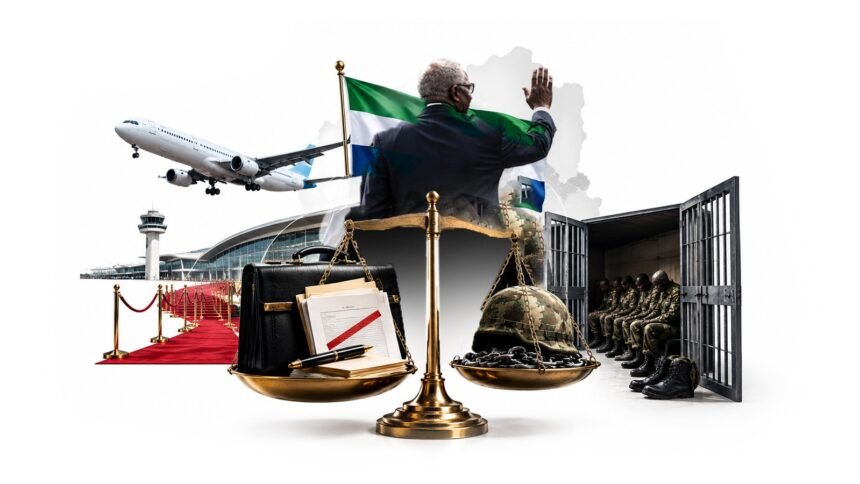
A former head of state who fled treason charges returns home smiling, flanked by a foreign ex-president, to a welcome from the very government that once accused him of plotting a coup. The optics of Ernest Bai Koroma’s homecoming to Freetown this week compress into a single tarmac scene, one of the continent’s most persistent institutional dilemmas: how African states reconcile the demands of accountability with the political convenience of rapprochement. Sierra Leone’s decision to drop treason charges against Koroma, unexplained in its official announcement, arrives ahead of 2028 elections and after two years of quiet diplomatic choreography involving Nigeria’s government and the Economic Community of West African States. Whether this represents genuine institutional healing after the deadly 2023 army uprising or a calculated recalibration of political alliances ahead of a contested vote remains an open question that will shape how the region’s opposition figures gauge their own prospects for return. Koroma’s case forces West Africa to confront, once again, the asymmetric standards applied to elite reconciliation versus the fates of soldiers imprisoned for the same events, and what genuine structural accountability would require.
The 2023 Uprising and Its Unequal Aftermath
The case against Koroma originated in November 2023, when armed attackers stormed a military armory, two barracks, two prisons and two police stations across Freetown, clashing with security forces in violence that authorities classified as an attempted coup. Twenty-one people were killed. In the uprising’s aftermath, two dozen soldiers and Koroma’s former bodyguard received prison sentences ranging from 50 to 100 years from a military court, sentences of striking severity that stand in stark contrast to the eventual dropping of charges against the former president himself, who was cleared to leave for medical treatment in Nigeria and remained there for more than two years beyond his original three-month window. The disparity between the fates of low-ranking soldiers and the political figure allegedly connected to the plot illustrates a structural pattern common across the continent: accountability architecture that bears down hardest on those with the least institutional protection.
Diplomatic Choreography Behind the Homecoming
Koroma’s return was neither spontaneous nor unmediated. He arrived at Freetown’s international airport with former Nigerian president Olusegun Obasanjo and Nigerian Foreign Minister Bianca Odumegwu-Ojukwu, and was welcomed by Sierra Leone’s Foreign Minister Mohamed Rahman Swarray and officials from Koroma’s opposition All People’s Congress party. Vice President Mohamed Jukdeh Jalloh had signaled the homecoming days earlier at a gathering in Koroma’s stronghold of Makeni, suggesting the government itself was managing the narrative around his return rather than merely permitting it. This level of coordination, a former ally’s ex-leader escorting a rehabilitated opposition figure home, reflects the layered diplomacy through which West African states increasingly resolve politically sensitive domestic disputes, using regional politicians as guarantors of safe passage.
ECOWAS’s Quiet Hand in Managing Political Transitions
Koroma briefly tested the waters of return in July, visiting Sierra Leone during an ECOWAS summit at the invitation of President Julius Maada Bio, an invitation notable given that Bio’s government had charged Koroma with treason. That the regional bloc’s summit provided the occasion for this initial thaw underscores ECOWAS’s evolving, informal role not just in crisis response but in facilitating the managed reintegration of exiled political figures, a function the organization has performed with uneven consistency across member states facing their own post-coup reconciliations.
Elections Loom Over the Optics of Forgiveness
Koroma’s homecoming lands roughly two years ahead of Sierra Leone’s 2028 presidential election, a timing unlikely to be coincidental. As a former two-term president who led the country from 2007 to 2018, Koroma retains substantial influence within the APC and among voters in Makeni and the country’s north. His return recalibrates the opposition’s institutional standing heading into the electoral cycle, raising the question of whether the charges were dropped on their legal merits or as part of a broader political bargain whose terms remain undisclosed to the Sierra Leonean public, a familiar tension between transparency and stability that recurs across the continent’s post-conflict transitions.
Toward a Sovereignty of Consistent Accountability
Sierra Leone’s decision to welcome Koroma home without public explanation for the dropped charges leaves unresolved the deeper structural question his case poses: what does justice mean in a system where those with the least power face the harshest penalties and those with the most retain the ability to negotiate their own return? A genuinely sovereign approach to post-conflict accountability would apply uniform standards regardless of rank or political utility, rather than allowing diplomatic choreography to substitute for public reckoning. As Sierra Leone moves toward 2028, the manner in which it resolves the unfinished business of the 2023 uprising, for the imprisoned soldiers as much as for Koroma, will determine whether this reconciliation strengthens or further erodes public trust in the country’s institutions.