





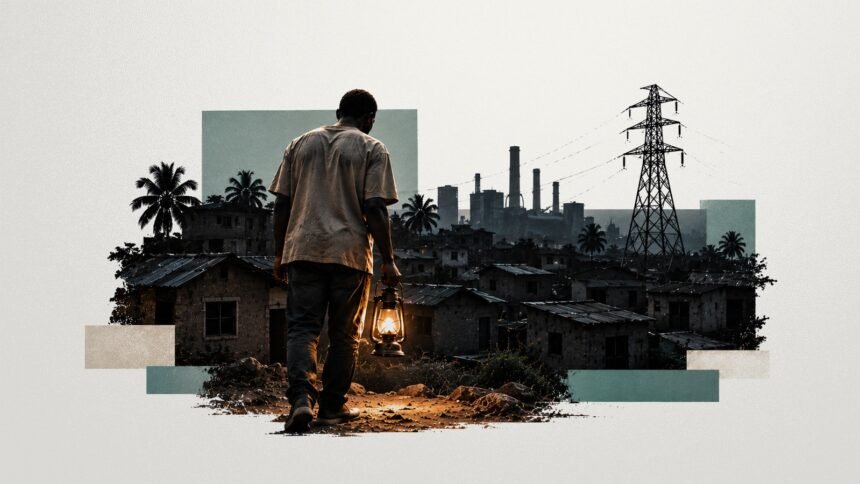
Africa’s Largest Population Still Runs on A National Grid That Can Lose Most of Its Power in an Hour, And Businesses and Households Pay for Every Collapse
Two thousand nine hundred and seventy-two megawatts. That is how much electricity vanished from Nigeria’s national grid in the space of about an hour on Monday, 19 October. At noon, 21 power plants were feeding 3,647 megawatts (MW) into the system. By 1 pm, only 12 plants were still connected and supply had fallen to 675MW, a drop of about 81.5 per cent, according to data from the Nigerian Independent System Operator (NISO).
Among the plants that went offline were Azura, Egbin, and the Jebba and Kainji hydroelectric stations, some of the most important generators in the country. The morning had looked better: the grid recorded 4,331MW at 1 am and 4,458MW at 6 am before slipping to 3,647MW by noon. By 5 pm supply had partly recovered to 2,150MW, an improvement of 1,475MW on the 1 pm low but still far below the morning peak.
What the Operator Says Happened
NISO said the incident began at approximately 12:40 pm on 19 October and involved multiple trippings on the 330-kilovolt transmission network. It said it immediately implemented corrective measures with the Transmission Company of Nigeria (TCN) to stabilize the system, that restoration had been completed and that the grid had returned to normal operation.
The operator also pushed back on how the event was being described. It said the incident affected only a section of the grid, “contrary to unverified reports and claims.” Its own hourly data, however, show supply falling by more than four-fifths within an hour. The two statements are not necessarily in conflict: a disturbance can begin in one part of the network and still cut national supply sharply. But NISO has not published a full technical account of which sections tripped and why, so the scale of what Nigerians experienced on Monday afternoon rests on the hourly figures rather than on an official explanation.
The Notices in Customers’ Inboxes
Distribution companies moved quickly to manage expectations. The Abuja Electricity Distribution Company (AEDC) told customers that supply from TCN had been interrupted by a grid-related challenge, that TCN’s technical team was working to restore stability. That power was gradually returning to its feeders. “We assure you that efforts are ongoing to restore full supply across our franchise area as soon as the situation permits,” the company said, apologizing for the inconvenience.
Ikeja Electric, which serves part of Lagos, attributed reduced supply across its network to a shortfall in the power allocated to it from the national grid. It said it was engaging relevant stakeholders to improve supply and would distribute what it received as efficiently and equitably as possible. Behind those carefully worded notices lies a familiar reality: when the grid falters, distribution companies have little to share, and customers fall back on generators or go without.
A System Running Close to the Edge
The most revealing number may not be the 675MW low but the 4,458MW high. Even at its best on Monday morning, the grid was delivering a modest amount of power for a country of Nigeria’s size and economic weight. A system operating with so little margin has few reserves to call on when several large plants drop out at once, and every trip on the transmission network can cascade quickly.
Monday’s event was not a total collapse: a dozen plants stayed on the grid, and supply began to recover within hours. Nigeria has, however, endured repeated grid disturbances, and each one carries costs that never appear in NISO’s tables. Hospitals switch to diesel, factories halt production lines, small shops lose refrigerated stock, and households that pay for electricity they do not receive grow more skeptical of every promise of reform. For businesses already paying high prices for fuel to run backup generators, an afternoon outage is a direct hit to margins.
Reform Without Reliability
Nigeria’s power sector has been restructured repeatedly over the past two decades. Generation and distribution were privatized, the transmission company remained in public hands, and an independent system operator was created to manage the grid’s day-to-day balance. Regulation has also been opened up, allowing states to build their own electricity markets. Those reforms were meant to attract investment and improve performance. Monday’s figures suggest that the weakest link remains the physical network that moves power from plants to cities, and the ability of operators to keep it stable when something goes wrong.
The questions that follow are practical ones. Which section of the 330kV network tripped first, and why? Did protection systems isolate the fault as designed, or did they allow it to spread? Why did plants as large as Egbin and Azura drop off at the same time? Clear answers, published quickly, would do more for public confidence than a statement that the grid is back to normal.
Closing: Power as a Measure of Self-Reliance
Electricity is one of the clearest tests of whether a state can deliver for its citizens. A country that cannot keep its grid stable cannot easily industrialize, process its own raw materials or offer young people the jobs that come with manufacturing. Nigeria has gas, sunlight, rivers and engineers. What it still needs is a transmission network robust enough to carry its output and an operator transparent enough to explain its failures. Until then, every Monday afternoon carries the risk of another drop from thousands of megawatts to hundreds, and of more households deciding that the grid is something to plan around rather than rely on.