




In context: In Nigeria’s north-east, armed groups are crossing state boundaries faster than help can follow, and a market town close to five state borders has paid for that gap.
Ten, then more than 18, then 26, then 37. By Saturday, the people of Binnari had heard four different death tolls for the attack on their town, and each was higher than the last.
The attack on Binnari, in Karim Lamido Local Government Area of Taraba State, came on Friday, 23 October. According to the Taraba State Police Command, gunmen described as large in number invaded the village at about 3 p.m., shortly after Jumu’ah prayers, firing heavily, looting food from shops and causing panic among residents. Police said officers sent to the scene recovered 10 bodies bearing gunshot wounds, which were handed to families for burial according to Islamic rites. One early local account placed the attack in the early hours of Friday; the police and several residents place it in the afternoon.
Four Counts, Still Rising
The figures differ because the counting is not finished. The police have confirmed 10 deaths. Yahuza Binnari, a resident who fled to a nearby village, said that when the attackers left, “we counted more than 18 dead bodies, while several others were still missing.” A later count reported that 11 more bodies were recovered on Saturday morning, taking the toll to 26. Another update put the toll at 37 after community leaders and young people searched the surrounding bush and rivers. Some residents were reported to have fallen into a river as they fled.
The police have confirmed none of the higher figures, and the number of missing people, the injured and the full extent of the damage remain unclear. This article therefore gives 10 as the confirmed toll and the community’s counts of up to 37 as unconfirmed. The gap matters. When bodies are recovered from rivers and bush in the days after an attack, the families of the missing need the official record to catch up with what their neighbors have already counted.
A Market Day, Chosen
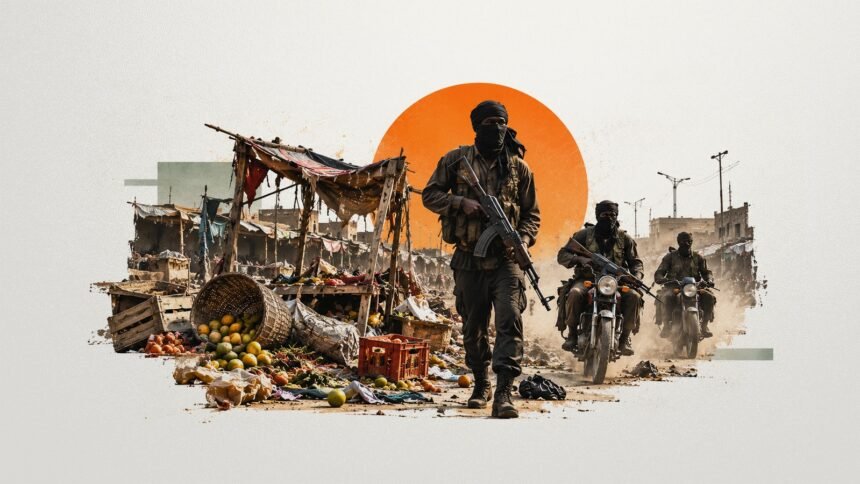
Residents describe an attack timed for the moment the town was most crowded. Community leader Alhaji Tanko Andami said the gunmen came on market day, arriving on about 50 motorcycles with two men on each. Residents said some attackers blocked the entrances to the town while others moved into the busy market and opened fire in different directions. “There was total confusion in the town as people ran in different directions,” Yahuza Binnari said.
After the killings, Andami said, the attackers looted shops, carried away cash, foodstuffs and other provisions, and took new motorcycles that owners had abandoned as they ran. Houses and shops were set on fire, and food stocks that local sources valued at millions of naira were destroyed. Several residents fled to neighboring communities, and some were reported missing.
Borders That Shelter Gunmen
The attackers are suspected to have crossed into Taraba from neighboring Plateau State. Karim Lamido also borders Adamawa, Bauchi, Gombe and Nasarawa states, which puts Binnari close to five state boundaries. Andami said the attackers belonged to bandit groups that have taken control of several communities in the area and operate around the Plateau and Bauchi borders with Taraba. “We appeal to the Taraba State governor and security agencies to pay special attention to Karim-Lamido Local Government Area because many communities are under the control of bandits who operate around the Plateau and Bauchi border areas with Taraba State,” he said.
Local sources also allege that residents made distress calls during the attack but that security help arrived too late to prevent the killings and destruction. That account comes from residents and has not been independently confirmed. It nonetheless captures the fear voiced in Karim Lamido: that a town on the edge of several jurisdictions can fall between them.
The Official Response
The police said additional personnel had been placed on red alert and that joint teams made up of police tactical units, the Police Mobile Force, conventional police, the Nigerian Army and other security agencies had been deployed to prevent further attacks and protect residents. Police spokesperson ASP Victor Mshelizah urged residents to stay calm, avoid spreading unverified information and report suspicious movements to the nearest police station.
Governor Agbu Kefas condemned the attack and directed security agencies to track down and prosecute those responsible. In a statement issued by his special adviser on media, Emmanuel Bello, the governor said no effort should be spared in identifying and arresting the perpetrators and that everyone involved must be held accountable under the law. By Saturday, no arrests had been announced, and the attackers had not been identified.
Who Guards the Market Town
The first test of any state is whether ordinary life can go on: a Friday prayer, a market day, a ride home on a new motorcycle. In Binnari, all three became targets in a single afternoon. The governor’s order for a search and the army’s deployment are the right first steps, but the residents’ appeal points to a harder task: holding territory along state lines that armed groups now treat as their own.
Nigeria’s ability to govern its own spaces will be judged less by statements after an attack than by whether villages like Binnari can call for help and receive it in time. Until the people of Karim Lamido can rely on that, the real authority in parts of the area will remain with whoever arrives first on motorcycles.