





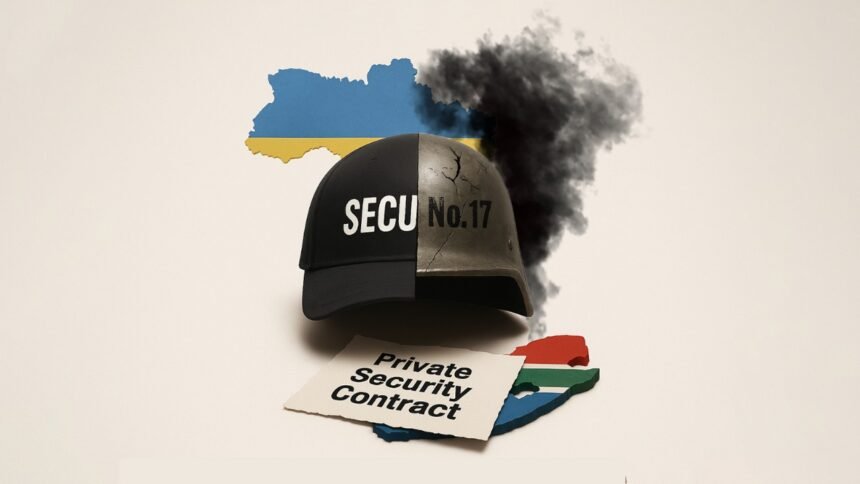
For years, South Africa has wrestled with the lingering ghost of its private-military past. But nothing in that history quite compares to the bizarre saga now gripping the nation: seventeen South African men, stranded in Ukraine’s conflict zone, pleading for help after discovering they had been recruited—apparently under false pretences—into the Russia-Ukraine war. What began as an ordinary search for work has ballooned into a geopolitical headache, a diplomatic rescue mission, and a moral puzzle about responsibility in an age of increasingly opaque global conflicts.
At the centre of this unfolding drama are men who thought they were signing up for private security jobs. What they received instead were contracts that reportedly placed them near active combat lines in the Donbas region. When the reality of their deployment became undeniable, distress calls began filtering back home. Their families, terrified and bewildered, contacted South African authorities, who were themselves caught off guard. The government eventually confirmed the situation and announced it would investigate how its citizens ended up in one of the world’s most dangerous war zones.
The story has touched a nerve for two reasons. First, the sheer audacity of recruiters who target vulnerable job seekers, especially those with prior military or security experience. South Africa, with its high unemployment and large pool of trained veterans, has long been a profitable hunting ground for private military contractors and shadowy intermediaries. But the idea that citizens could be lured into a major foreign war under misleading terms is both new and deeply unsettling.
Second, the episode exposes the blurry lines that increasingly define modern warfare. Many conflicts today involve semi-state actors, private militias, outsourced combat roles, and recruitment channels that operate below the radar of formal diplomacy. A South African man signing what he thinks is a job contract in Johannesburg could, within weeks, find himself on a battlefield thousands of kilometres away without ever being told the truth of what he signed up for. The Ukraine case is only the latest—and perhaps most dramatic—example of this widening grey zone.
For South Africa’s government, the situation is politically awkward. The country officially maintains a non-aligned position in the Russia-Ukraine war, though its overall posture has often been interpreted as sympathetic to Moscow. That makes the case of South Africans possibly fighting on one side of the conflict even more diplomatically explosive. Pretoria must now attempt a delicate balancing act: protecting its citizens, avoiding international embarrassment, and conveying neutrality—all while acknowledging that its citizens may have been used as expendable labour in a conflict with global stakes.
The families of the stranded men have been more blunt. They accuse recruiters of deception, warn that their relatives are in grave danger, and describe a pattern of exploitation that preys on economic desperation. Many of the men reportedly believed they were taking up short-term protection roles or logistics support positions, not roles that would place them in the direct path of artillery, drones, and hostile forces. When the truth surfaced, some attempted to flee. Others remained trapped, unable to leave or break their contracts, which may have been written in languages they did not fully understand.
South Africa’s mercenary laws add yet another layer of complexity. The country has one of the world’s strictest anti-mercenary frameworks, designed to prevent its citizens from participating in foreign conflicts. But enforcement has historically been inconsistent, largely because recruitment networks have become more sophisticated and harder to track. The Ukraine case reveals just how outdated traditional legal frameworks have become. A man misled into a foreign conflict is both a victim and, technically, a lawbreaker—though few expect the state to prosecute individuals who were tricked into a war.
Globally, the incident has triggered questions about other African nationals who may also have been recruited under similar pretences. Foreign fighting forces in Ukraine come from dozens of countries, some through official channels, many through informal or deceptive ones. Africa’s role in this shadow labour market is rarely discussed openly, but the South African case has dragged it into the public eye. If seventeen men could be lured this easily, how many others—across Africa’s vast and economically strained labour pool—are also being shipped into conflicts they barely understand?
Meanwhile, foreign-policy analysts warn of ripple effects. If South Africa is seen as a source of unwitting combatants, other states may begin imposing travel restrictions, scrutinising private-security companies or questioning Pretoria’s ability to regulate its own labour markets. The government’s reaction will therefore matter not just for the stranded men, but for its international credibility. A forceful investigation could restore confidence; a sluggish or evasive approach could do the opposite.
At its core, however, this story is human. It is about seventeen families glued to their phones, waiting for updates from sons, husbands and brothers who vanished into a war they never intended to join. It is about men who were told they would guard warehouses or escorts, only to find themselves dodging gunfire. It is about the crushing weight of economic pressure that pushes people to take risks they do not fully comprehend.
The episode lays bare a truth that extends well beyond South Africa: global conflicts today are no longer fought solely by professional armies. They are fought by networks of recruits, contractors, freelancers and, in some tragic cases, desperate men misled into becoming soldiers by accident. And as the world becomes more connected, the distance between a job advertisement and a battlefield continues to shrink.
The South African government now faces a race against time: to rescue its citizens, dismantle the recruitment networks that enabled their deployment, and restore public trust. Whether it succeeds will depend not only on diplomatic skill, but on political will. The lives of seventeen men hang in the balance, caught between a war they do not own and a state scrambling to understand how they ended up there.