





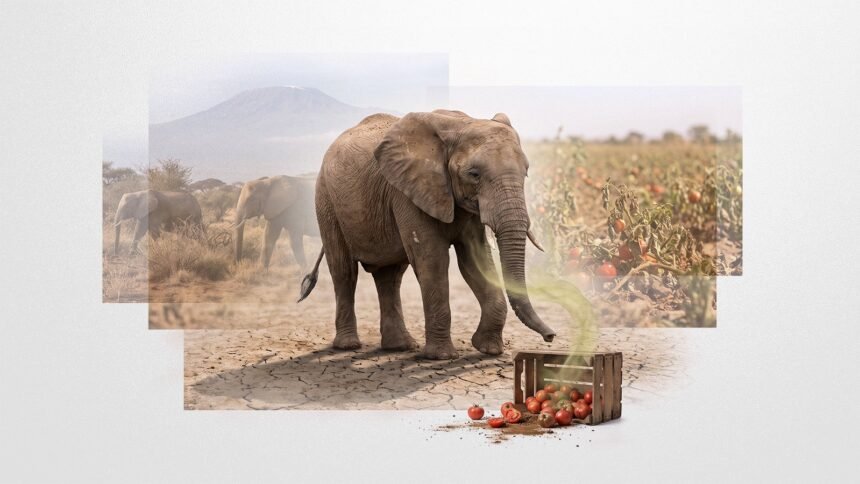
The Pan-African Paradigm of Ecological Sovereignty and Community Coexistence
Across the African landscape, few structural tensions are as persistent or poorly resolved as the conflict between agricultural survival and wildlife conservation in areas where both depend on the same finite terrain. The deaths of 15 elephants near Kenya’s Amboseli National Park, likely caused by cyanide poisoning linked to pesticide use on nearby tomato farms, according to the Kenya Wildlife Service, crystallize that tension in devastating terms. Erustus Kanga, the agency’s director general, confirmed that laboratory analysis of samples collected from the carcasses found traces of cyanide, a chemical compound used both as a predator-control poison in farming and, historically, as a tool of ivory poachers. The incident fits within a broader continental paradigm. As human populations expand into landscapes shared with some of Africa’s most ecologically and economically significant wildlife, the informal, often unregulated use of agricultural chemicals has become a structural threat rivaling traditional poaching in its lethality. Reclaiming a sustainable architecture of coexistence, one that protects both farmers’ livelihoods and the ecosystems that sustain long-term tourism revenue, remains an unresolved and urgent continental priority.
The Toxicology of a Cluster Die-Off
The Kenya Wildlife Service confirmed the deaths occurred across the Kimana sanctuary and the Kuku Group Ranch areas surrounding Amboseli, a 392-square-kilometer ecosystem, roughly 96,865 acres, that, together with neighboring conservancies, is home to more than 1,600 elephants. Isaac Lekolool, head of veterinary and capture services at KWS, said the stomach contents of one elephant from a herd that roamed the Kimana sanctuary contained “lots of tomatoes,” a detail that directly implicates agrochemical exposure rather than natural causes or drought. Ten of the 15 elephants showed signs of partial paralysis before dying, according to KWS’s initial investigation, launched after the deaths were first recorded between June 24 and July 24. Kanga described the toxicological mechanism starkly: “Cyanide is a highly toxic chemical. If elephants consume cyanide, they cannot survive a day or two,” underscoring how rapidly a substance intended for localized pest control can produce catastrophic wildlife mortality when it enters a shared ecosystem.
Kimana’s Agricultural Economy and a Documented Chemical Pattern
Kimana town is a leading regional tomato producer, and researchers at the Route to Food Initiative, a food rights program, have previously documented the use of cyanide-based substances on the crop in the area, suggesting this is not an isolated or accidental contamination but part of a recurring agrochemical pattern in the region’s farming practices. That prior documentation gives the current die-off a structural, rather than incidental, character: a known chemical risk operating within a landscape explicitly shared between smallholder agriculture and one of Africa’s most ecologically significant elephant populations. Kanga warned that the danger extends beyond wildlife, noting that livestock, including goats and cattle grazing near the same farms, face comparable exposure risk. “Eventually, if this cyanide is truly the one that is in the system, then we are going to see a bigger impact,” he said, a warning that reframes the elephant deaths as an early indicator of a wider ecological and public health matrix rather than a contained wildlife incident.
Conservation Gains Under Structural Threat
The scale of the die-off carries particular weight given Amboseli’s conservation trajectory. Benson Leyian, chief executive of the Big Life Foundation, which operates across the ecosystem, noted that “thanks to decades of community-centered conservation, the Amboseli elephant population is one of the best protected in Africa, and elephant poaching has been virtually eliminated here.” Aside from losses during severe drought periods, he said, the region has not seen a comparable cluster of elephant deaths in years. The International Fund for Animal Welfare described the incident as “deeply alarming,” emphasizing that “every elephant lost is significant, not only for the species, but for the health of the ecosystems they help sustain and the communities that live alongside them.” That framing situates the die-off within a broader institutional achievement now under direct threat: decades of successful anti-poaching and community conservation work potentially undermined by an entirely different, and in some ways more diffuse, structural hazard rooted in agricultural practice rather than criminal poaching networks.
Governance Tensions Compounding an Ecological Crisis
The elephant deaths arrive amid unrelated but structurally adjacent tensions over who governs the Amboseli ecosystem. Local leaders in Kajiado County have, in recent months, pushed to take over the management and operations of the park from national authorities, a bid that a court recently suspended. While unrelated to the poisoning incident, the governance dispute underscores the broader institutional fragility in one of Kenya’s most economically vital conservation areas, a major source of tourism revenue whose long-term sustainability depends on coherent, accountable management structures capable of addressing both wildlife protection and the agricultural livelihoods of surrounding communities.
Toward a Reclaimed Ecological Architecture
The Amboseli elephant deaths are a warning embedded within a broader continental pattern. As agricultural expansion and wildlife conservation increasingly compete for the same finite land, the chemical tools used to protect crops carry consequences that extend far beyond any single farm’s boundary. Kenya Wildlife Service’s ongoing investigation and the structural questions it has raised about cyanide use in Kimana’s tomato economy represent an opportunity to build a more durable architecture of coexistence, grounded in regulated agrochemical use, community engagement, and coherent conservation governance. For an ecosystem that has achieved genuine success in eliminating poaching through community-centered conservation, the challenge now is ensuring that the same institutional commitment extends to confronting the subtler, more diffuse threats posed by unregulated chemical inputs. Reclaiming that balance, between farmers’ livelihoods and the wildlife populations that anchor Kenya’s tourism economy, remains the defining structural task ahead for Amboseli and ecosystems like it across the continent.