





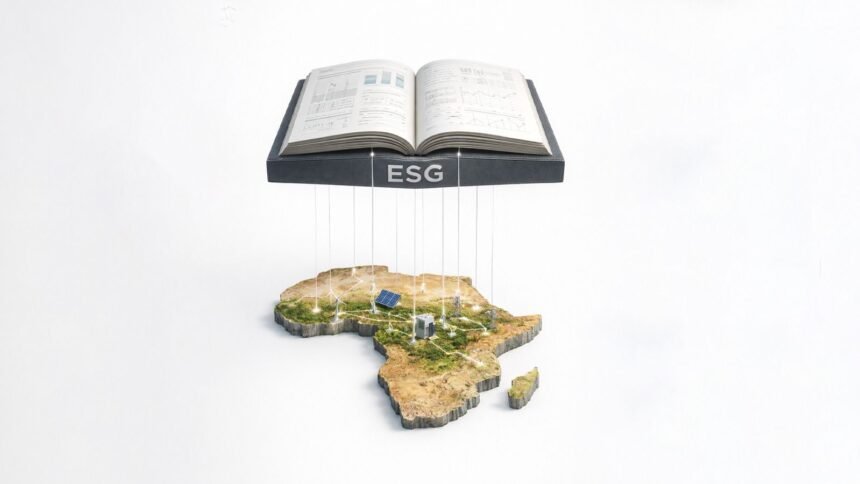
In a glassed-in room above Nairobi’s Upper Hill, organizers of the 2nd Annual ESG and Climate Africa Summit argue over the draft agenda, weighing whose priorities will frame the conversation.
A sovereign wealth fund manager pushes for more time on “bankable pipelines,” while a youth climate organizer insists loss and damage deserves a full plenary, not a side event.
Outside, traffic inches past billboards for green bonds and new expressways, all financed in the language of sustainability.
By the time delegates arrive here on November 24–25, the stakes will be clear. ESG, environmental, social, and governance standards, has shifted from a niche investor acronym into a contested grammar of power, deciding which African projects win climate finance, at what price, and under whose rules.
For Nairobi, pitching itself as a regional green finance hub, the summit is not just about panels and photo calls; it is a test of whether Africa can move from adapting to imported ESG criteria to reshaping them.
This story matters now because the Nairobi summit will gather African and global actors at a moment when the continent is racing to secure climate finance and infrastructure investment amid rising scrutiny of ESG standards, volatile capital flows, and mounting public pressure for a just transition.
Nairobi’s Quiet Power Struggle
The first edition of the ESG and Climate Africa Summit was modest in scale but revealing in tone. It brought together a mix of pension funds, development banks, insurers, corporates, and civil society groups wrestling with a shared dilemma: global capital increasingly demands ESG compliance, yet the metrics and disclosure frameworks have been written elsewhere. The second summit, scheduled for late November, is more ambitious. Organizers speak of consolidating a “pan‑African ESG language” that can persuade investors without reproducing every Northern standard by default.
Behind the branding lies a concrete political economy. African governments face mounting climate impacts, droughts in the Horn, floods in West Africa, cyclones in the southeast, while fiscal space shrinks and debt servicing rises.
They need private capital to build climate-resilient grids, transport systems, water systems, and digital infrastructure that are also socially acceptable. ESG has become the passport to that capital: a way for investors to reassure their own regulators and clients that African risk is being managed responsibly.
Yet the passport comes with conditions. Disclosure requirements, taxonomy labels, and governance benchmarks can be so demanding that state utilities, small municipalities, and local firms struggle to comply without the expense of advisory support.
That creates a new asymmetry: the more essential ESG becomes, the more influence those who define it can wield over what “good” African development looks like. The Nairobi summit recognizes this tension. Its real subject is not whether ESG is desirable, but who gets to calibrate it for African realities.
Ground-Level Realities
For Nairobi’s financial district, ESG is not an abstraction. On any given weekday, staff at Kenyan pension funds and commercial banks sift through proposals branded as green or sustainable: solar mini‑grids in northern counties, climate‑smart agriculture schemes, green real estate in satellite towns.
Each project promises impact and returns; each is constrained by documentation. A rural solar developer, for instance, may have robust informal community support but no formal grievance mechanism that satisfies international checklists.
Similar stories play out in Lagos, Johannesburg, and Casablanca. In Nigeria, asset managers juggle oil‑linked portfolios with pressure to finance renewables and gas plants as “transition” assets.
In South Africa, where local capital pools are deeper, institutional investors still confront the legacy of coal, inequality, and governance scandals when applying ESG filters. Across these markets, ESG officers spend as much time translating between local regulators and global frameworks as they do analyzing underlying assets.
For smaller African firms and communities, the summit’s themes land even more tangibly. A Kenyan farmer cooperative hoping to access climate‑linked credit hears about ESG through the demands of an off‑taker or aggregator: proof of land rights, labor standards, and environmental safeguards.
A municipal utility trying to issue a green bond must hire consultants to align its disclosure with international standards, even as it struggles to maintain basic service. In these contexts, ESG can feel less like a shared value system and more like a moving target set by distant actors.
Yet there is also experimentation. Some East African banks are piloting simplified ESG scorecards tailored for small and medium‑sized enterprises. Pan‑African institutions are drafting guidance that blends global frameworks with local policy priorities—such as universal access to electricity, informal settlement upgrading, or climate adaptation in fragile zones.
In this sense, the Nairobi summit is as much a marketplace of templates as a forum for speeches. The quietly revealing truth is that, in African finance today, who writes the spreadsheet can matter more than who signs the communiqué.
Policy Fault Lines
As November approaches, three major fault lines are likely to shape discussions in Nairobi.
The first concerns definitions. Global debates over what counts as green, transitional, or high‑emitting mirror Africa’s own dilemmas: should gas be labeled a transition fuel, and under what conditions?
How should adaptation projects, which often generate diffuse social benefits rather than direct cash flows, be treated in ESG taxonomies? African governments argue that their energy and infrastructure pathways cannot be judged by the same metrics as post‑industrial economies. Critics worry that broadening definitions could dilute environmental integrity.
The summit’s panels on taxonomies and disclosure will effectively ask whether Africa can articulate its own thresholds without losing investor confidence.
The second fault line is governance. ESG’s “G” has become particularly salient in African contexts where state‑owned enterprises, public–private partnerships, and local authorities play central roles.
Investors look for board independence, transparent procurement, and anti‑corruption safeguards; citizens look for accountability, equitable service delivery, and protection from elite capture. At the summit, questions will arise about who sits on project boards, how communities are consulted, and how grievances are handled when ESG‑branded projects disrupt livelihoods.
The answers will test whether governance is treated as a checkbox for financiers or as a shared political commitment.
The third fault line runs through the climate justice debate. Youth movements and civil society networks are increasingly vocal about what they see as “ESG‑washing”: projects that tick environmental boxes while displacing communities, or funds that brand themselves as climate‑aligned while backing extractive activities.
At the same time, some policymakers fear that overly stringent ESG demands could slow urgently needed investment. Nairobi’s summit will have to navigate between calls for stronger safeguards and the pragmatic desire to keep capital flowing.
Across all three lines, African agency is the live experiment. Delegates from regional development banks, stock exchanges, and ministries will bring their own draft solutions: African sustainability bond guidelines, localized disclosure frameworks, and regional climate risk assessment tools.
They will also come with constraints, from limited data systems to competing donor expectations. Whether these homegrown initiatives gain traction will depend less on rhetoric and more on whether they become the default references in deal rooms and term sheets.
When the 2nd Annual ESG and Climate Africa Summit closes on November 25, few immediate breakthroughs are likely. ESG will remain a contested field, and capital will continue to flow unevenly.
But the conversations in Nairobi will leave their mark on how African projects are structured, reported, and justified in the years ahead.
The open question, still unresolved as delegates pack their bags, is whether the continent can turn ESG from an imported filter into a shared framework that reflects its own priorities, or whether the rules of “responsible investment” will continue to be written elsewhere, with Africa merely adjusting at the margins.