




The Pan-African Paradigm of Technological Sovereignty and Asymmetric Threat
What happens when a fifteen-year insurgency that has already outlasted multiple counterterrorism campaigns gains free, frictionless access to expert-level problem-solving software? That is the question now confronting security services from Abuja to Nairobi, after Cambridge University researchers documented how Islamic State West Africa Province, a Boko Haram breakaway faction, has spent years institutionalizing commercial artificial intelligence tools into its combat operations. The finding forces a reframing of a debate that African governments have approached largely through the lens of opportunity- how generative AI might modernize agriculture, healthcare, or public administration- without adequately confronting its capacity to modernize violence as well. This is fundamentally a question of technological sovereignty: whether the continent’s security architecture can govern and anticipate the diffusion of frontier technology as quickly as non-state actors can weaponize it. The answer, on current evidence, is not encouraging, and reclaiming the initiative will require African security institutions to treat AI literacy as a frontline capability rather than an afterthought.
From Marketing Department to Battlefield
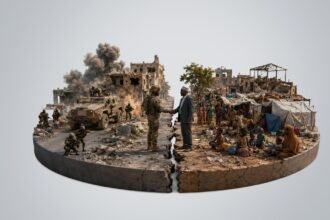
For several years, security analysts have discussed generative AI’s role in insurgency primarily through propaganda: translated manifestos, synthetic recruitment videos, fabricated imagery. The Cambridge findings, drawn from interviews with 27 former Boko Haram and ISWAP members, including senior commanders, describe something more consequential: AI’s migration into tactical decision-making itself. Commanders reportedly used commercial models to brainstorm workarounds for battlefield obstacles, including how motorcycles might be used to jump the defensive trenches that ring Nigerian military bases, and to breach fortified perimeter gates. Other operatives used the tools to troubleshoot captured government weaponry, refine attack logistics, and engineer explosives. Researcher Antonia Juelich’s fieldwork found that both factions have systematically queried mainstream commercial platforms, including ChatGPT, Claude, Gemini, Grok, Meta AI and DeepSeek, the same tools used daily by students in Nairobi and developers in Lagos.
The Architecture of an AI Cell
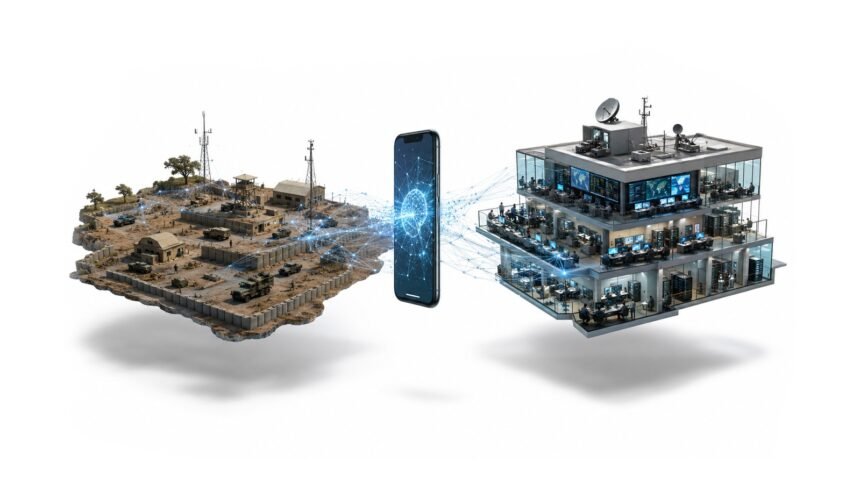
The scale of institutionalization is what distinguishes this from opportunistic misuse. According to the research, ISWAP built specialized AI cells of five to twenty trusted operatives, with access tightly restricted to designated prompt engineers trained specifically to bypass model safety filters. The technology transfer traces to around 2023, when central Islamic State cadres supplied ISWAP with hardware, encrypted satellite links and paid software subscriptions, alongside instruction in jailbreaking techniques designed to circumvent guardrails against generating dangerous content. This is not casual experimentation but a structured capability-building programme layered atop an insurgency that has already killed roughly 43,000 people, displaced 3.1 million, and pushed more than four million into severe food insecurity across the Lake Chad Basin since 2009, a toll that includes the 2011 bombing of the UN headquarters in Abuja and the 2014 Chibok abductions, more than 80 of whose victims remain unaccounted for according to Amnesty International.
The Uplift Effect and East Africa’s Exposure
Cambridge researchers describe the phenomenon as “uplift,” the improvement of an existing actor’s capability without a comparable increase in resources. Applied to Al-Shabaab, the Somalia-based group responsible for the 2013 Westgate mall attack that killed 67 people, the 2015 Garissa University massacre that killed 148, and the 2019 DusitD2 complex attack in Nairobi, the implication is unsettling even though direct evidence of comparable AI adoption remains thinner than for ISWAP. The danger is not that AI turns novice militants into masterminds; it is that seasoned organizations become incrementally faster, more precise, and better at operational security using tools they already know how to operate. That asymmetry runs directly counter to the institutional pace at which African states can respond, where budget approval, procurement, data protection and inter-agency coordination move at a fraction of the speed with which a militant cell can adopt a new smartphone application.
Outspending Is Not Outlearning
Nigeria’s military possesses vastly greater resources, personnel and firepower than ISWAP; Kenya and its regional partners similarly outmatch Al-Shabaab in every conventional metric. Yet the Cambridge findings suggest the more urgent question is not whether African states can outspend militant groups, which they plainly can, but whether they can outlearn them. The barrier to insurgent AI adoption is a smartphone, an internet connection and, at most, a paid subscription. The barrier to state adoption runs through procurement cycles, legal frameworks around surveillance, and bureaucratic silos between agencies- necessary safeguards, but ones that create a structural lag exploitable by any actor untroubled by such constraints.
Building a Faster Institutional Response
The trajectory here is unambiguous: the AI capabilities documented in the Cambridge study reflect 2024-era technology, while today’s multimodal systems can already analyze satellite imagery and synthesize real-time audio and video at a level unavailable to ISWAP’s early adopters. A counterterrorism strategy calibrated to 2024 is already obsolete. What the continent needs is not a ban on the same commercial tools used by its own entrepreneurs and students, an approach both impractical and self-defeating, but a recalibrated security architecture that treats AI monitoring, rapid-response procurement and cross-border intelligence sharing as urgent institutional priorities rather than long-term aspirations. The insurgencies of the Lake Chad Basin and the Horn of Africa have proven durable precisely because they adapt faster than the states pursuing them. Closing that gap, before frontier AI capabilities widen it further, is now a matter of continental self-determination as much as counterterrorism policy.