




The Pan-African Paradigm of Aviation Safety and Institutional Crisis Response
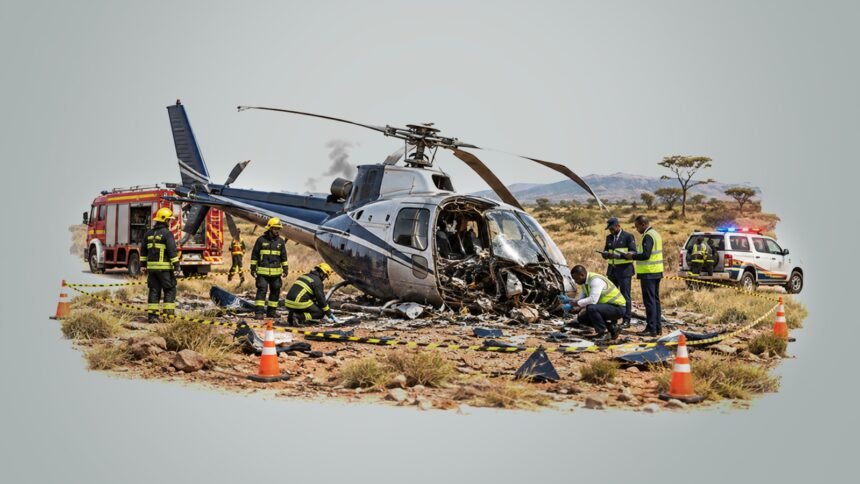
Six individuals have lost their lives following a helicopter crash in Zimbabwe’s rural Marondera district, east of the capital, Harare. Government spokesperson Nick Mangwana confirmed the tragedy, stating that the aircraft went down carrying a prominent businessman, three passengers, and two crew members, with no survivors recovered from the wreckage. What does regional safety mean for an aviation network whose interior routes are increasingly traversed by private aircraft operating across isolated terrains? The fatal incident underlines how infrastructure safety and rapid accident investigation remain critical tests for national emergency response capabilities across the continent. Addressing these tragedies demands transparent civil oversight and technical rigor, not merely episodic statements of condolence.
A Disaster in the Marondera Corridor
The flight went down at approximately 17:00 local time (15:00 GMT), prompting an immediate deployment of emergency responders to the rural impact site. According to statements from national authorities, the intensity of the post-crash fire left the victims badly burned, complicating the process of formal forensic identification. Initial reports from local media indicated that prominent businessman Wicknell Chivayo was among the passengers on board. However, police officials stated that formal verification of the victims’ identities would follow standard investigative protocols. The disaster brings immediate legal and regulatory questions of airworthiness, maintenance standards, and flight conditions to the forefront, questions that demand clear, evidence-based answers if future risks are to be mitigated.
The Demands of Crisis Communication and Civil Aviation Oversight
The incident also highlights the complexities of official crisis communication during sudden disasters. Early updates regarding the passenger manifest underwent public corrections as state communications scrambled to verify the exact numbers aboard. In moments of public distress, national institutions must balance rapid reporting with factual accuracy to prevent speculation from outrunning verified reality. Beyond the immediate shock, the crash places a renewed spotlight on the regulatory frameworks governing private charter aviation in southern Africa, where private flights frequently support corporate, extractive, and executive transit across vast distances.
The Shadow of Regional Aviation Gaps
Aviation safety remains a vital structural pillar of continental integration and economic life. While Africa’s commercial airline networks have significantly improved their safety records over recent decades, general and charter aviation continues to face uneven operational environments. Challenging terrain, variable regional weather patterns, and the strain on localized search-and-rescue units create persistent hurdles when accidents occur outside major urban centers. For Zimbabwean civil aviation authorities, the enduring lesson is clear: robust accident prevention requires unyielding enforcement of flight clearance standards, continuous technical auditing of rotary aircraft, and resourced rural emergency response units capable of securing sites and preserving critical flight evidence.
Confronting the Skies with Institutional Rigor
The loss of six lives in Marondera is a profound national sorrow first, and the families of the passengers and crew bear the deepest grief. It is also a stark systemic reminder. If the safety of the continent’s airspace is to be assured on African terms, national authorities must ensure that independent air-crash investigation boards possess the independence, resources, and technical expertise to establish the root causes of fatal descents. The coordinated mobilization in Marondera demonstrates local operational readiness to attend disaster scenes. Translating those emergency responses into enforceable aviation safety protocols is the essential, long-term work of protecting African lives in the air.