





The Pan-African Paradigm of Sovereignty and Externally Imposed Grievance
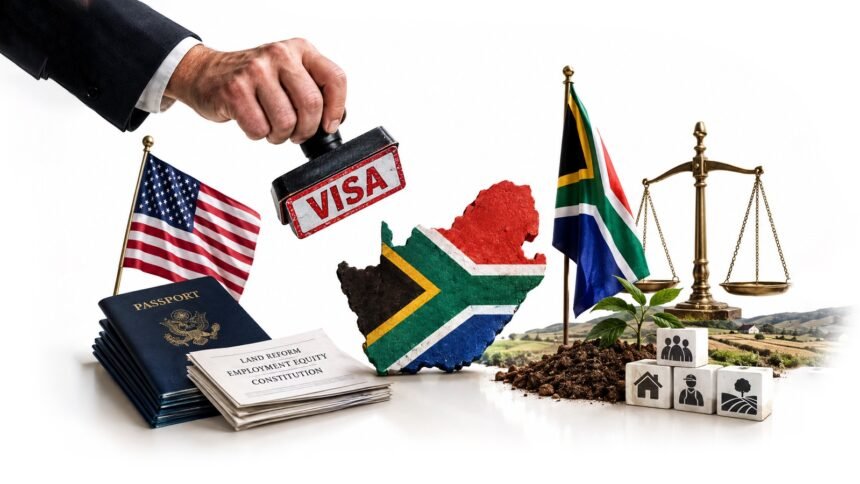
A post on a social media platform, signed by the United States’ top diplomat, now functions as declared foreign policy toward fifty-eight million South Africans. This week Washington announced visa restrictions targeting South Africans it accuses of enabling race-based discrimination against the country’s white Afrikaner minority, the latest escalation in a campaign built substantially on claims that independent courts, demographic data and the South African government itself have repeatedly disputed. The episode belongs to a familiar and structurally significant pattern: a former hegemonic power asserting the authority to adjudicate, from thousands of miles away, whether a formerly colonized state’s domestic redress policies constitute persecution of the group that once held near-total economic and political control. For the Pan-African project, the stakes extend beyond South Africa’s borders. Every instance in which an external government reframes legitimate efforts at structural redress as discriminatory overreach chips at the continent’s claim to define its own reckoning with historical injustice on its own terms. South Africa’s response, measured, sovereign, unapologetic, offers a case study in how a state under diplomatic pressure can defend its right to self-determination without abandoning the substance of its policy.
Rubio’s Restrictions and the Grammar of ‘Race-Based Discrimination’
Secretary of State Marco Rubio announced the visa measures would apply to foreign nationals who enact or enable policies that promote race-based discrimination, incite violence, or enable land confiscation without compensation, language that maps almost entirely onto South Africa’s constitutionally sanctioned land reform and employment equity frameworks rather than any documented persecution. Rubio’s statement accused Pretoria of an obsessive pursuit of racial grievance against the Afrikaner minority and of failing to address rural crime and dehumanising rhetoric. The US ambassador to South Africa, Leo Brent Bozell III, went further, describing the visa policy as merely the first step in a series of escalatory measures. The announcement builds on more than a year of coordinated pressure: the cutting of bilateral aid, South Africa’s exclusion from this year’s G20 summit, and a bespoke refugee resettlement programme created specifically for Afrikaners and other white South African minorities, even as broader US refugee and asylum systems have been dismantled for populations fleeing war.
A Sovereign Rebuttal from Pretoria
South Africa’s foreign ministry, through spokesperson Chrispin Phiri, rejected the characterization outright, stating that the criticism aligns with a mischaracterisation of South Africa’s domestic policies by fringe groups who claim to speak for Afrikaners broadly. Phiri’s rebuttal, published first in Afrikaans, asserted South Africa’s sovereign right to put in place laws that address the nation’s concern over centuries of racial injustice, while noting the country’s respect for the fact that Washington may hold differing views on implementation. That framing is deliberate: it concedes nothing on substance while explicitly naming sovereignty as the governing principle, refusing to let the dispute be adjudicated as a bilateral values disagreement rather than an assertion of one nation’s authority over its own constitutional order.
Land, Law and the Politics of Confiscation
Central to Washington’s complaint is South Africa’s law, passed last year, permitting land expropriation without compensation under narrowly defined circumstances, abandoned land or land held purely for speculation. No large-scale expropriation has in fact occurred under the statute, a detail largely absent from the American critique. The gap between the law’s actual application and its portrayal abroad illustrates a recurring asymmetry: incremental, legally bounded redress mechanisms are frequently rhetorically inflated into existential threats against a minority, a framing that serves political constituencies in the critiquing country more than it reflects conditions on the ground. Three decades after the end of apartheid, white South Africans retain roughly twenty times the wealth of Black South Africans, according to research published in the Review of Political Economy, a structural imbalance largely unaddressed by the policies now drawing sanction.
Malema’s Chant and the Manufacture of a Narrative
Much of the discriminatory narrative animating US policy traces to opposition leader Julius Malema’s use of the apartheid-era chant Kill the Boer, which Trump has personally invoked in meetings with President Cyril Ramaphosa, including by screening footage purporting to show violence against white South Africans. South African courts have ruled the chant symbolic rather than a literal incitement to violence, and the governing African National Congress has publicly disavowed it. That a single opposition figure’s rhetoric, judicially assessed as non-literal, has become a load-bearing pillar of formal US diplomatic sanction against an entire nation reveals how selectively curated evidence can calcify into policy when amplified by a receptive foreign administration.
The Long Arithmetic of Redress
What unfolds between Washington and Pretoria in the coming months will test more than one bilateral relationship. It will test whether African states attempting to correct entrenched, generational economic imbalances can do so without triggering diplomatic retaliation dressed in the language of minority protection. South Africa’s calibrated refusal to abandon its land and equity frameworks under pressure, even as visa restrictions escalate, signals an intent to hold the line on sovereignty rather than negotiate away domestic policy for diplomatic comfort. Whether that resolve survives further escalation from Washington remains to be seen, but the confrontation itself has already clarified the terms: for a growing number of African governments, redress for historical injustice is no longer treated as a matter open to external veto, however loudly that veto is asserted.