




Rwanda is turning to technology to ensure that every tree planted survives, grows, and contributes to the global carbon balance. Scientists and ICT experts in the country are building digital systems to monitor forest growth, detect threats, and enhance accountability in reforestation efforts.
A recent study revealed that trees planted under agroforestry schemes in Rwanda have an average survival rate of only 64 percent, with some areas recording rates as low as 30 percent due to weak follow-up and limited monitoring.
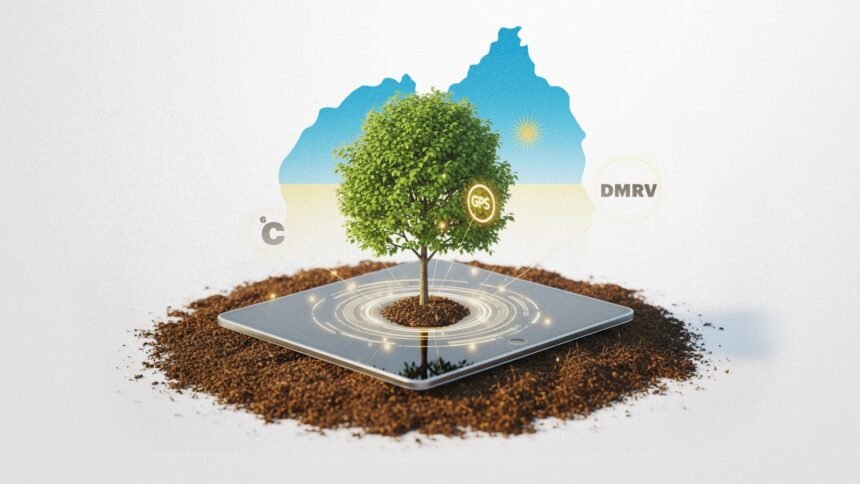
To address this, innovators have launched the Ecoforest Climate Tech Platform, a digital monitoring, reporting, and verification tool, known as dMRV, that connects reforestation projects with real-time data, particularly supporting smallholder farmers.
“The platform functions like a digital file for every tree, it tracks how many trees are alive, how they are growing, and where replacements are needed. It provides digital evidence of climate-smart tree growth,” explained Amudala Museme, one of the platform’s developers.
Once trees are planted, each one is registered with GPS coordinates, farmer details, and species information. Trained field agents, called Green Agents, collect data through a mobile application and USSD codes, allowing updates on tree health, survival rates, and growth stages. The system also integrates satellite data and weather analytics to detect diseases, pests, and drought stress.
Smallholder farmers, even those with basic phones, can access updates through the Igiti App or USSD services, while organizations can view results through digital dashboards. According to Museme, the platform reduces tree mortality and boosts transparency, helping attract investors to verified, high-impact conservation projects.
“Planting a tree is one thing, ensuring it survives and sequesters carbon long-term is another,” Museme added.
Among the first corporate adopters is Britam Insurance Company Rwanda Ltd, which has partnered with farmers to plant 10,000 climate-smart trees.
“The platform provides digital monitoring. Each tree planted under this corporate social responsibility initiative is mapped, monitored, and supported. We receive live data on survival, growth, and social impact. Farmers, in turn, get productive tree species, training, and follow-up,” said Julie Mutoni, a Board Director at Britam.
Britam plans to expand the initiative to 1.5 million trees nationwide within five years, contributing to Rwanda’s reforestation and climate goals while improving livelihoods.
According to the Rwanda Forestry Authority (RFA), from 2009 to 2019, the country achieved a net forest cover gain of 5 percent, after replanting 139,674 hectares to offset losses from deforestation. Yet, poor monitoring continues to threaten progress. Research led by Jean Nduwamungu of the University of Rwanda and Athanase Mukuralinda from CIFOR found that many public forests still face illegal harvesting, over cutting, and low productivity due to weak oversight.
“There should be sufficient monitoring to prevent inefficiencies. Management of planted forests remains poor,” said MP Jean René Niyorurema, calling for stronger follow-up after planting.
Concorde Nsengumuremyi, Director General of RFA, said that a new forestmonitoring and evaluation system and forest master plan are being developed. “The system will detect carbon storage and tree species. We must collaborate with space agencies and developers,” he said.
Rwanda targets planting 300 million trees by 2029, with 70 percent under agroforestry. For the ongoing season alone, 72 million trees are being planted nationwide.
Complementing these efforts, the Rwanda Environment Management Authority (REMA) is establishing a national carbon market registry to track emissions reductions and carbon credit transactions under both voluntary markets and Article 6 of the Paris Agreement.
“The carbon registry promotes transparency and simplifies tracking of Rwanda’s carbon market performance,” said Juliet Kabera, Director General of REMA.
The system aligns with the Standardised Crediting Framework (SCF), defining how emission reductions are measured and verified, an important step for countries looking to participate in global carbon trading.
Innovators believe that the fusion of conservation and technology will ensure that every planted tree is counted, protected, and contributes meaningfully to the planet’s ecological balance.