



Mali has long been the kind of crisis diplomats discuss in late-night briefing rooms—serious, complicated, but safely distant enough for the world to believe the fire could be contained. That illusion has evaporated. With the African Union now urging “urgent action” as insurgencies tear through the country’s centre and north, Mali has become Africa’s most unignorable alarm bell, ringing loudly over a region increasingly engulfed in conflict, coups and collapsing governance.
The latest AU warning did not come from the usual crisis-management vocabulary that so often serves as diplomatic filler. It was unusually blunt: jihadist factions have tightened their grip on rural territories, supply routes are being choked off, fuel blockades are emerging, and even basic life—schools, markets, movement—is being strangled. The AU rarely sounds panicked. This time, the language carried the tone of an institution running out of euphemisms.
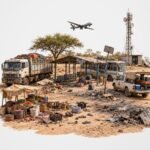
At the centre of the storm is Jama’at Nusrat al-Islam wal-Muslimin (JNIM), an al-Qaeda-linked coalition that has mastered a distinctly Sahelian formula for insurgency. They do not simply attack checkpoints or plant roadside bombs; they suffocate the functions of ordinary life. Set fire to fuel depots, cut off access to roads, threaten local leaders, and suddenly a village becomes ungovernable even without a single spectacular attack. The violence is not always loud, but its effects echo everywhere.
The Malian state, already stretched thin, has been unable to reverse the trend. Military operations—both under regional alliances and with Russian Wagner-linked support—have not translated into sustainable stability. The government in Bamako has moved from strategy to reaction, reacting to territorial losses here, civilian displacement there, and shifting frontlines everywhere. The insurgency, meanwhile, has adapted, expanded, and entrenched itself, learning from each cycle of military pressure.
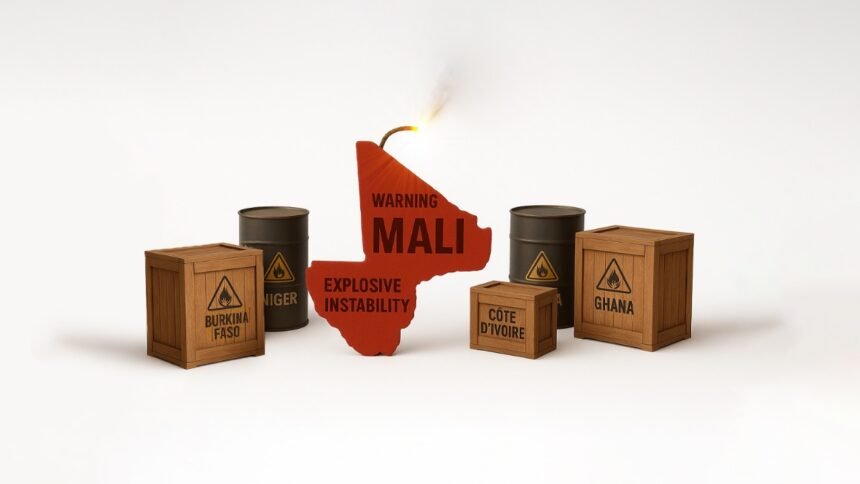
The AU’s intervention is not only about Mali. It is a reflection of what regional leaders fear the most: the domino effect. If Mali collapses into deeper chaos, the vibrations will hit Niger, Burkina Faso, Côte d’Ivoire, Ghana and beyond. Borders in the Sahel are theoretical; fighters cross them with more ease than government officials. Arms flow freely. Smuggling networks and ideological currents ignore national demarcations. A destabilised Mali is not a national problem—it is a neighbourhood catastrophe.
But here lies the diplomatic paradox. African governments know that stabilising Mali requires coordination: intelligence-sharing, joint patrols, regional diplomacy and, crucially, consistent political pressure on Bamako to open political space and restore some semblance of credibility to its governance. Yet many of Mali’s military rulers see external involvement as interference. They distrust Western partners, remain ambivalent toward ECOWAS, and rely heavily on security arrangements that are as politically symbolic as they are militarily effective.
The AU’s call for action, then, is also a call for access. To act, it must first be allowed to. Mali’s junta faces a shrinking circle of allies, and every new massacre, village displacement, or militant advance increases the pressure on them to show results. But results require cooperation, and cooperation requires trust—something in short supply.
Meanwhile, civilians are bearing the brunt of the conflict. Reports emerging from the ground speak of villagers forced to choose between hunger and danger: venture out to buy fuel or grain and risk encountering militants; stay at home and watch resources dwindle. Children miss school because roads are unsafe. Traders abandon markets because supplies cannot get through. Local leaders, once the glue holding communities together, are threatened into silence or flight.
The international community’s patience is thinning. The AU’s statement, while diplomatic in tone, hints at an emerging consensus that Mali’s crisis is spilling beyond its ability to manage. Even countries fatigued by years of Sahel peacekeeping discussions are beginning to accept that ignoring Mali is no longer an option.
Yet the risk of overreaction is as real as the danger of inaction. Any large-scale foreign intervention—military or political—risks feeding Malians’ resentment of external meddling, a sentiment that has already fuelled the junta’s rise. The challenge is to offer help that strengthens local institutions rather than replaces them.
The AU’s plea is therefore a kind of regional plea for sanity: the crisis is accelerating, and without coordinated, calibrated support, Mali may slide into a level of instability that no amount of after-the-fact diplomacy can reverse. The country’s burning fuse may still be extinguishable, but no one knows how much wick is left.